

but not
e sha ower SW Wall Reef. Brown tube sponges (Ag
conifera) exhibited large sizes, with ran
g a
a
the bot
r
re
r
e
s
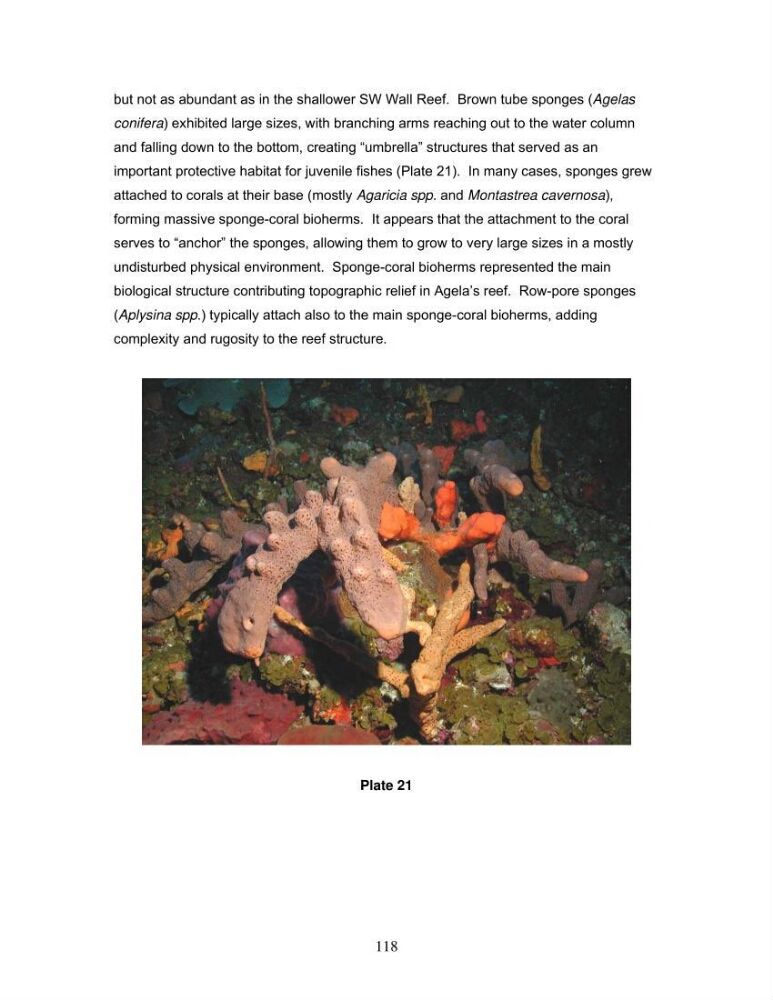
portant protective habitat for juvenile fishes (Plate 21). In many cases, sponges grew
ttached to corals at their base (mostly Agaricia spp. and Montastrea cavernosa),
rming massive sponge-coral bioherms. It appears that the attachment to the coral
erves to “anchor” the sponges, allowing them to grow to very large sizes in a mostly
ndisturbed physical environment. Sponge-coral bioherms represented the main
b
(
ng
complexity and rugosity to the re
ture.
as abundant as in th
ll
elas
b chin rms reaching out to the water column
nd falling down to
tom, c eating “umb lla” st uctur s that erved as an
im
a
fo
s
u
iological structure contributing topographic relief in Agela’s reef. Row-pore sponges
Aplysina spp.) typically attach also to the main sponge-coral bioherms, addi
ef struc
Plate 21
118
e sha ower SW Wall Reef. Brown tube sponges (Ag
conifera) exhibited large sizes, with ran
g a
a
the bot
r
re
r
e
s
portant protective habitat for juvenile fishes (Plate 21). In many cases, sponges grew
ttached to corals at their base (mostly Agaricia spp. and Montastrea cavernosa),
rming massive sponge-coral bioherms. It appears that the attachment to the coral
erves to “anchor” the sponges, allowing them to grow to very large sizes in a mostly
ndisturbed physical environment. Sponge-coral bioherms represented the main
b
(
ng
complexity and rugosity to the re
ture.
as abundant as in th
ll
elas
b chin rms reaching out to the water column
nd falling down to
tom, c eating “umb lla” st uctur s that erved as an
im
a
fo
s
u
iological structure contributing topographic relief in Agela’s reef. Row-pore sponges
Aplysina spp.) typically attach also to the main sponge-coral bioherms, addi
ef struc
Plate 21
118