

Post-Harvest Processing
If you process oysters to reduce the level of a particular pathogen, you must:
• Have a HACCP plan approved by LDHH that ensures the processing method
reduces pathogen(s) in the product to established safe levels for the at-risk
population. This plan must include process controls and periodic sampling
to ensure and verify that these criteria are met.
•
Package and label all oysters in accordance with all National Shellfish
Sanitation Program requirements .
•
Keep records in accordance with the National Shellfish Sanitation Program.
If you meet the above requirements, you may label your processed product as:
•
“Processed for added safety”, if the process reduces the levels of all
pathogens of public health concern to safe levels for the at-risk population
•
“Processed to reduce [name of target pathogen(s)] to non-detectable levels”,
if the process reduces one or more, but not all, pathogens of public health
concern to safe levels for the at-risk population, and if that level is nondetectable
•
“Processed to reduce [name of target pathogen(s)] to non-detectable levels
for added safety”, if the process reduces one or more, but not all, pathogens
of public health concern to safe levels for the at-risk population, and if that
level is non-detectable
•
A term that describes the type of process applied (e.g. “pasteurized, ”
“individually quick frozen, ” “pressure treated”) may be substituted for the
word “processed” in the above options.
If your end product is dead, refrigerate it according to requirements for shucked
oysters; if your end product is live, refrigerate it according to requirements for
in-shell oysters.
You must tag all in-shell oysters that have gone through post-harvest processing
with a blue tag, which must include the certification number of the post-harvest
processing facility. A blue tag indicates that the oysters have been post-harvest
processed by a certified dealer and may now be sold for raw (half-shell)
consumption in both interstate and intrastate commerce.
Selling Raw Oysters
You may sell oysters harvested from Louisiana waters for raw consumption within
the state throughout the year as long as they meet refrigeration requirements
specified on page 21.
All establishments that sell or serve raw oysters must display one of the
following messages at the point of sale; the message must also appear on the
main display panel and on top of containers of prepackaged raw oysters.
• “There may be a risk associated with consuming raw shellfish as is the case
with other raw protein products. If you suffer from chronic illness of the
liver, stomach, or blood or have other immune disorders, you should eat
these products fully cooked. ”
• “Consuming raw or undercooked meats, poultry, seafood, shellfish, or eggs
may increase your risk of foodborne illness, especially if you have certain
medical conditions. ”
Other Requirements
You must keep oysters in the container in which they were received until they
are used, unless displaying them for retail sale. You may not mix oysters from
different lots.
Recalls
Certified dealers must have written procedures for recalling adulterated
or misbranded oyster products. These procedures must be based on and
complementary to FDA policy.
Certified dealers must follow these procedures including timely notification to
LDHH and the product buyer of a situation requiring recall and effective removal
or correction of the affected product.
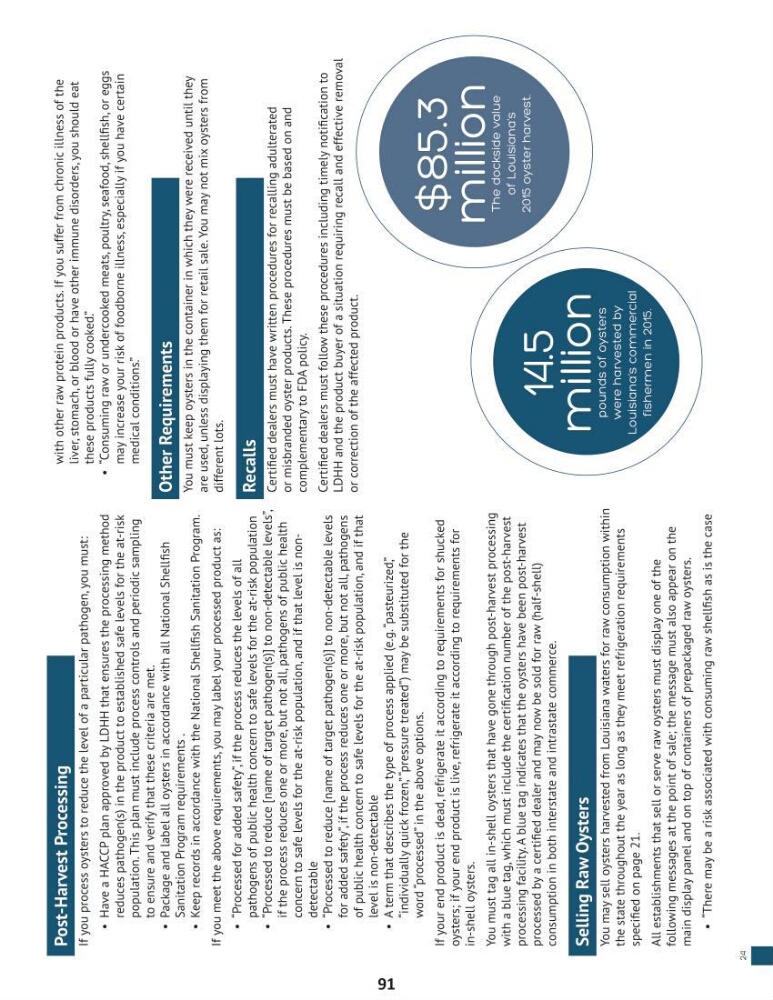
14.5
million
pounds of oysters
were harvested by
Louisiana’s commercial
fishermen in 2015.
$85.3
million
The dockside value
of Louisiana’s
2015 oyster harvest.
24
91
If you process oysters to reduce the level of a particular pathogen, you must:
• Have a HACCP plan approved by LDHH that ensures the processing method
reduces pathogen(s) in the product to established safe levels for the at-risk
population. This plan must include process controls and periodic sampling
to ensure and verify that these criteria are met.
•
Package and label all oysters in accordance with all National Shellfish
Sanitation Program requirements .
•
Keep records in accordance with the National Shellfish Sanitation Program.
If you meet the above requirements, you may label your processed product as:
•
“Processed for added safety”, if the process reduces the levels of all
pathogens of public health concern to safe levels for the at-risk population
•
“Processed to reduce [name of target pathogen(s)] to non-detectable levels”,
if the process reduces one or more, but not all, pathogens of public health
concern to safe levels for the at-risk population, and if that level is nondetectable
•
“Processed to reduce [name of target pathogen(s)] to non-detectable levels
for added safety”, if the process reduces one or more, but not all, pathogens
of public health concern to safe levels for the at-risk population, and if that
level is non-detectable
•
A term that describes the type of process applied (e.g. “pasteurized, ”
“individually quick frozen, ” “pressure treated”) may be substituted for the
word “processed” in the above options.
If your end product is dead, refrigerate it according to requirements for shucked
oysters; if your end product is live, refrigerate it according to requirements for
in-shell oysters.
You must tag all in-shell oysters that have gone through post-harvest processing
with a blue tag, which must include the certification number of the post-harvest
processing facility. A blue tag indicates that the oysters have been post-harvest
processed by a certified dealer and may now be sold for raw (half-shell)
consumption in both interstate and intrastate commerce.
Selling Raw Oysters
You may sell oysters harvested from Louisiana waters for raw consumption within
the state throughout the year as long as they meet refrigeration requirements
specified on page 21.
All establishments that sell or serve raw oysters must display one of the
following messages at the point of sale; the message must also appear on the
main display panel and on top of containers of prepackaged raw oysters.
• “There may be a risk associated with consuming raw shellfish as is the case
with other raw protein products. If you suffer from chronic illness of the
liver, stomach, or blood or have other immune disorders, you should eat
these products fully cooked. ”
• “Consuming raw or undercooked meats, poultry, seafood, shellfish, or eggs
may increase your risk of foodborne illness, especially if you have certain
medical conditions. ”
Other Requirements
You must keep oysters in the container in which they were received until they
are used, unless displaying them for retail sale. You may not mix oysters from
different lots.
Recalls
Certified dealers must have written procedures for recalling adulterated
or misbranded oyster products. These procedures must be based on and
complementary to FDA policy.
Certified dealers must follow these procedures including timely notification to
LDHH and the product buyer of a situation requiring recall and effective removal
or correction of the affected product.
14.5
million
pounds of oysters
were harvested by
Louisiana’s commercial
fishermen in 2015.
$85.3
million
The dockside value
of Louisiana’s
2015 oyster harvest.
24
91