

Harvesting Oysters for Raw Consumption
If you harvest oysters for raw consumption, you must have a HACCP plan.
Your time/temperature log sheet must document the time harvest began for
each lot of oysters and the time you refrigerated each lot. Log sheets for pink
tag oysters must be separated from log sheets for oysters intended for shipment
outside of Louisiana. Harvesters must note on log sheets for pink tag oysters that
the oysters are “For Intrastate Shipments Only”. If your harvest vessel is equipped
with refrigeration capabilities, you must provide documentation to the original
dealer that you have met the time and temperature requirements.
You must attach an LDHH- and LDWF-approved tag on all containers holding
in-shell oysters, with the corresponding lot identification number or character
printed legibly on the tag, prior to refrigerating them. You must record the
number of sacks contained within each lot immediately after refrigerating the
oysters.
Harvesting Oysters for Shucking or Post-Harvest
Processing
Your time/temperature log sheet must document the date and time harvest
began for each lot of oysters. If your harvest vessel is equipped with refrigeration
capabilities, you must provide documentation to the original dealer that you have
met the time and temperature requirements.
If you harvest oysters for delivery to a steam factory for canning and thermal
processing, you must land them at the factory within 72 hours from the time
harvesting begins. You must document the time harvesting begins and the time
of arrival at the factory on your invoice.
Landing Oysters
If you’re harvesting oysters from Louisiana’s public reefs for sale or consumption,
you must land them in Louisiana and tag them appropriately.
If you land oysters harvested from a private lease in Louisiana’s waters outside
the state (with applicable permit from LDWF), you must tag all sacks or
containers prior to leaving the state. You must install a VMS on the vessel used to
transport oysters to another state and allow LDWF to access the system.
If you harvest oysters outside of Louisiana waters but land them in Louisiana,
you must tag sacks or containers according to the laws of the state where you
harvested the oysters.
Oyster Severance Tax
Louisiana collects a severance tax on all oysters harvested from state waters.
Taxes apply as follows:
• 2-1/2 cents per barrel of oysters
fished from leased water bottoms
• 3 cents per barrel of oysters fished from the natural reefs.
The oyster fisherman or lessee is responsible for paying these taxes, unless
they are sold to a resident wholesale/retail dealer. In that case, the dealer
is responsible. If a nonresident wholesale/retail dealer buys oysters from a
Louisiana fisherman to ship out-of-state and no severance taxes have been paid
on the oysters, the nonresident dealer is responsible for the tax.
Standard Measurements and Labeling
A
barrel is equal to 6,451.26 cubic inches
and is the equivalent of two sacks/baskets or
three bushels of unshucked oysters.
A
sack (or
basket) is exactly 3,225.63 cubic
inches and is the equivalent of 1/2 barrel or
1-1/2 bushels of unshucked oysters.
A
mini-sack is 1,075.21 cubic inches and is
the equivalent of 1/3 of a sack or 1/2 bushel
of unshucked oysters.
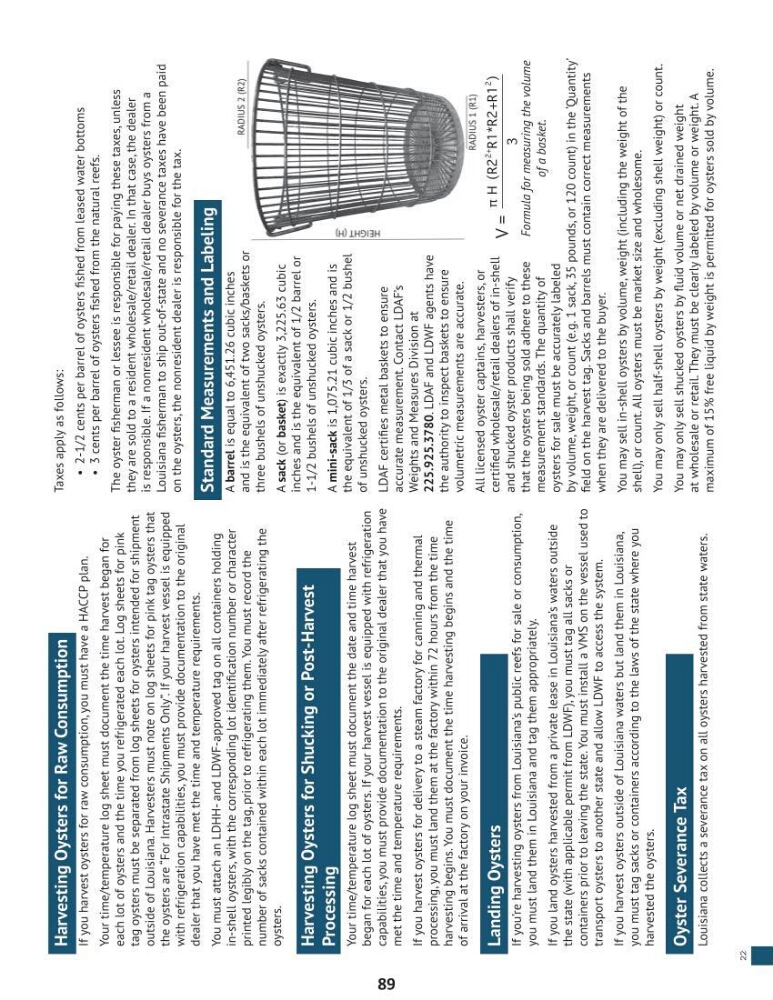
LDAF certifies metal baskets to ensure
accurate measurement. Contact LDAF’s
Weights and Measures Division at
225.925.3780. LDAF and LDWF agents have
the authority to inspect baskets to ensure
volumetric measurements are accurate.
All licensed oyster captains, harvesters, or
certified wholesale/retail dealers of in-shell
and shucked oyster products shall verify
that the oysters being sold adhere to these
measurement standards. The quantity of
oysters for sale must be accurately labeled
by volume, weight, or count (e.g. 1 sack, 35 pounds, or 120 count) in the ‘Quantity’
field on the harvest tag. Sacks and barrels must contain correct measurements
when they are delivered to the buyer.
You may sell in-shell oysters by volume, weight (including the weight of the
shell), or count. All oysters must be market size and wholesome.
You may only sell half-shell oysters by weight (excluding shell weight) or count.
You may only sell shucked oysters by fluid volume or net drained weight
at wholesale or retail. They must be clearly labeled by volume or weight. A
maximum of 15% free liquid by weight is permitted for oysters sold by volume.
Formula for measuring the volume
of a basket.
π H (R2
2+
R1*R2+R1
2
)
3
V =
22
89
If you harvest oysters for raw consumption, you must have a HACCP plan.
Your time/temperature log sheet must document the time harvest began for
each lot of oysters and the time you refrigerated each lot. Log sheets for pink
tag oysters must be separated from log sheets for oysters intended for shipment
outside of Louisiana. Harvesters must note on log sheets for pink tag oysters that
the oysters are “For Intrastate Shipments Only”. If your harvest vessel is equipped
with refrigeration capabilities, you must provide documentation to the original
dealer that you have met the time and temperature requirements.
You must attach an LDHH- and LDWF-approved tag on all containers holding
in-shell oysters, with the corresponding lot identification number or character
printed legibly on the tag, prior to refrigerating them. You must record the
number of sacks contained within each lot immediately after refrigerating the
oysters.
Harvesting Oysters for Shucking or Post-Harvest
Processing
Your time/temperature log sheet must document the date and time harvest
began for each lot of oysters. If your harvest vessel is equipped with refrigeration
capabilities, you must provide documentation to the original dealer that you have
met the time and temperature requirements.
If you harvest oysters for delivery to a steam factory for canning and thermal
processing, you must land them at the factory within 72 hours from the time
harvesting begins. You must document the time harvesting begins and the time
of arrival at the factory on your invoice.
Landing Oysters
If you’re harvesting oysters from Louisiana’s public reefs for sale or consumption,
you must land them in Louisiana and tag them appropriately.
If you land oysters harvested from a private lease in Louisiana’s waters outside
the state (with applicable permit from LDWF), you must tag all sacks or
containers prior to leaving the state. You must install a VMS on the vessel used to
transport oysters to another state and allow LDWF to access the system.
If you harvest oysters outside of Louisiana waters but land them in Louisiana,
you must tag sacks or containers according to the laws of the state where you
harvested the oysters.
Oyster Severance Tax
Louisiana collects a severance tax on all oysters harvested from state waters.
Taxes apply as follows:
• 2-1/2 cents per barrel of oysters
fished from leased water bottoms
• 3 cents per barrel of oysters fished from the natural reefs.
The oyster fisherman or lessee is responsible for paying these taxes, unless
they are sold to a resident wholesale/retail dealer. In that case, the dealer
is responsible. If a nonresident wholesale/retail dealer buys oysters from a
Louisiana fisherman to ship out-of-state and no severance taxes have been paid
on the oysters, the nonresident dealer is responsible for the tax.
Standard Measurements and Labeling
A
barrel is equal to 6,451.26 cubic inches
and is the equivalent of two sacks/baskets or
three bushels of unshucked oysters.
A
sack (or
basket) is exactly 3,225.63 cubic
inches and is the equivalent of 1/2 barrel or
1-1/2 bushels of unshucked oysters.
A
mini-sack is 1,075.21 cubic inches and is
the equivalent of 1/3 of a sack or 1/2 bushel
of unshucked oysters.
LDAF certifies metal baskets to ensure
accurate measurement. Contact LDAF’s
Weights and Measures Division at
225.925.3780. LDAF and LDWF agents have
the authority to inspect baskets to ensure
volumetric measurements are accurate.
All licensed oyster captains, harvesters, or
certified wholesale/retail dealers of in-shell
and shucked oyster products shall verify
that the oysters being sold adhere to these
measurement standards. The quantity of
oysters for sale must be accurately labeled
by volume, weight, or count (e.g. 1 sack, 35 pounds, or 120 count) in the ‘Quantity’
field on the harvest tag. Sacks and barrels must contain correct measurements
when they are delivered to the buyer.
You may sell in-shell oysters by volume, weight (including the weight of the
shell), or count. All oysters must be market size and wholesome.
You may only sell half-shell oysters by weight (excluding shell weight) or count.
You may only sell shucked oysters by fluid volume or net drained weight
at wholesale or retail. They must be clearly labeled by volume or weight. A
maximum of 15% free liquid by weight is permitted for oysters sold by volume.
Formula for measuring the volume
of a basket.
π H (R2
2+
R1*R2+R1
2
)
3
V =
22
89