

REGULATIONS SUMMARY Texas Parks and Wildlife Outdoor Annual 2017-2018 37
RED DRUM:
RDrm1 - For red drum, MLL = 20 inches and daily
bag = 3 and no maximum length limit.
SHAD (GIZZARD AND THREADFIN SHAD):
Shad1 - For the Trinity River below Lake Livingston between
Polk and San Jacinto counties, the daily bag for shad = 500
and the possession limit = 1,000 fi sh in any combination.
TROUT (RAINBOW AND BROWN TROUT):
Trout1 - For rainbow and brown trout in the Guadalupe River
800 yards downstream from the Canyon Dam release and
extending downstream to the easternmost Highway 306
bridge crossing, length limit is a 12-18 inch slot. Trout 12 inches
and less or 18 inches or greater in length may be retained.
Daily bag = 5 trout and only one trout 18 inches or greater in
length may be retained. Harvest of trout is by artifi cial lures
only. See pg. 30 under “Pole and Line” for additional restrictions on use of artifi cial lures.
Trout2 - For rainbow and brown trout in the Guadalupe River
from the easternmost Highway 306 bridge crossing downstream to the second bridge crossing River Road, MLL is 18
inches and daily bag is one fi sh. Harvest of trout is by artifi cial
lures only. See pg. 30 under “Pole and Line” for additional
restrictions on use of artifi cial lures.
WALLEYE:
Wall1 - For walleye, MLL = 18 inches and daily bag = 5.
How to Attach Red Drum Tag
Immediately upon retaining a fi sh:
1. Remove tag from license and use entire tag.
2. Fill in ALL information spaces on front of tag.
3. Cut out day and month.
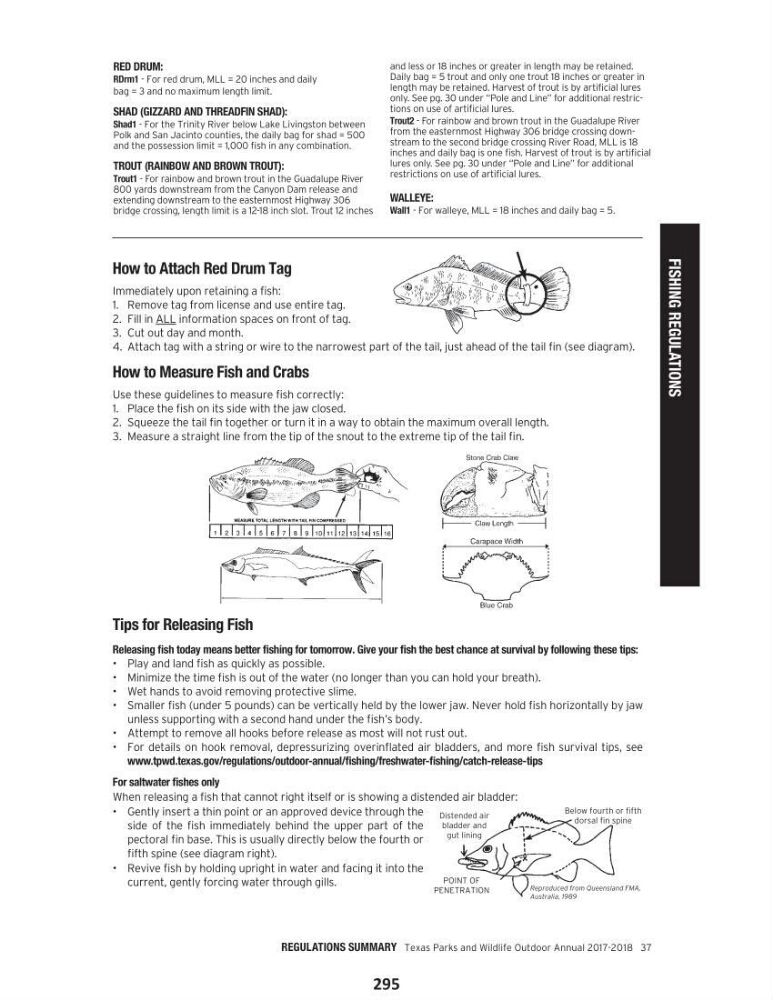
4. Attach tag with a string or wire to the narrowest part of the tail, just ahead of the tail fi n (see diagram).
How to Measure Fish and Crabs
Use these guidelines to measure fi sh correctly:
1. Place the fi sh on its side with the jaw closed.
2. Squeeze the tail fi n together or turn it in a way to obtain the maximum overall length.
3. Measure a straight line from the tip of the snout to the extreme tip of the tail fi n.
Tips for Releasing Fish
Releasing fi sh today means better fi shing for tomorrow. Give your fi sh the best chance at survival by following these tips:
• Play and land fi sh as quickly as possible.
• Minimize the time fi sh is out of the water (no longer than you can hold your breath).
• Wet hands to avoid removing protective slime.
• Smaller fi sh (under 5 pounds) can be vertically held by the lower jaw. Never hold fi sh horizontally by jaw
unless supporting with a second hand under the fi sh’s body.
• Attempt to remove all hooks before release as most will not rust out.
• For details on hook removal, depressurizing overinfl ated air bladders, and more fi sh survival tips, see
www.tpwd.texas.gov/regulations/outdoor-annual/fi shing/freshwater-fi shing/catch-release-tips
For saltwater fi shes only
When releasing a fi sh that cannot right itself or is showing a distended air bladder:
• Gently insert a thin point or an approved device through the
side of the fi sh immediately behind the upper part of the
pectoral fi n base. This is usually directly below the fourth or
fi fth spine (see diagram right).
• Revive fi sh by holding upright in water and facing it into the
current, gently forcing water through gills.
FISHING REGULATIONS
Distended air
bladder and
gut lining
POINT OF
PENETRATION
Reproduced from Queensland FMA,
Australia, 1989
Below fourth or fi fth
dorsal fi n spine
295
RED DRUM:
RDrm1 - For red drum, MLL = 20 inches and daily
bag = 3 and no maximum length limit.
SHAD (GIZZARD AND THREADFIN SHAD):
Shad1 - For the Trinity River below Lake Livingston between
Polk and San Jacinto counties, the daily bag for shad = 500
and the possession limit = 1,000 fi sh in any combination.
TROUT (RAINBOW AND BROWN TROUT):
Trout1 - For rainbow and brown trout in the Guadalupe River
800 yards downstream from the Canyon Dam release and
extending downstream to the easternmost Highway 306
bridge crossing, length limit is a 12-18 inch slot. Trout 12 inches
and less or 18 inches or greater in length may be retained.
Daily bag = 5 trout and only one trout 18 inches or greater in
length may be retained. Harvest of trout is by artifi cial lures
only. See pg. 30 under “Pole and Line” for additional restrictions on use of artifi cial lures.
Trout2 - For rainbow and brown trout in the Guadalupe River
from the easternmost Highway 306 bridge crossing downstream to the second bridge crossing River Road, MLL is 18
inches and daily bag is one fi sh. Harvest of trout is by artifi cial
lures only. See pg. 30 under “Pole and Line” for additional
restrictions on use of artifi cial lures.
WALLEYE:
Wall1 - For walleye, MLL = 18 inches and daily bag = 5.
How to Attach Red Drum Tag
Immediately upon retaining a fi sh:
1. Remove tag from license and use entire tag.
2. Fill in ALL information spaces on front of tag.
3. Cut out day and month.
4. Attach tag with a string or wire to the narrowest part of the tail, just ahead of the tail fi n (see diagram).
How to Measure Fish and Crabs
Use these guidelines to measure fi sh correctly:
1. Place the fi sh on its side with the jaw closed.
2. Squeeze the tail fi n together or turn it in a way to obtain the maximum overall length.
3. Measure a straight line from the tip of the snout to the extreme tip of the tail fi n.
Tips for Releasing Fish
Releasing fi sh today means better fi shing for tomorrow. Give your fi sh the best chance at survival by following these tips:
• Play and land fi sh as quickly as possible.
• Minimize the time fi sh is out of the water (no longer than you can hold your breath).
• Wet hands to avoid removing protective slime.
• Smaller fi sh (under 5 pounds) can be vertically held by the lower jaw. Never hold fi sh horizontally by jaw
unless supporting with a second hand under the fi sh’s body.
• Attempt to remove all hooks before release as most will not rust out.
• For details on hook removal, depressurizing overinfl ated air bladders, and more fi sh survival tips, see
www.tpwd.texas.gov/regulations/outdoor-annual/fi shing/freshwater-fi shing/catch-release-tips
For saltwater fi shes only
When releasing a fi sh that cannot right itself or is showing a distended air bladder:
• Gently insert a thin point or an approved device through the
side of the fi sh immediately behind the upper part of the
pectoral fi n base. This is usually directly below the fourth or
fi fth spine (see diagram right).
• Revive fi sh by holding upright in water and facing it into the
current, gently forcing water through gills.
FISHING REGULATIONS
Distended air
bladder and
gut lining
POINT OF
PENETRATION
Reproduced from Queensland FMA,
Australia, 1989
Below fourth or fi fth
dorsal fi n spine
295