

2017-2018 Texas Commercial Fishing Guide
25
TEXAS STATE WATERS —
FEDERAL WATERS
Texas recreational and commercial fishermen fishing more than 9 nautical miles off
the coast of Texas are in federal waters and
are subject to rules and regulations that
may differ from those in state waters. It is a
violation of state law to possess aquatic
animal life in Texas that was unlawfully
taken in violation of federal law in the Exclusive Economic Zone. To insure you are in
compliance with federal regulations, you
should contact the Gulf of Mexico Fishery
Management Council at (888) 833-1844
(toll-free) or visit www.gulfcouncil.org and
click on REGULATIONS.
INDIVIDUAL FISHING QUOTA
(IFQ) FOR RED SNAPPER
No person aboard any vessel shall sell,
barter, trade, or exchange red snapper;
land or attempt to land red snapper for the
purpose of sale, barter, trade, or exchange;
or possess red snapper for the purpose of
sale, barter, trade, or exchange unless the
person possesses a valid federal permit for
the harvest of Gulf of Mexico Reef Fish, a
valid federal red snapper Individual Fishing
Quota (IFQ) vessel endorsement and a
sufficient allocation for red snapper.
TOTAL ALLOWABLE CATCH (TAC)
FOR GULF MENHADEN
The commercial season for menhaden
(Brevoortia patronus) is open beginning on
the third Monday in April and will continue
until whichever of the following first occurs:
the first day in November; or the total catch
for the season has reached 31,500,000
pounds.
PADRE ISLAND NATIONAL
SEASHORE —
SPECIAL REGULATIONS
Starting March 7, 2009 anyone, excluding
vendors and concessionaires, who makes
money from a public resource at the Padre
Island National Seashore or within its
aquatic perimeter is required to possess a
National Park Service issued “Commercial
Use Authorization” permit while operating
their service. Direct questions at (361) 9499239, ext. 33. Also check the website for a
full explanation of the rule: www.nps.gov/
pais
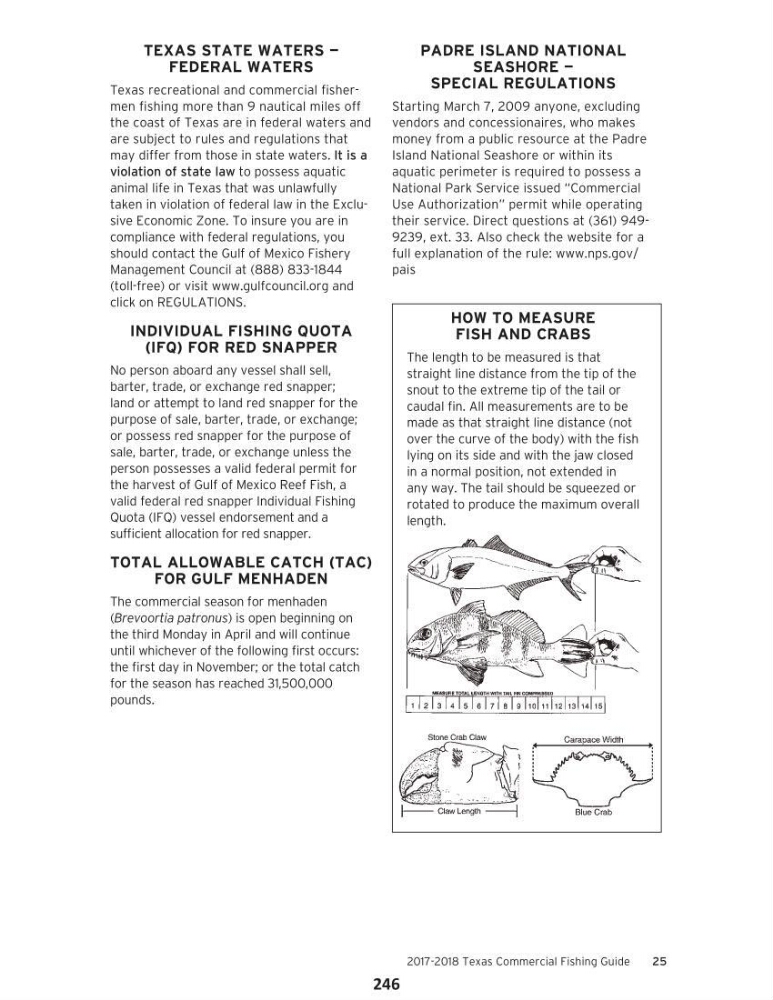
HOW TO MEASURE
FISH AND CRABS
The length to be measured is that
straight line distance from the tip of the
snout to the extreme tip of the tail or
caudal fin. All measurements are to be
made as that straight line distance (not
over the curve of the body) with the fish
lying on its side and with the jaw closed
in a normal position, not extended in
any way. The tail should be squeezed or
rotated to produce the maximum overall
length.
246
25
TEXAS STATE WATERS —
FEDERAL WATERS
Texas recreational and commercial fishermen fishing more than 9 nautical miles off
the coast of Texas are in federal waters and
are subject to rules and regulations that
may differ from those in state waters. It is a
violation of state law to possess aquatic
animal life in Texas that was unlawfully
taken in violation of federal law in the Exclusive Economic Zone. To insure you are in
compliance with federal regulations, you
should contact the Gulf of Mexico Fishery
Management Council at (888) 833-1844
(toll-free) or visit www.gulfcouncil.org and
click on REGULATIONS.
INDIVIDUAL FISHING QUOTA
(IFQ) FOR RED SNAPPER
No person aboard any vessel shall sell,
barter, trade, or exchange red snapper;
land or attempt to land red snapper for the
purpose of sale, barter, trade, or exchange;
or possess red snapper for the purpose of
sale, barter, trade, or exchange unless the
person possesses a valid federal permit for
the harvest of Gulf of Mexico Reef Fish, a
valid federal red snapper Individual Fishing
Quota (IFQ) vessel endorsement and a
sufficient allocation for red snapper.
TOTAL ALLOWABLE CATCH (TAC)
FOR GULF MENHADEN
The commercial season for menhaden
(Brevoortia patronus) is open beginning on
the third Monday in April and will continue
until whichever of the following first occurs:
the first day in November; or the total catch
for the season has reached 31,500,000
pounds.
PADRE ISLAND NATIONAL
SEASHORE —
SPECIAL REGULATIONS
Starting March 7, 2009 anyone, excluding
vendors and concessionaires, who makes
money from a public resource at the Padre
Island National Seashore or within its
aquatic perimeter is required to possess a
National Park Service issued “Commercial
Use Authorization” permit while operating
their service. Direct questions at (361) 9499239, ext. 33. Also check the website for a
full explanation of the rule: www.nps.gov/
pais
HOW TO MEASURE
FISH AND CRABS
The length to be measured is that
straight line distance from the tip of the
snout to the extreme tip of the tail or
caudal fin. All measurements are to be
made as that straight line distance (not
over the curve of the body) with the fish
lying on its side and with the jaw closed
in a normal position, not extended in
any way. The tail should be squeezed or
rotated to produce the maximum overall
length.
246