

Crawfish
Gear License Fees, Requirements, and Restrictions
You may use approved crawfish traps to harvest wild crawfish in Louisiana’s
waters. Trap mesh must be a hexagon of 3/4-inch by 11/16-inch or larger,
measured from wire to wire, not including any coating on the wire. The openings
of trap flues and throats must not exceed 2 inches. These requirements allow
small crawfish to escape the trap—small crawfish have little market value and
are important to the population for breeding.
To use or possess crawfish traps, you must have a Commercial Gear License for
any legal number of traps. A Commercial Gear License for crawfish traps costs
$25 for residents and $100 for nonresidents.
Seasons and Size/Possession Limits
There are no limits on season, size, or possession for commercial crawfish
harvests. Harvest controls are not necessary as crawfish populations are
productive, resilient, and influenced by environmental conditions, rather than
fishing.
WMAs and Refuges
Commercial fishing is permitted in:
• Fort Polk (see fishing regulations posted at specific lakes)
• Grassy Lake*, except in Smith Bay, Red River Bay, and Grassy Lake on Saturday
and Sunday and during waterfowl season
• Pomme de Terre*, except on weekends and during duck season
• Richard K. Yancey, except during regular waterfowl season in Grand Bay,
Silver Lake, and Lower Sunk Lake
• Spring Bayou* (Monday through Friday and after 2 pm during waterfowl
season).
*You must have a permit to fish Grassy Lake, Pomme de Terre, and Spring Bayou
WMAs. Permits are available from Spring Bayou Headquarters or the Opelousas
Field Office at
337.948.0255.
Commercial fishing is prohibited in Ouachita WMA.
Labeling
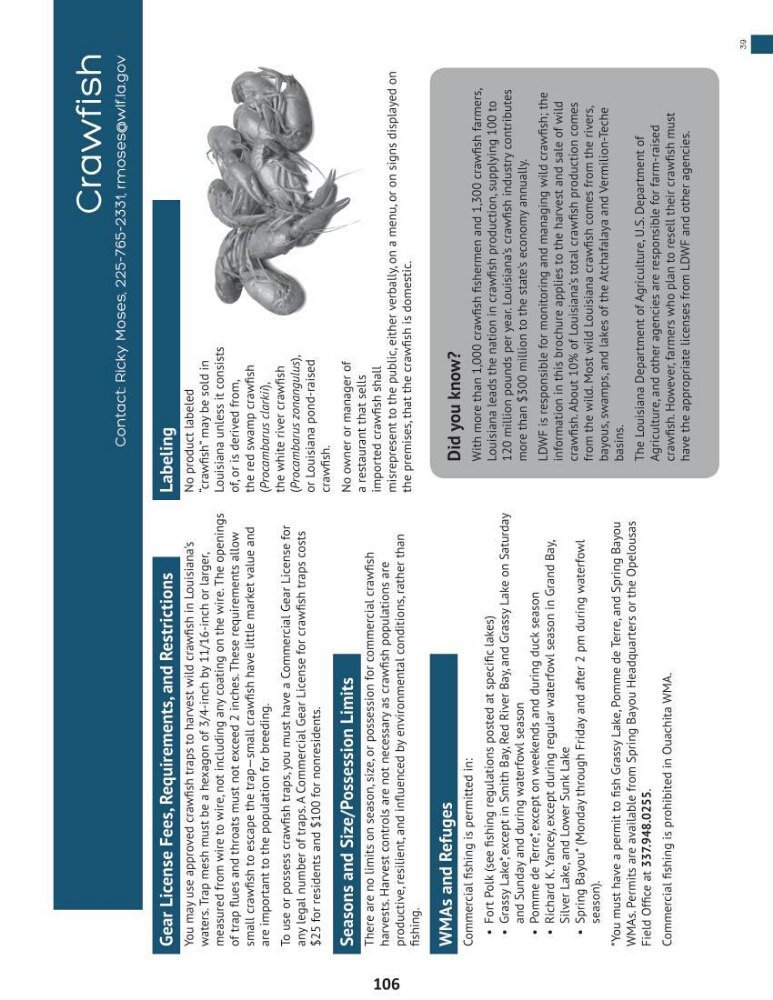
No product labeled
“crawfish” may be sold in
Louisiana unless it consists
of, or is derived from,
the red swamp crawfish
(Procambarus clarkii),
the white river crawfish
(Procambarus zonangulus),
or Louisiana pond-raised
crawfish.
No owner or manager of
a restaurant that sells
imported crawfish shall
misrepresent to the public, either verbally, on a menu, or on signs displayed on
the premises, that the crawfish is domestic.
Did you know?
With more than 1,000 crawfish fishermen and 1,300 crawfish farmers,
Louisiana leads the nation in crawfish production, supplying 100 to
120 million pounds per year. Louisiana’s crawfish industry contributes
more than $300 million to the state’s economy annually.
LDWF is responsible for monitoring and managing wild crawfish; the
information in this brochure applies to the harvest and sale of wild
crawfish. About 10% of Louisiana’s total crawfish production comes
from the wild. Most wild Louisiana crawfish comes from the rivers,
bayous, swamps, and lakes of the Atchafalaya and Vermilion-Teche
basins.
The Louisiana Department of Agriculture, U.S. Department of
Agriculture, and other agencies are responsible for farm-raised
crawfish. However, farmers who plan to resell their crawfish must
have the appropriate licenses from LDWF and other agencies.
Contact: Ricky Moses, 225-765-2331, rmoses@wlf.la.gov
39
106
Gear License Fees, Requirements, and Restrictions
You may use approved crawfish traps to harvest wild crawfish in Louisiana’s
waters. Trap mesh must be a hexagon of 3/4-inch by 11/16-inch or larger,
measured from wire to wire, not including any coating on the wire. The openings
of trap flues and throats must not exceed 2 inches. These requirements allow
small crawfish to escape the trap—small crawfish have little market value and
are important to the population for breeding.
To use or possess crawfish traps, you must have a Commercial Gear License for
any legal number of traps. A Commercial Gear License for crawfish traps costs
$25 for residents and $100 for nonresidents.
Seasons and Size/Possession Limits
There are no limits on season, size, or possession for commercial crawfish
harvests. Harvest controls are not necessary as crawfish populations are
productive, resilient, and influenced by environmental conditions, rather than
fishing.
WMAs and Refuges
Commercial fishing is permitted in:
• Fort Polk (see fishing regulations posted at specific lakes)
• Grassy Lake*, except in Smith Bay, Red River Bay, and Grassy Lake on Saturday
and Sunday and during waterfowl season
• Pomme de Terre*, except on weekends and during duck season
• Richard K. Yancey, except during regular waterfowl season in Grand Bay,
Silver Lake, and Lower Sunk Lake
• Spring Bayou* (Monday through Friday and after 2 pm during waterfowl
season).
*You must have a permit to fish Grassy Lake, Pomme de Terre, and Spring Bayou
WMAs. Permits are available from Spring Bayou Headquarters or the Opelousas
Field Office at
337.948.0255.
Commercial fishing is prohibited in Ouachita WMA.
Labeling
No product labeled
“crawfish” may be sold in
Louisiana unless it consists
of, or is derived from,
the red swamp crawfish
(Procambarus clarkii),
the white river crawfish
(Procambarus zonangulus),
or Louisiana pond-raised
crawfish.
No owner or manager of
a restaurant that sells
imported crawfish shall
misrepresent to the public, either verbally, on a menu, or on signs displayed on
the premises, that the crawfish is domestic.
Did you know?
With more than 1,000 crawfish fishermen and 1,300 crawfish farmers,
Louisiana leads the nation in crawfish production, supplying 100 to
120 million pounds per year. Louisiana’s crawfish industry contributes
more than $300 million to the state’s economy annually.
LDWF is responsible for monitoring and managing wild crawfish; the
information in this brochure applies to the harvest and sale of wild
crawfish. About 10% of Louisiana’s total crawfish production comes
from the wild. Most wild Louisiana crawfish comes from the rivers,
bayous, swamps, and lakes of the Atchafalaya and Vermilion-Teche
basins.
The Louisiana Department of Agriculture, U.S. Department of
Agriculture, and other agencies are responsible for farm-raised
crawfish. However, farmers who plan to resell their crawfish must
have the appropriate licenses from LDWF and other agencies.
Contact: Ricky Moses, 225-765-2331, rmoses@wlf.la.gov
39
106