

Sex differentiation and puberty
103
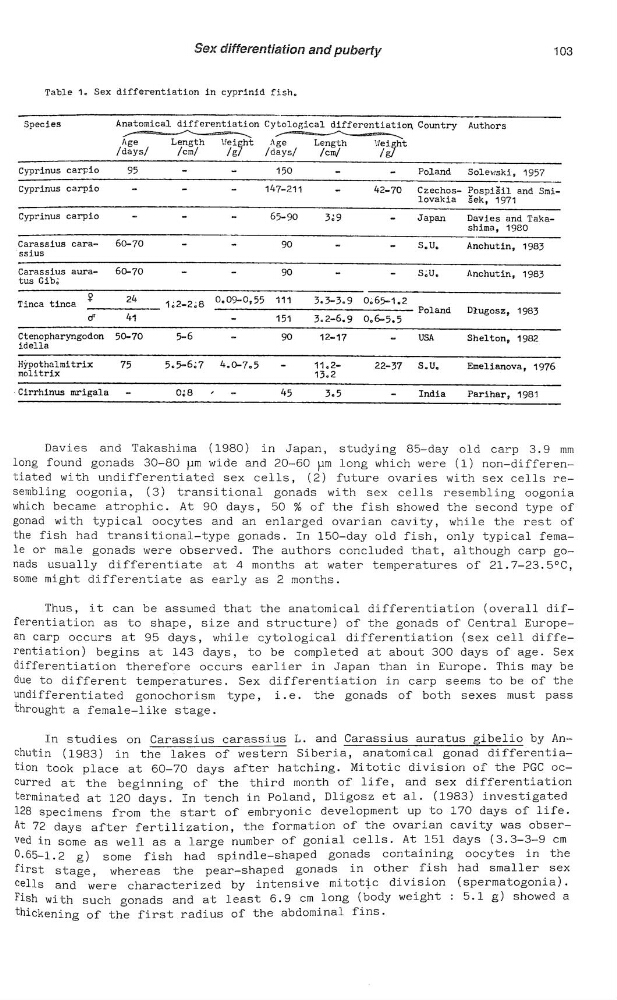
Table
Sex differentiation in cyprinid fish°
Species
Anatomical differentiation Cytological differentiation Country
Authors
W
…
Age
Length
Wei ht
Age
Length
Wei ht
/day5/
/cm/
/gÿ
/day5/
/cm/
/gÿ
Cyprinus carpio
95
—
—
150
-
-
Poland
Solewski, 1957
Cyprinus carpio
—
-
—
147—211
—
ü2—70
Czechos— Pospiëil and Smi:
lovakia
ëek, 1971
__——————————_———___—____—_
Cyprinus carpio
-
—
—
65—90
339
-
Japan
Davies and Taka—
shima, 1980
Carassius cara—
60—70
—
—
90
-
—
Anchutin, 1983
'ssius
…—_—_____
Carassius aura—
60—70
—
-
90
—
—
Anchutin, 1983
tus Gibà
.
2
24
.
0.09—0,55
111
35—3.9
0565—1.2
T1nca tinca
1e2—258
Poland
Dlugosz, 1983
&
h1
—
151
3°2—6.9
006°505
———————————————_—____—
Ctenopharyngodon
50—70
5—6
—
90
12—17
-
USA
Shelton, 1982
ide11a
…_
Hÿpotha1mitrix
75
5.5—6à7
4.0—7°5
-
11°2—
22—37
S.U°
Emelianova, 1976
molitrix
13.2
___—__…
-Cirrhinus mrigala
-
0é8
'
—
À5
3.5
-
India
Parihar, 1981
_—W—__—__—
Davies
and
Takashima
(1980)
in
Japan,
studying 85—day old carp
3.9
mm
long found gonads 3080 pm wide and 20—60 pm long which were (1) non—differen—
tiated
with
undifferentiated
sex
cells,
(2)
future
ovaries
with sex cells re—
sembling oogonia,
(3)
transitional
gonads
with
sex
cells
resembling oogonia
which
became
atrophic.
At
90
days,
50
% of the fish showed the second type of
gonad with typical oocytes and an enlarged ovarian cavity,
while
the
rest
of
the
fish
had
transitional—type gonads. In 150—day old fish, only typical fema—
le or
male
gonads were observed. The authors concluded that, although carp go—
nads
usually
differentiate
at
4
months
at
water
temperatures of 21.7—23.5°0,
some
might differentiate as early as 2 months.
Thus,
it
can
be
assumed that
the
anatomical
differentiation
(overall dif—
ferentiation as
to
shape,
size
and
structure) of the gonads of Central Europe—
an
carp
occurs
at
95
days,
while
cytological differentiation (sex cell diffe—
rentiation)
begins at 143 days,
to
be
completed at about 300 days of age. Sex
differentiation therefore occurs earlier in Japan than in Europe. This may be
due to
different
temperatures.
Sex
differentiation
in
carp
seems
to be
of the
undifferentiated
gonochorism
type,
i.e.
the
gonads
of
both
sexes
must
pass
throught a female—like stage.
In
studies
on
Carassius
carassius L.
and Carassius
auratus gibelio by An—
chutin
(1983)
in
the
lakes
of
western
Siberia,
anatomical
gonad differentia—
tion took
place at 60—70 days after hatching.
Mitotic
division of the PGC oc—
curred
at
the
beginning of the
third
month
of
life,
and
sex
differentiation
terminated at 120 days. In tench in Poland, Dligosz et al.
(1983) investigated
128 Specimens
from
the
start
of
embryonio development up to 170 days of life.
At 72
days after fertilization, the formation of the ovarian cavity was obser—
ved in some as well
as
a
large number of gonial cells. At 151 days (3.3—3—9 cm
0.65—1.2
g)
some
fish
had
Spindle—shaped gonads
containing
oocytes
in
the
first
stage,
whereas
the
pear—shaped
gonads
in
other
fish
had
smaller
sex
cells
and
were
characterized
by
intenSive
mitotic
division
(spermatogon1a).
FiSh with such gonads and at least 6.9 cm long (bOdY weight : 5-1 g) showed a
thickening of the first radius of the abdominal fins.
103
Table
Sex differentiation in cyprinid fish°
Species
Anatomical differentiation Cytological differentiation Country
Authors
W
…
Age
Length
Wei ht
Age
Length
Wei ht
/day5/
/cm/
/gÿ
/day5/
/cm/
/gÿ
Cyprinus carpio
95
—
—
150
-
-
Poland
Solewski, 1957
Cyprinus carpio
—
-
—
147—211
—
ü2—70
Czechos— Pospiëil and Smi:
lovakia
ëek, 1971
__——————————_———___—____—_
Cyprinus carpio
-
—
—
65—90
339
-
Japan
Davies and Taka—
shima, 1980
Carassius cara—
60—70
—
—
90
-
—
Anchutin, 1983
'ssius
…—_—_____
Carassius aura—
60—70
—
-
90
—
—
Anchutin, 1983
tus Gibà
.
2
24
.
0.09—0,55
111
35—3.9
0565—1.2
T1nca tinca
1e2—258
Poland
Dlugosz, 1983
&
h1
—
151
3°2—6.9
006°505
———————————————_—____—
Ctenopharyngodon
50—70
5—6
—
90
12—17
-
USA
Shelton, 1982
ide11a
…_
Hÿpotha1mitrix
75
5.5—6à7
4.0—7°5
-
11°2—
22—37
S.U°
Emelianova, 1976
molitrix
13.2
___—__…
-Cirrhinus mrigala
-
0é8
'
—
À5
3.5
-
India
Parihar, 1981
_—W—__—__—
Davies
and
Takashima
(1980)
in
Japan,
studying 85—day old carp
3.9
mm
long found gonads 3080 pm wide and 20—60 pm long which were (1) non—differen—
tiated
with
undifferentiated
sex
cells,
(2)
future
ovaries
with sex cells re—
sembling oogonia,
(3)
transitional
gonads
with
sex
cells
resembling oogonia
which
became
atrophic.
At
90
days,
50
% of the fish showed the second type of
gonad with typical oocytes and an enlarged ovarian cavity,
while
the
rest
of
the
fish
had
transitional—type gonads. In 150—day old fish, only typical fema—
le or
male
gonads were observed. The authors concluded that, although carp go—
nads
usually
differentiate
at
4
months
at
water
temperatures of 21.7—23.5°0,
some
might differentiate as early as 2 months.
Thus,
it
can
be
assumed that
the
anatomical
differentiation
(overall dif—
ferentiation as
to
shape,
size
and
structure) of the gonads of Central Europe—
an
carp
occurs
at
95
days,
while
cytological differentiation (sex cell diffe—
rentiation)
begins at 143 days,
to
be
completed at about 300 days of age. Sex
differentiation therefore occurs earlier in Japan than in Europe. This may be
due to
different
temperatures.
Sex
differentiation
in
carp
seems
to be
of the
undifferentiated
gonochorism
type,
i.e.
the
gonads
of
both
sexes
must
pass
throught a female—like stage.
In
studies
on
Carassius
carassius L.
and Carassius
auratus gibelio by An—
chutin
(1983)
in
the
lakes
of
western
Siberia,
anatomical
gonad differentia—
tion took
place at 60—70 days after hatching.
Mitotic
division of the PGC oc—
curred
at
the
beginning of the
third
month
of
life,
and
sex
differentiation
terminated at 120 days. In tench in Poland, Dligosz et al.
(1983) investigated
128 Specimens
from
the
start
of
embryonio development up to 170 days of life.
At 72
days after fertilization, the formation of the ovarian cavity was obser—
ved in some as well
as
a
large number of gonial cells. At 151 days (3.3—3—9 cm
0.65—1.2
g)
some
fish
had
Spindle—shaped gonads
containing
oocytes
in
the
first
stage,
whereas
the
pear—shaped
gonads
in
other
fish
had
smaller
sex
cells
and
were
characterized
by
intenSive
mitotic
division
(spermatogon1a).
FiSh with such gonads and at least 6.9 cm long (bOdY weight : 5-1 g) showed a
thickening of the first radius of the abdominal fins.