

R. Billard et J. Marcel, Ed. Aquaculture of Cyprinids, INRA, Paris, 1986.
Pasäer sammanes
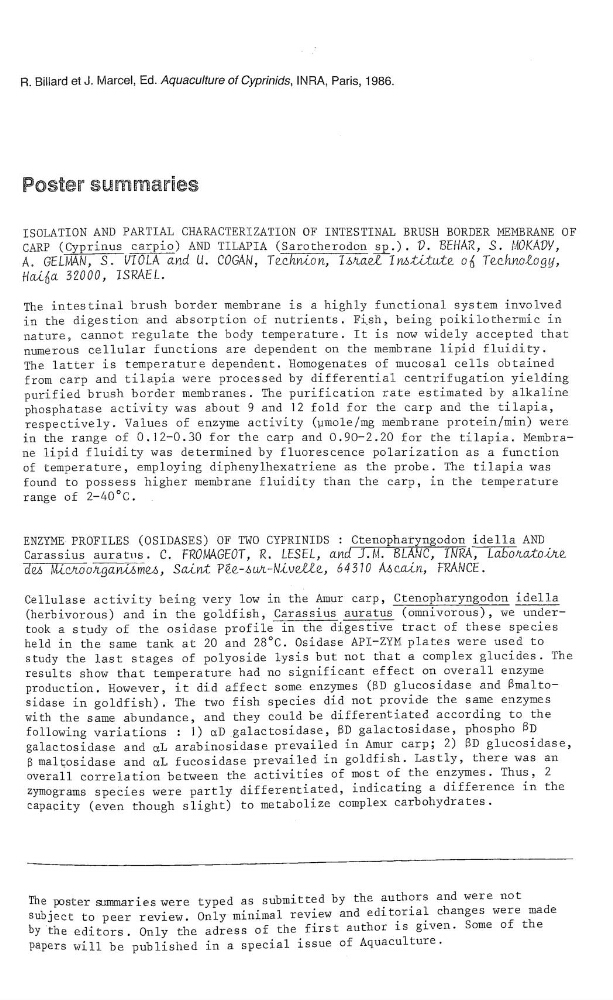
ISOLATION AND PARTIAL CHARACTERIZATION OF INTESTINAL BRUSH BORDER MEMBRANE OF
CARE
(Cyprinus carpio) AND TILAPIA (Sarotherodon sp.). 0. BEHÀR, S. MOKÀÜV,
A. GELMAN, S. UIOLA cmd U. COGAN,
lA&aŒIMMM@ 06 Tcc/mo£ogy,
Haiéa 32000, ÏSRAEL.
The intestinal brush border membrane is a highly functional system involved
in the digestion and absorption of nutrients. Fish, being poikilothermic in
nature,
cannot
regulate the body temperature. It is now widely accepted that
numerous
cellular functions are dependent on the membrane lipid fluidity.
The latter is
temperature dependent. Homogenates of mucosal cells obtained
from carp and tilapia were processed by differential centrifugation yielding
purified brush border membranes. The purification rate estimated by alkaline
phosphatase activity was about 9 and 12 fold for the carp and the tilapia,
respectively. Values of enzyme activity (pm01e/mg membrane protein/min) were
in the range of 0.12—0.30 for the carp and 0.90-2.20 for the tilapia. Membra—
ne
lipid fluidity was determined by fluorescence polarization as a function
of temperature, employing diphenylhexatriene as the probe. The tilapia was
found
to
possess higher membrane fluidity than the carp, in the temperature
range of
2—40°C.
ENZYME PROFILES
(OSIDASES) OF TWO CYPRINIDS : Ctenophatyngodon idella AND
Carassius auratus.
C.
FROMÀGEOT, R. LESEL, and J.M. BLANC, INRA,
El@A Wmoo/1ga…mœ,
64570 A4cæén, FRANCE.
Cellulase activity being very low in the Amur carp, Ctenopharyngodon idella
(herbivorous) and in the goldfish, Carassius auratus (omnivorous), we under—
took a study of the osidase profile in the digestive tract of these species
held in the same
tank at 20 and 28°C. Osidase API—ZYM plates were used to
Study the last stages of polyoside lysis but not that a complex glucides. The
results
show
that temperature had no significant effect on overall enzyme
production. However, it did affect some enzymes (BD glucosidase and 8malto—
sidase in goldfish). The two fish Species did not provide the same enzymes
with the same abundance, and they could be differentiated according to the
following variations : ]) dD_galactosidase, BD galactosidase, ph03pho BD
galactosidase and ŒL arabinosidase prevailed in Amur carp; 2) BD glucosidase,
B maltosidase and ŒL fucosidase prevailed in goldfish. Lastly, there was an
overall correlation between the activities of most of the enzymes. Thu5, 2
zymograms speCies were partly differentiated, indicating a difference in the
capacity (even though slight) to metabolize complex carbohydrate5.
The poster summaries were typed as submitted by the authors
and were not
SUbjeCt to peer review. Only minimal review and editorial
changes were made
editors. Only the adress of the first author is given. Some of the
papers will be published in a special issue of Aquaculture.
Pasäer sammanes
ISOLATION AND PARTIAL CHARACTERIZATION OF INTESTINAL BRUSH BORDER MEMBRANE OF
CARE
(Cyprinus carpio) AND TILAPIA (Sarotherodon sp.). 0. BEHÀR, S. MOKÀÜV,
A. GELMAN, S. UIOLA cmd U. COGAN,
lA&aŒIMMM@ 06 Tcc/mo£ogy,
Haiéa 32000, ÏSRAEL.
The intestinal brush border membrane is a highly functional system involved
in the digestion and absorption of nutrients. Fish, being poikilothermic in
nature,
cannot
regulate the body temperature. It is now widely accepted that
numerous
cellular functions are dependent on the membrane lipid fluidity.
The latter is
temperature dependent. Homogenates of mucosal cells obtained
from carp and tilapia were processed by differential centrifugation yielding
purified brush border membranes. The purification rate estimated by alkaline
phosphatase activity was about 9 and 12 fold for the carp and the tilapia,
respectively. Values of enzyme activity (pm01e/mg membrane protein/min) were
in the range of 0.12—0.30 for the carp and 0.90-2.20 for the tilapia. Membra—
ne
lipid fluidity was determined by fluorescence polarization as a function
of temperature, employing diphenylhexatriene as the probe. The tilapia was
found
to
possess higher membrane fluidity than the carp, in the temperature
range of
2—40°C.
ENZYME PROFILES
(OSIDASES) OF TWO CYPRINIDS : Ctenophatyngodon idella AND
Carassius auratus.
C.
FROMÀGEOT, R. LESEL, and J.M. BLANC, INRA,
El@A Wmoo/1ga…mœ,
64570 A4cæén, FRANCE.
Cellulase activity being very low in the Amur carp, Ctenopharyngodon idella
(herbivorous) and in the goldfish, Carassius auratus (omnivorous), we under—
took a study of the osidase profile in the digestive tract of these species
held in the same
tank at 20 and 28°C. Osidase API—ZYM plates were used to
Study the last stages of polyoside lysis but not that a complex glucides. The
results
show
that temperature had no significant effect on overall enzyme
production. However, it did affect some enzymes (BD glucosidase and 8malto—
sidase in goldfish). The two fish Species did not provide the same enzymes
with the same abundance, and they could be differentiated according to the
following variations : ]) dD_galactosidase, BD galactosidase, ph03pho BD
galactosidase and ŒL arabinosidase prevailed in Amur carp; 2) BD glucosidase,
B maltosidase and ŒL fucosidase prevailed in goldfish. Lastly, there was an
overall correlation between the activities of most of the enzymes. Thu5, 2
zymograms speCies were partly differentiated, indicating a difference in the
capacity (even though slight) to metabolize complex carbohydrate5.
The poster summaries were typed as submitted by the authors
and were not
SUbjeCt to peer review. Only minimal review and editorial
changes were made
editors. Only the adress of the first author is given. Some of the
papers will be published in a special issue of Aquaculture.