

Carp nui‘ri‘ion
57
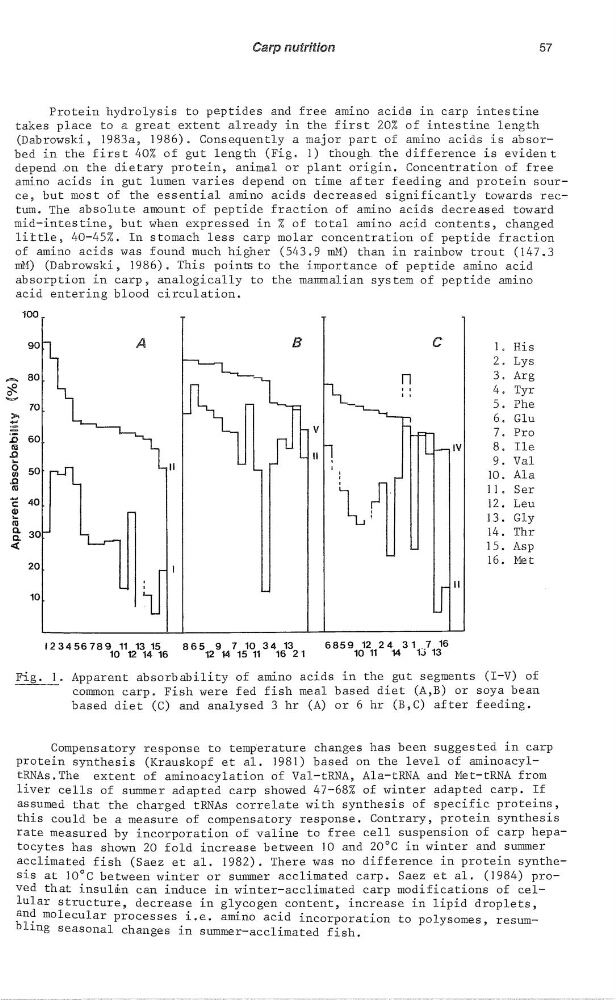
Protein hydrolysis to peptides and free amino acids in carp intestine
takes place to a great extent already in the first 20% of intestine length
(Dabrowski, 1983a, 1986). Consequently a major part of amino acids is absor—
bed in the first 40% of gut length (Fig. 1) though the difference is evident
depend on the dietary protein, animal or plant origin. Concentration of free
amino acids in gut lumen varies depend on time after feeding and protein sour—
ce,
but most of
the essential amino acids decreased significantly towards rec—
tum.
The
absolute aumunt of peptide fraction of amino acids decreased toward
mid—intestine, but when expressed in % of total amino acid contents, changed
little, 40—452. In stomach less carp molar concentration of peptide fraction
of amino acids was found much higher (543.9 mM) than in rainbow trout (147.3
mM) (Dabrowski, 1986). This poinüât0 the importance of peptide amino acid
absorption in carp, analogically to the mammalian system of peptide amino
acid entering blood circulation.
î00
,
90
A
B
C
1. His
.
2.
Lys
80_
.
r]
3.
Arg
39
‘
::
4«
Tyr
70
_
—
5.
Phe
E
6.
Glu
È
—
-,
V
-
7.
Pro
‘Ë
60
|"
| w
8.
Ile
ë
.
”
‘
;
9. Val
3
50
;
.
10.
Ala
@
.
11.
Ser
Ë 40.
12. Leu
%
'
=
13.
Gly
& 30
14. Thr
<
'
15.
Asp
20
|
16.
Met
H
10
|2 3 4 56 78 910111213141516
8 6
3 4161321
6 85 91012112 4143
Fig. ]. Apparent absorbability of amino acids in the gut segments (I—V) of
common
carp.
Fish were fed fish meal based diet
(A,B) or soya bean
based diet (C) and analysed 3 hr (A) or 6 hr (B,C) after feeding.
Compensatory response to temperature changes has been suggested in carp
protein synthesis (Krauskopf et al. 1981) based on the level of aminoacyl—
tRNAS.Th€
extent
of aminoacylation of Val—tRNA, Ala—tRNA and Met—tRNA from
liver cells of summer adapted carp showed 47—68% of winter adapted carp. If
assumed that
the charged tRNAS correlate with synthesis of specific proteins,
this could be a measure of compensatory response. Contrary, protein synthesis
rate measured by incorporation of valine to free cell suspension of carp hepa—
tocytes has shown 20 fold increase between 10 and 20°C in winter and summer
acclimated fish (Saez et al.
1982). There was no difference in protein synthe—
sis at 10°C between winter or summer acclimated carp. Saez et al.
(1984) pro—
ved that insulin can induce in winter—acclimated carp modifications of cel—
lular structure, decrease in glycogen content, increase in lipid droplets,
ÊÎÎ
molecular processes i.e. amino acid incorporation to polysomes, resum—
ng seasonal changes in summer—acclimated fish.
57
Protein hydrolysis to peptides and free amino acids in carp intestine
takes place to a great extent already in the first 20% of intestine length
(Dabrowski, 1983a, 1986). Consequently a major part of amino acids is absor—
bed in the first 40% of gut length (Fig. 1) though the difference is evident
depend on the dietary protein, animal or plant origin. Concentration of free
amino acids in gut lumen varies depend on time after feeding and protein sour—
ce,
but most of
the essential amino acids decreased significantly towards rec—
tum.
The
absolute aumunt of peptide fraction of amino acids decreased toward
mid—intestine, but when expressed in % of total amino acid contents, changed
little, 40—452. In stomach less carp molar concentration of peptide fraction
of amino acids was found much higher (543.9 mM) than in rainbow trout (147.3
mM) (Dabrowski, 1986). This poinüât0 the importance of peptide amino acid
absorption in carp, analogically to the mammalian system of peptide amino
acid entering blood circulation.
î00
,
90
A
B
C
1. His
.
2.
Lys
80_
.
r]
3.
Arg
39
‘
::
4«
Tyr
70
_
—
5.
Phe
E
6.
Glu
È
—
-,
V
-
7.
Pro
‘Ë
60
|"
| w
8.
Ile
ë
.
”
‘
;
9. Val
3
50
;
.
10.
Ala
@
.
11.
Ser
Ë 40.
12. Leu
%
'
=
13.
Gly
& 30
14. Thr
<
'
15.
Asp
20
|
16.
Met
H
10
|2 3 4 56 78 910111213141516
8 6
3 4161321
6 85 91012112 4143
Fig. ]. Apparent absorbability of amino acids in the gut segments (I—V) of
common
carp.
Fish were fed fish meal based diet
(A,B) or soya bean
based diet (C) and analysed 3 hr (A) or 6 hr (B,C) after feeding.
Compensatory response to temperature changes has been suggested in carp
protein synthesis (Krauskopf et al. 1981) based on the level of aminoacyl—
tRNAS.Th€
extent
of aminoacylation of Val—tRNA, Ala—tRNA and Met—tRNA from
liver cells of summer adapted carp showed 47—68% of winter adapted carp. If
assumed that
the charged tRNAS correlate with synthesis of specific proteins,
this could be a measure of compensatory response. Contrary, protein synthesis
rate measured by incorporation of valine to free cell suspension of carp hepa—
tocytes has shown 20 fold increase between 10 and 20°C in winter and summer
acclimated fish (Saez et al.
1982). There was no difference in protein synthe—
sis at 10°C between winter or summer acclimated carp. Saez et al.
(1984) pro—
ved that insulin can induce in winter—acclimated carp modifications of cel—
lular structure, decrease in glycogen content, increase in lipid droplets,
ÊÎÎ
molecular processes i.e. amino acid incorporation to polysomes, resum—
ng seasonal changes in summer—acclimated fish.