

R. Billard et J. Marcel, Ed. Aquaculture of Cyprinids,lNRA, Paris, 1986
Poster summames
COMPUTERIZED EVALUATION AND PREDICTION OF THE PRODUCTION COST IN A COMBINED
PIKE AND
CARP HATCHERY.
C.
CAUSSE, P. BOUJET, G. DE MONTALEMBERT, M.G. HOL—
LEBECQ, and R. BILLARD,
and Mamie Cu/uéc, EmeégnemcM
Supë/uÇeu/r, PM.
Preliminary work was carried out to evaluate the production costs in a poly—
valent hatchery operation in continental climate condition. Evaluating precise
production costs seems necessary in all fishfarms. A specific computer program
is then of great help to have a rapid evalution of these costs. This makes it
possible for the fishfarmer to take decisions which will optimize each bree—
ding stage. It is also used to compare the different breeding stages to see
which one has the best ”profitability". This program is written in Basic and
is used on a computer Apple two. It calculates production costs for Carp and
Pike at the following stages : in carp —larvae, juveniles 3 weeks and 3 months
old; in pike —larvae and fingerling. Three groups of parameters are taken into
account
:
]) production characteristics : this includes the weight and number
of fish, and the survival rates; 2) variable costs : (price of food, energy,
equipment, labor, ...) fixed costs : (interest and amortized capital cost);
3) saling prices. The total input represents 35 elements for each stage and
each one
can
be
changed without affecting the others. The program calculates
the following wariables : ]) costs of equipment, labor, amortized capital and
interests; Z) economic indicators : production/ha, profit/kg (or unit) and
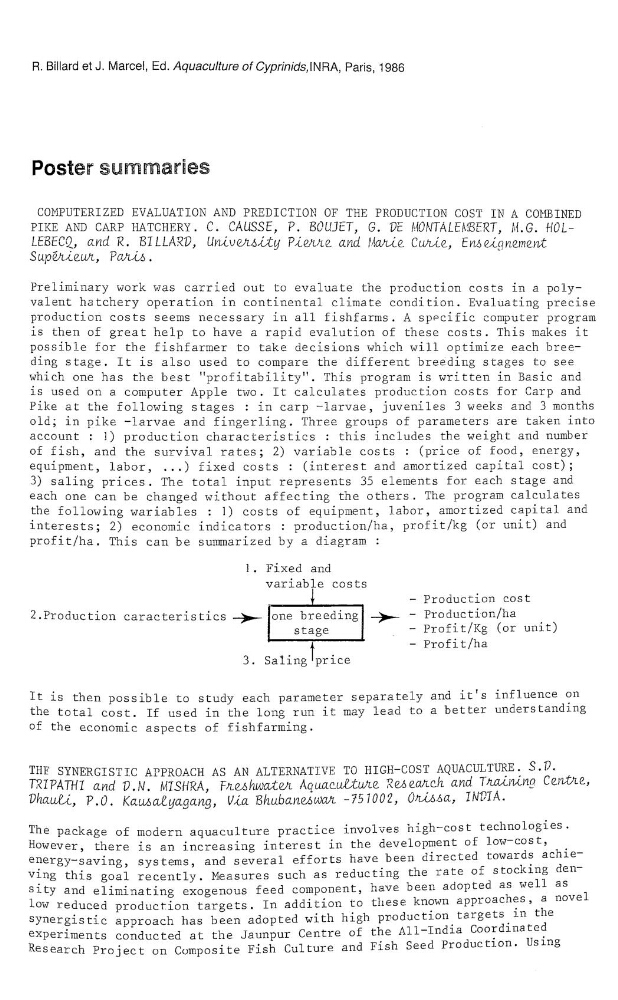
profit/ha. This can be summarized by a diagram :
l.
Fixed and
variable costs
.
_
—
Production cost
2.Production caracteristics —>-—
-—>— — Production/ha
stage
_
—
Profit/Kg (or unit)
î
—
Profit/ha
3.
Saling price
It is
then possible to study each parameter separately and it's influence on
the total
cost.
If
used in the long run it may lead to a better understanding
of
the
economic aspects of fishfarming.
THE SYNERGÏSTIC APPROACH AS AN ALTERNATIVE TO HIGH—COST
S.Ü—
TRIPATHI cmd Û.N. MÏSHRA, FÆQ/ShWŒÉQ/L Aquacuüu}rc Kuga/rah
and Taauwæg CmWœ,
Dhauü, P.O. Kawsa£gugang, um B/…ban…m —757002, Umm, INŒA.
The Package of modern aquaculture practice involves high—cost technologies.
However, there is an increasing interest in the development
of low—cost,
_
energy—saving, systems, and several efforts have been directed towards acË1e_
Ving this goal recently. Measures such as reducting the rate of stock1ng
en
Sity and eliminating exogenous feed component, have been adopted as wel
asve1
low reduced production targets. In addition to these known approaches,
DO
synergistic approach has been adopted with high production targets 1n tâe
exP€riments conducted at the Jaunpur Centre of the All—India
Research Project on Composite Fish Culture and Fish Seed Production.
Sing
Poster summames
COMPUTERIZED EVALUATION AND PREDICTION OF THE PRODUCTION COST IN A COMBINED
PIKE AND
CARP HATCHERY.
C.
CAUSSE, P. BOUJET, G. DE MONTALEMBERT, M.G. HOL—
LEBECQ, and R. BILLARD,
and Mamie Cu/uéc, EmeégnemcM
Supë/uÇeu/r, PM.
Preliminary work was carried out to evaluate the production costs in a poly—
valent hatchery operation in continental climate condition. Evaluating precise
production costs seems necessary in all fishfarms. A specific computer program
is then of great help to have a rapid evalution of these costs. This makes it
possible for the fishfarmer to take decisions which will optimize each bree—
ding stage. It is also used to compare the different breeding stages to see
which one has the best ”profitability". This program is written in Basic and
is used on a computer Apple two. It calculates production costs for Carp and
Pike at the following stages : in carp —larvae, juveniles 3 weeks and 3 months
old; in pike —larvae and fingerling. Three groups of parameters are taken into
account
:
]) production characteristics : this includes the weight and number
of fish, and the survival rates; 2) variable costs : (price of food, energy,
equipment, labor, ...) fixed costs : (interest and amortized capital cost);
3) saling prices. The total input represents 35 elements for each stage and
each one
can
be
changed without affecting the others. The program calculates
the following wariables : ]) costs of equipment, labor, amortized capital and
interests; Z) economic indicators : production/ha, profit/kg (or unit) and
profit/ha. This can be summarized by a diagram :
l.
Fixed and
variable costs
.
_
—
Production cost
2.Production caracteristics —>-—
-—>— — Production/ha
stage
_
—
Profit/Kg (or unit)
î
—
Profit/ha
3.
Saling price
It is
then possible to study each parameter separately and it's influence on
the total
cost.
If
used in the long run it may lead to a better understanding
of
the
economic aspects of fishfarming.
THE SYNERGÏSTIC APPROACH AS AN ALTERNATIVE TO HIGH—COST
S.Ü—
TRIPATHI cmd Û.N. MÏSHRA, FÆQ/ShWŒÉQ/L Aquacuüu}rc Kuga/rah
and Taauwæg CmWœ,
Dhauü, P.O. Kawsa£gugang, um B/…ban…m —757002, Umm, INŒA.
The Package of modern aquaculture practice involves high—cost technologies.
However, there is an increasing interest in the development
of low—cost,
_
energy—saving, systems, and several efforts have been directed towards acË1e_
Ving this goal recently. Measures such as reducting the rate of stock1ng
en
Sity and eliminating exogenous feed component, have been adopted as wel
asve1
low reduced production targets. In addition to these known approaches,
DO
synergistic approach has been adopted with high production targets 1n tâe
exP€riments conducted at the Jaunpur Centre of the All—India
Research Project on Composite Fish Culture and Fish Seed Production.
Sing