

470
,
R. Berka
-‘
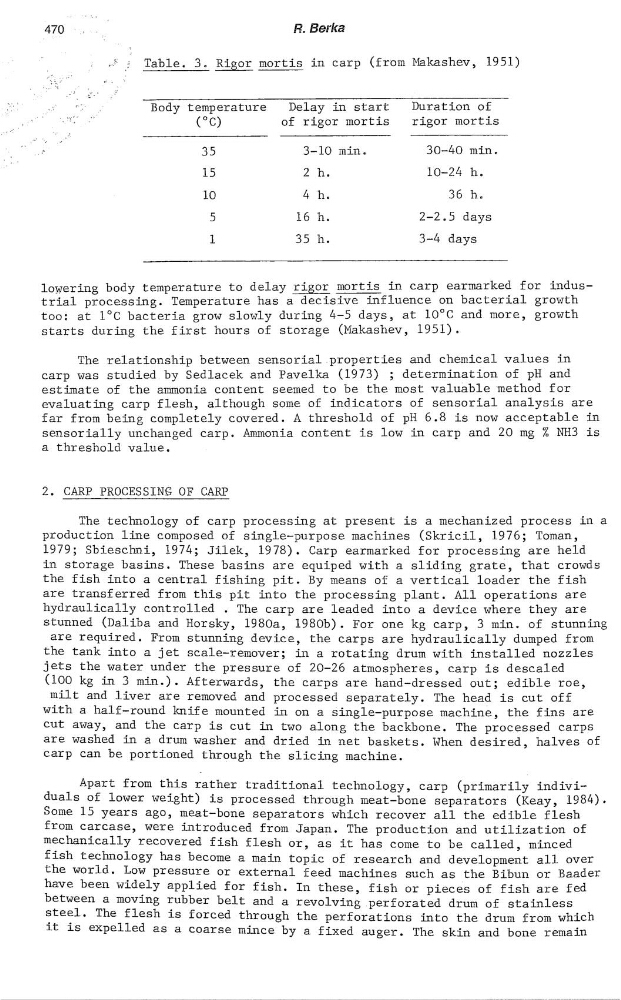
Table.
3.
Rigor mortis in carp (from.M3kashev, 1951)
.
…
(°C)
of rigor mortis
rigor mortis
35
3—10 min.
30—40 min.
15
2 h.
10—24 h.
10
4 h.
36 h.
5
16 h.
2—2.5 days
1
35 h.
3—4 days
lowering body temperature to delay rigor mgrEis_in carp earmarked for indu5—
trial processing. Temperature has a decisive influence on bacterial growth
too:
at
1°C bacteria grow slowly during 4—5 days, at 10°C and more, growth
starts
during the first hours of storage (Makashev, 1951).
The relationship between sensorial.properties and chemical values in
carp was studied by Sedlacek and Pavelka (1973) ; determination of pH and
estimate of the ammonia content seemed to be the most valuable method for
evaluating carp flesh, although some of indicators of sensorial analysis are
far from being completely covered. A threshold of pH 6.8 is now acceptable in
sensorially unchanged carp. Ammonia content is low in carp and 20 mg % NH3 is
a
threshold value.
2.
CAR? PROCESSING OF CARP
The technology of carp processing at present is a mechanized process in a
production line composed of single—purpose machines (Skricil, 1976; Toman,
1979; Sbieschni, 1974; Jilek, 1978). Carp earmarked for processing are held
in storage basins. These basins are equiped with a sliding grate, that crowds
the fish into a central fishing pit. By means of a vertical loader the fish
are
transferred from this pit into the processing plant. All operations are
hydraulically controlled
.
The carp are leaded into a device where they are
stunned
(Daliba and Horsky, 1980a, 1980b). For one kg carp, 3 min. of stunning
are
required. From stunning device, the carps are hydraulically dumped from
the tank into a jet scale—remover; in a rotating drum with installed nozzles
jets the water under the pressure of 20—26 atmospheres, carp is descaled
(100 kg in 3 min.). Afterwards, the carpe are hand—dressed out; edible roe,
milt and liver are removed and processed separate1y. The head is cut off
with a half—round knife mounted in on a Single—purpose machine, the fins are
cut
away,
and the carp is cut in two along the backbone. The processed carps
are
washed in a drum washer and dried in net baskets. When desired, halves of
carp can be portioned through the slicing machine.
Apart from this rather traditional technology, carp (primarily indivi—
duals of lower weight) is processed through meat—bone separators (Keay, 1984).
Some 15 years ago, meat—bone separators which recover all the edible flesh
from carcase, were introduced from Japan. The production and utilization of
mechanically recovered fish flesh or, as it has come to be called, minced
fish technology has become a main topic of research and development all over
the world.
how pressure or external feed machines such as the Bibun or Baader
Ïave
been w1dely applied for fish. In these, fish or pieces of fish are fed
etween a mov1ng rubber belt and a revolving perforated drum of stainless
steel.
The flesh is forced through the perforations into the drum from which
lt
lS
expelled as a coarse mince by a fixed auger. The skin and bone remain
,
R. Berka
-‘
Table.
3.
Rigor mortis in carp (from.M3kashev, 1951)
.
…
(°C)
of rigor mortis
rigor mortis
35
3—10 min.
30—40 min.
15
2 h.
10—24 h.
10
4 h.
36 h.
5
16 h.
2—2.5 days
1
35 h.
3—4 days
lowering body temperature to delay rigor mgrEis_in carp earmarked for indu5—
trial processing. Temperature has a decisive influence on bacterial growth
too:
at
1°C bacteria grow slowly during 4—5 days, at 10°C and more, growth
starts
during the first hours of storage (Makashev, 1951).
The relationship between sensorial.properties and chemical values in
carp was studied by Sedlacek and Pavelka (1973) ; determination of pH and
estimate of the ammonia content seemed to be the most valuable method for
evaluating carp flesh, although some of indicators of sensorial analysis are
far from being completely covered. A threshold of pH 6.8 is now acceptable in
sensorially unchanged carp. Ammonia content is low in carp and 20 mg % NH3 is
a
threshold value.
2.
CAR? PROCESSING OF CARP
The technology of carp processing at present is a mechanized process in a
production line composed of single—purpose machines (Skricil, 1976; Toman,
1979; Sbieschni, 1974; Jilek, 1978). Carp earmarked for processing are held
in storage basins. These basins are equiped with a sliding grate, that crowds
the fish into a central fishing pit. By means of a vertical loader the fish
are
transferred from this pit into the processing plant. All operations are
hydraulically controlled
.
The carp are leaded into a device where they are
stunned
(Daliba and Horsky, 1980a, 1980b). For one kg carp, 3 min. of stunning
are
required. From stunning device, the carps are hydraulically dumped from
the tank into a jet scale—remover; in a rotating drum with installed nozzles
jets the water under the pressure of 20—26 atmospheres, carp is descaled
(100 kg in 3 min.). Afterwards, the carpe are hand—dressed out; edible roe,
milt and liver are removed and processed separate1y. The head is cut off
with a half—round knife mounted in on a Single—purpose machine, the fins are
cut
away,
and the carp is cut in two along the backbone. The processed carps
are
washed in a drum washer and dried in net baskets. When desired, halves of
carp can be portioned through the slicing machine.
Apart from this rather traditional technology, carp (primarily indivi—
duals of lower weight) is processed through meat—bone separators (Keay, 1984).
Some 15 years ago, meat—bone separators which recover all the edible flesh
from carcase, were introduced from Japan. The production and utilization of
mechanically recovered fish flesh or, as it has come to be called, minced
fish technology has become a main topic of research and development all over
the world.
how pressure or external feed machines such as the Bibun or Baader
Ïave
been w1dely applied for fish. In these, fish or pieces of fish are fed
etween a mov1ng rubber belt and a revolving perforated drum of stainless
steel.
The flesh is forced through the perforations into the drum from which
lt
lS
expelled as a coarse mince by a fixed auger. The skin and bone remain