

460
M. Leopold
used pond area were considered since they were the only ones directly rela—
ted to fish production and thus fully reliable.
6.
Total amount of feeds used
RESULTS AND DISCUSSION
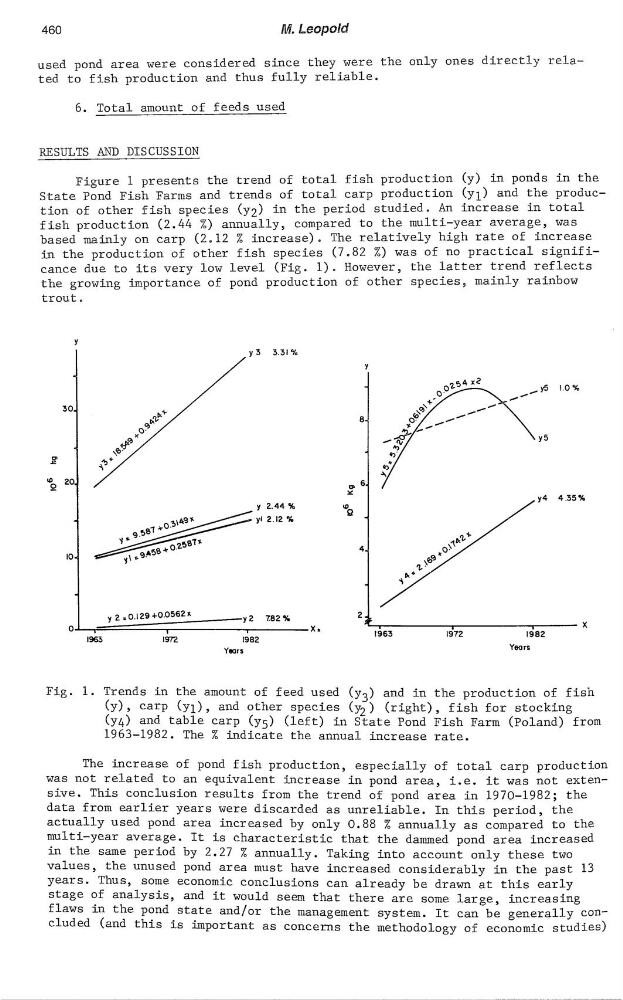
Figure 1 presents the trend of total fish production (y) in ponds in the
State Pond Fish Farms and trends of total carp production (y1) and the produc—
tion of other fish species (yz) in the period studied. An increase in total
fish production (2.44 %) annually, compared to the multi—year average, was
based mainly on carp (2.12 % increase). The relatively high rate of increase
in the production of other fish species (7.82 %) was of no practical signifi—
cance
due to
its very low level
(Fig. 1). However, the latter trend reflects
the growing importance of pond production of other species, mainly rainbow
trout
.
y
.
y3
351%
y
09154
“2
//y5
1.0%
30
q\+'
//
'
8
////
0‘
/
*
»â’
@
,
y5
b‘?N
Ç"
@”
“’s 2
:.
6
y4
455%
y
2.44— %
wQ
03\A91—
y‘ 2.l2 %
\!
9561
fu—
‘
597*
58 * °“2
4
0-\
[0
‘i‘
,9.‘*
2
182 %
2
0
X‘
l963
X
l965
l972
l982
'972
'932
Yours
Years
Fig. 1. Trends in the amount of feed used (y3)
and in the production of fish
(y), carp (y1), and other species
(right), fish for stocking
(Y4) and table carp (Y5) (left) in State Pond Fish Farm (Poland) from
1963—1982. The % indicate the annual increase rate.
The increase of pond fish production, especially of total carp production
was
not
related
to
an
equivalent increase in pond area, i.e. it was not extensrve.
This conclu510n
results from the trend of pond area in 1970—1982; the
data from earlier years were
discarded as unreliable.
In this period, the
actually
used pond area increased by only 0.88 % annually as compared to the
multi—year average.
It
is
characteristic that the dammed pond area increased
inlthe
same
period by 2.27 % annually. Taking into account only these two
va
ues,
the unused pond area
must have increased considerably in the past
13
Yî3rS- Ëhus,lsome economic
conclusions can already be drawn at this early
Êlîîe ? Îäa
Y51S,
and lt Would seem that there are some large, increasing
de
and/or the management system. It can be generally con—
an
t
18
18
important as concerns the methodology of economic studies)
M. Leopold
used pond area were considered since they were the only ones directly rela—
ted to fish production and thus fully reliable.
6.
Total amount of feeds used
RESULTS AND DISCUSSION
Figure 1 presents the trend of total fish production (y) in ponds in the
State Pond Fish Farms and trends of total carp production (y1) and the produc—
tion of other fish species (yz) in the period studied. An increase in total
fish production (2.44 %) annually, compared to the multi—year average, was
based mainly on carp (2.12 % increase). The relatively high rate of increase
in the production of other fish species (7.82 %) was of no practical signifi—
cance
due to
its very low level
(Fig. 1). However, the latter trend reflects
the growing importance of pond production of other species, mainly rainbow
trout
.
y
.
y3
351%
y
09154
“2
//y5
1.0%
30
q\+'
//
'
8
////
0‘
/
*
»â’
@
,
y5
b‘?N
Ç"
@”
“’s 2
:.
6
y4
455%
y
2.44— %
wQ
03\A91—
y‘ 2.l2 %
\!
9561
fu—
‘
597*
58 * °“2
4
0-\
[0
‘i‘
,9.‘*
2
182 %
2
0
X‘
l963
X
l965
l972
l982
'972
'932
Yours
Years
Fig. 1. Trends in the amount of feed used (y3)
and in the production of fish
(y), carp (y1), and other species
(right), fish for stocking
(Y4) and table carp (Y5) (left) in State Pond Fish Farm (Poland) from
1963—1982. The % indicate the annual increase rate.
The increase of pond fish production, especially of total carp production
was
not
related
to
an
equivalent increase in pond area, i.e. it was not extensrve.
This conclu510n
results from the trend of pond area in 1970—1982; the
data from earlier years were
discarded as unreliable.
In this period, the
actually
used pond area increased by only 0.88 % annually as compared to the
multi—year average.
It
is
characteristic that the dammed pond area increased
inlthe
same
period by 2.27 % annually. Taking into account only these two
va
ues,
the unused pond area
must have increased considerably in the past
13
Yî3rS- Ëhus,lsome economic
conclusions can already be drawn at this early
Êlîîe ? Îäa
Y51S,
and lt Would seem that there are some large, increasing
de
and/or the management system. It can be generally con—
an
t
18
18
important as concerns the methodology of economic studies)