

48
T.Æ. Merchant et al.
environmental history of the fish, and water temperature may confound the
.
influence of light on growth.
,
In an attempt to clarify the influence of photoperiod on somatic growth
j
in teleosts, we examined the influence of long (16 hours light; 8 hours dark—
:
mess) and short (8 hours light; 16 hours darkness) photoperiods, at both cold
:
(12 C) and warm (20 C) temperatures, on the body growth rate in the goldfish
“
at
several times throughout the year (Merchant, 1983)° Goldfish were main—
l
tained under the environmental conditions for a period of 30 days; body
weights and lengths were recorded for each fish at the start and end of the
experimental period. In addition, serum samples for GH determination were
obtained from each fish at the end of the experiment. The results of this
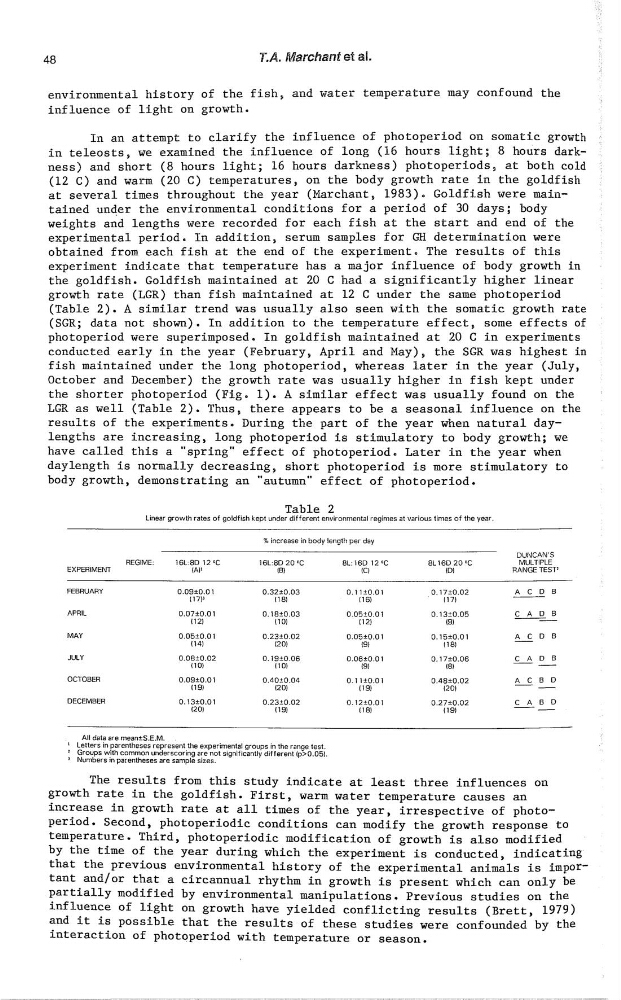
experiment indicate that temperature has a major influence of body growth in
the goldfish. Goldfish maintained at 20 C had a significantly higher linear
growth rate (LCR) than fish maintained at 12 C under the same photoperiod
(Table 2). A similar trend was usually also seen with the somatic growth rate
(SCR; data not shown). In addition to the temperature effect, some effects of
ï
photoperiod were superimposed. In goldfish maintained at 20 C in experiments
conducted early in the year (February, April and May), the SGR was highest in
fish maintained under the long photoperiod, whereas later in the year (July,
October and December) the growth rate was usually higher in fish kept under
-
the shorter photoperiod (Fig. 1). A similar effect was usually found on the
ÿ
LGR as well (Table 2). Thus, there appears to be a seasonal influence on the
results of the experiments. During the part of the year when natural day—
lengths are increasing, long photoperiod is stimulatory to body growth; we
have called this a "spring" effect of photoperiod° Later in the year when
daylength is normally decreasing, short photoperiod is more stimulatory to
body growth, demonstrating an "autumn" effect of photoperiod.
Table 2
Linear growth rates of goldfish kept under different environmental regimes at various times of the year.
.
% increase in body length per day
___—_”.—
DUNCAN'S
REGIME:
16L:8D 12 °C
16L:8D 20 °C
8L:16D 12 °C
8L16D 20 °C
MULTIPLE
EXPERIMENT
(All
(8)
(C)
(D)
RANGE TEST”
FEBRUARY
0.091001
0.321003
0.111001
0171002
A
C
D
8
11711
(18)
(18)
'
1171
”_“—
APRIL
0.071001
0.181003
0.051001
0.131005
C
A
D
8
nm
(m1
un
(m
‘
MAY
0.051001
0.231002
0.051001
0151001
A
C
D
B
1141
1201
191
(18)
_
JULY
0.081002
0.191006
0.061001
0.171006
C
A
D
B
1101
1101
191
(8)
_
——
OCTOBER
0.091001
0.401004
0.111001
0481002
A
C
B
D
1191
1201
1191
(20)
_”
——
DECEMBER
0.131001
0.231002
0.121001
0.271002
C
A
B
D
1201
1191
(18)
(19)
_—
All data are mean18.E.M.
‘
Letters in parentheses represent the experimental groups in the range test.
‘ .
’
Groups with common underscoring are not significantly different (p>0.05).
’
Numbers 1n parentheses are sample sizes.
The results from this study indicate at least three influences on
growth rate in the goldfish. First, warm water temperature causes an
increase in growth rate at all times of the year, irrespective of photo—
period. Second, photoperiodic conditions can modify the growth response to
temperature. Third, photoperiodic modification of growth is also modified
by the time of the year during which the experiment is conducted, indicating
that the previous environmental history of the experimental animals is important
and/or that a circannual rhythm in growth is present which can only be
partially
modified by environmental manipulations. Previous studies on the
influence of light on growth have yielded conflicting results (Brett, 1979)
and
it is possible that the results of these studies were confounded by the
interaction of photoperiod with temperature or season.
T.Æ. Merchant et al.
environmental history of the fish, and water temperature may confound the
.
influence of light on growth.
,
In an attempt to clarify the influence of photoperiod on somatic growth
j
in teleosts, we examined the influence of long (16 hours light; 8 hours dark—
:
mess) and short (8 hours light; 16 hours darkness) photoperiods, at both cold
:
(12 C) and warm (20 C) temperatures, on the body growth rate in the goldfish
“
at
several times throughout the year (Merchant, 1983)° Goldfish were main—
l
tained under the environmental conditions for a period of 30 days; body
weights and lengths were recorded for each fish at the start and end of the
experimental period. In addition, serum samples for GH determination were
obtained from each fish at the end of the experiment. The results of this
experiment indicate that temperature has a major influence of body growth in
the goldfish. Goldfish maintained at 20 C had a significantly higher linear
growth rate (LCR) than fish maintained at 12 C under the same photoperiod
(Table 2). A similar trend was usually also seen with the somatic growth rate
(SCR; data not shown). In addition to the temperature effect, some effects of
ï
photoperiod were superimposed. In goldfish maintained at 20 C in experiments
conducted early in the year (February, April and May), the SGR was highest in
fish maintained under the long photoperiod, whereas later in the year (July,
October and December) the growth rate was usually higher in fish kept under
-
the shorter photoperiod (Fig. 1). A similar effect was usually found on the
ÿ
LGR as well (Table 2). Thus, there appears to be a seasonal influence on the
results of the experiments. During the part of the year when natural day—
lengths are increasing, long photoperiod is stimulatory to body growth; we
have called this a "spring" effect of photoperiod° Later in the year when
daylength is normally decreasing, short photoperiod is more stimulatory to
body growth, demonstrating an "autumn" effect of photoperiod.
Table 2
Linear growth rates of goldfish kept under different environmental regimes at various times of the year.
.
% increase in body length per day
___—_”.—
DUNCAN'S
REGIME:
16L:8D 12 °C
16L:8D 20 °C
8L:16D 12 °C
8L16D 20 °C
MULTIPLE
EXPERIMENT
(All
(8)
(C)
(D)
RANGE TEST”
FEBRUARY
0.091001
0.321003
0.111001
0171002
A
C
D
8
11711
(18)
(18)
'
1171
”_“—
APRIL
0.071001
0.181003
0.051001
0.131005
C
A
D
8
nm
(m1
un
(m
‘
MAY
0.051001
0.231002
0.051001
0151001
A
C
D
B
1141
1201
191
(18)
_
JULY
0.081002
0.191006
0.061001
0.171006
C
A
D
B
1101
1101
191
(8)
_
——
OCTOBER
0.091001
0.401004
0.111001
0481002
A
C
B
D
1191
1201
1191
(20)
_”
——
DECEMBER
0.131001
0.231002
0.121001
0.271002
C
A
B
D
1201
1191
(18)
(19)
_—
All data are mean18.E.M.
‘
Letters in parentheses represent the experimental groups in the range test.
‘ .
’
Groups with common underscoring are not significantly different (p>0.05).
’
Numbers 1n parentheses are sample sizes.
The results from this study indicate at least three influences on
growth rate in the goldfish. First, warm water temperature causes an
increase in growth rate at all times of the year, irrespective of photo—
period. Second, photoperiodic conditions can modify the growth response to
temperature. Third, photoperiodic modification of growth is also modified
by the time of the year during which the experiment is conducted, indicating
that the previous environmental history of the experimental animals is important
and/or that a circannual rhythm in growth is present which can only be
partially
modified by environmental manipulations. Previous studies on the
influence of light on growth have yielded conflicting results (Brett, 1979)
and
it is possible that the results of these studies were confounded by the
interaction of photoperiod with temperature or season.