

History of Bohemian carp pond management
39
By the end of the 15th century, the methods of pond fish culture were
already advanced. Even that time, these were three types of pond : l) those
for carp
spawning and yearling rearing; 2) those for rearing two—year—old
stock fish; 3) those for rearing marketable fish. The carp breeding cycle
from spawning to marketing was 4 to 6 years. One hectare of pond accommodated
a
stock of
about 300 two—year—old carp.
The ponds already had a drainage
outlet.
The carps were marketed not only in proximity of the pond regions but
also
in present—day Austria, Bavaria and even at the papal court. The fish
were
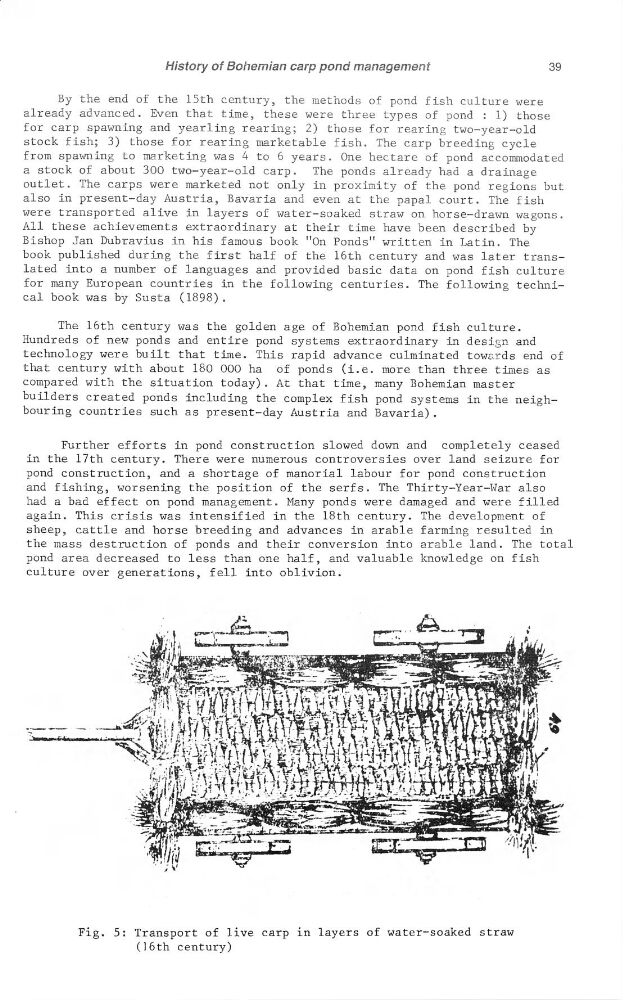
transported alive in layers of water—soaked straw on horse—drawn wagons.
All these achievements extraordinary at their time have been described by
Bishop Jan Dubravius in his famous book "On Fonds" written in Latin. The
book published during the first half of the 16th century and was later trans—
lated
into
a
number of languages and provided basic data on pond fish culture
for many European countries in the following centuries. The following techni—
cal book was by Susta (1898).
The
16th century was the golden age of Bohemian pond fish culture.
Hundreds of new ponds and entire pond systems extraordinary in design and
technology were built that tùne. This rapid advance culminated towards end of
that century with about 180 000 ha
of ponds (i.e. more than three times as
compared with the situation today). At that time, many Bohemian master
builders created ponds including the complex fish pond systems in the neigh—
bouring countries such as present—day Austria and Bavaria).
Further efforts
in pond construction slowed down and
completely ceased
in the l7th century. There were numerous controversies over land seizure for
pond construction, and a shortage of manorial labour for pond construction
and fishing, worsening the position of the serfs. The Thirty—Year—War also
had a bad effect on pond management. Many ponds were damaged and were filled
again. This crisis was intensified in the 18th century. The development of
sheep, cattle and horse breeding and advances in arable farming resulted in
the mass destruction of ponds and their conversion into arable land. The total
pond area decreased to less than one half, and valuable knowledge on fish
culture over generations, fell into oblivion.
-'
È… ‘
:
.
_
\
-
"
,
____-_….__,__…u
.
—
.
.
'
'
"
a
'
‘
-_
.
“
!
_
…
,
.E:: _
_
—
,
—
Fig. 5: Transport of live carp in layers of water—soaked straw
(16th century)
39
By the end of the 15th century, the methods of pond fish culture were
already advanced. Even that time, these were three types of pond : l) those
for carp
spawning and yearling rearing; 2) those for rearing two—year—old
stock fish; 3) those for rearing marketable fish. The carp breeding cycle
from spawning to marketing was 4 to 6 years. One hectare of pond accommodated
a
stock of
about 300 two—year—old carp.
The ponds already had a drainage
outlet.
The carps were marketed not only in proximity of the pond regions but
also
in present—day Austria, Bavaria and even at the papal court. The fish
were
transported alive in layers of water—soaked straw on horse—drawn wagons.
All these achievements extraordinary at their time have been described by
Bishop Jan Dubravius in his famous book "On Fonds" written in Latin. The
book published during the first half of the 16th century and was later trans—
lated
into
a
number of languages and provided basic data on pond fish culture
for many European countries in the following centuries. The following techni—
cal book was by Susta (1898).
The
16th century was the golden age of Bohemian pond fish culture.
Hundreds of new ponds and entire pond systems extraordinary in design and
technology were built that tùne. This rapid advance culminated towards end of
that century with about 180 000 ha
of ponds (i.e. more than three times as
compared with the situation today). At that time, many Bohemian master
builders created ponds including the complex fish pond systems in the neigh—
bouring countries such as present—day Austria and Bavaria).
Further efforts
in pond construction slowed down and
completely ceased
in the l7th century. There were numerous controversies over land seizure for
pond construction, and a shortage of manorial labour for pond construction
and fishing, worsening the position of the serfs. The Thirty—Year—War also
had a bad effect on pond management. Many ponds were damaged and were filled
again. This crisis was intensified in the 18th century. The development of
sheep, cattle and horse breeding and advances in arable farming resulted in
the mass destruction of ponds and their conversion into arable land. The total
pond area decreased to less than one half, and valuable knowledge on fish
culture over generations, fell into oblivion.
-'
È… ‘
:
.
_
\
-
"
,
____-_….__,__…u
.
—
.
.
'
'
"
a
'
‘
-_
.
“
!
_
…
,
.E:: _
_
—
,
—
Fig. 5: Transport of live carp in layers of water—soaked straw
(16th century)