

364
M.
LUkÔWICZ et ai.
6.3
Smaii, shaiiow ponds with a muddy bottom partiy covered with
vegetation are most suited to rearing advanced fry to i—year
;
It is not advisabie to stock tench of this age with common carp, but fairy
good resu1ts have been obtained with 1arger tench, siiver carp, bighead«
and grass carp in poiycuiture. Stocking density is 40 000 to 60 000 advanced
fry per ha and, depending on pond conditions, about the same numbers
'
each of the other three species.
.
-
There are two prerequistes for rearing advanced fry up to 1—summer tench:T
the pond water shouid be rich in piankton, and common carp and carnivorous
fish species shou1d not be introduced. If these conditions are met,
;
develop weii and attain a weight of 2 to 3 9 by autumn and their survivai
rate is
'
,
6.4
of fry to 1—summer fish
iv
The_ideai facilities for this purpose are shaiiow ponds of 0.5 to 1.0
with a good water suppiy where tench fry are grown up to the end of the'=f
‘—
season
in monocuiture without harvesting in—between. This method is
_
“
ï
especiaiiy advantageous for rearing fry hatched at the end of the breeding
period.
;
Stocked
Harvested ‘»Survivai
=Length of
‘time‘_ f‘
fish
_
‘
'
106
days
103
%
cm
45
95
240
145
510
‘
…‘
-'90. ,;
*
v
‘,
6 — 78
‘
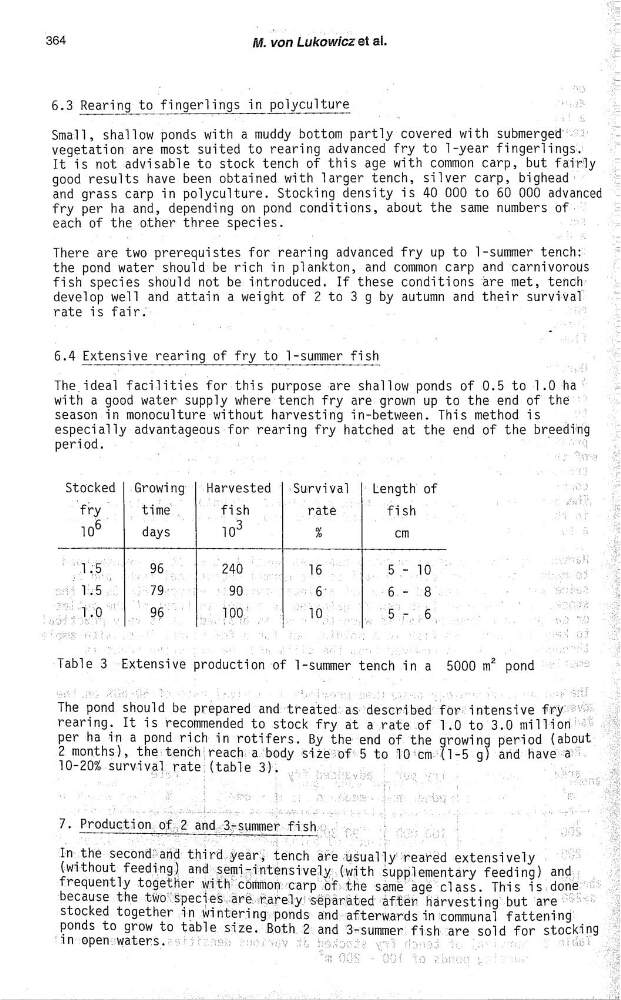
3 -Extehsive production of 1—summer tench in a 5000 m2 pond
Ÿ
The pond should
be prepared and treated as described f0r intensive
rear1ng:
It is recommended
to stock fry at a rate of 1.0 to 3.0
per ha in a pond rich in rotifers. By the end of the growing period
2 months), the tench reach a body size of 5 to 10 Cm (1—5 9)
10-20% survival rate (tabie 3):
?
,
In the
and
Supplement&ry feeding)
…‘°‘“equenW
dass. T…s
.:::
because the
after harvesting but
stocked together in Winter1ng ponds and afterwardsinccommunai
ponds
to grow t0 tahie Size. Both 2 and
are
soid for stockng
Ï
“
M.
LUkÔWICZ et ai.
6.3
Smaii, shaiiow ponds with a muddy bottom partiy covered with
vegetation are most suited to rearing advanced fry to i—year
;
It is not advisabie to stock tench of this age with common carp, but fairy
good resu1ts have been obtained with 1arger tench, siiver carp, bighead«
and grass carp in poiycuiture. Stocking density is 40 000 to 60 000 advanced
fry per ha and, depending on pond conditions, about the same numbers
'
each of the other three species.
.
-
There are two prerequistes for rearing advanced fry up to 1—summer tench:T
the pond water shouid be rich in piankton, and common carp and carnivorous
fish species shou1d not be introduced. If these conditions are met,
;
develop weii and attain a weight of 2 to 3 9 by autumn and their survivai
rate is
'
,
6.4
of fry to 1—summer fish
iv
The_ideai facilities for this purpose are shaiiow ponds of 0.5 to 1.0
with a good water suppiy where tench fry are grown up to the end of the'=f
‘—
season
in monocuiture without harvesting in—between. This method is
_
“
ï
especiaiiy advantageous for rearing fry hatched at the end of the breeding
period.
;
Stocked
Harvested ‘»Survivai
=Length of
‘time‘_ f‘
fish
_
‘
'
106
days
103
%
cm
45
95
240
145
510
‘
…‘
-'90. ,;
*
v
‘,
6 — 78
‘
3 -Extehsive production of 1—summer tench in a 5000 m2 pond
Ÿ
The pond should
be prepared and treated as described f0r intensive
rear1ng:
It is recommended
to stock fry at a rate of 1.0 to 3.0
per ha in a pond rich in rotifers. By the end of the growing period
2 months), the tench reach a body size of 5 to 10 Cm (1—5 9)
10-20% survival rate (tabie 3):
?
,
In the
and
Supplement&ry feeding)
…‘°‘“equenW
dass. T…s
.:::
because the
after harvesting but
stocked together in Winter1ng ponds and afterwardsinccommunai
ponds
to grow t0 tahie Size. Both 2 and
are
soid for stockng
Ï
“