

Aquaculture of tench
359
feeders).
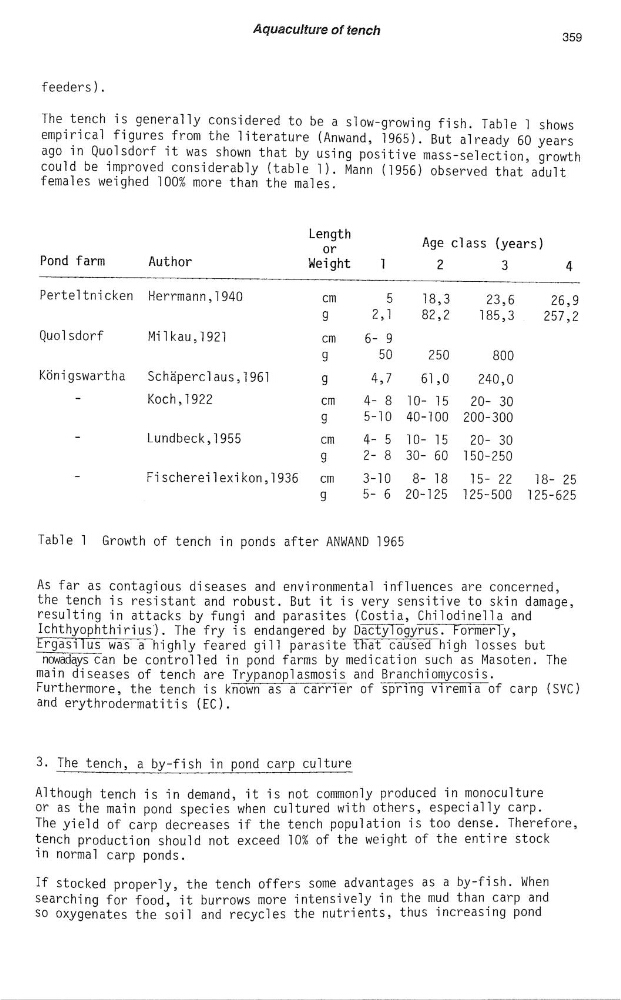
The tench is genera11y considered to be a s1ow—growing fish. Tab1e 1 shows
empirica1 figures from the 1iterature (Anwand, 1965). But a1ready 60 years
ago in Quo1sdorf it was shown that by using positive mass—se1ection, growth
cou1d be improved considerab1y (tab1e 1). Mann (1956) observed that adu1t
fema1es weighed 100% more than the ma1es.
Leggth
Age c1ass (years)
Pond farm
Author
Weight
1
2
3
4
Perte1tnicken
Herrmann,1940
cm
5
18,3
23,6
26,9
9
2,1
82,2
185,3
257,2
Quo1sdorf
Mi1kau,1921
cm
6— 9
g
50
250
800
Kônigswartha
Schäperc1aus,1961
9
4,7
61,0
240,0
—
Koch,1922
cm
4— 8
10— 15
20— 30
9
5—10
40—100
200—300
—
Lundbeck,1955
cm
4— 5
10— 15
20— 30
g
2— 8
30— 60
150—250
—
Fischerei1exikon,1936
cm
3—10
8— 18
15— 22
18— 25
g
5— 6
20—125
125—500
125-625
Tab1e 1
Growth of tench in ponds after ANNAND 1965
As far as contagious diseases and environmenta1 inf1uences are concerned,
the tench is resistant and robust. But it is very senSitive
to skin damage,
resu1ting in attacks by fungi and parasites (Costia, 0hi10dine11a and
Ichthyophthirius). The fry is endangered by Dactylogyrus. Formerly,
Ergasilus was a high1y feared gi11 parasite that caused high 1osses but
nœædæœ can be contro11ed in pond farms by medication such as Masoten. The
main diseases of tench are Trypanop1asmosis and Branchiomyc05is.
Furthermore, the tench is known as a carrier of spring Viremia of carp (SVC)
and erythrodermatitis (EC).
3. The tench, a by—fish in pond carp cu1ture
A1though tench is in demand, it is not common1y produced in monocu1ture
or
as
the main pond species when cu1tured with others, espe01a11y carp.
The yie1d of carp decreases if the tench popu1ation is too dense. Therefore,
tench production shou1d not exceed 10% of the weight of the entire stock
in norma1 carp ponds.
If stocked proper1y, the tench offers some advantages
as
a
by—fish. When
searching for food, it burrows more intensive1y in the mud
than carp and
so
oxygenates the soi1 and recyc1es the nutrients, thus increa5ing pond
359
feeders).
The tench is genera11y considered to be a s1ow—growing fish. Tab1e 1 shows
empirica1 figures from the 1iterature (Anwand, 1965). But a1ready 60 years
ago in Quo1sdorf it was shown that by using positive mass—se1ection, growth
cou1d be improved considerab1y (tab1e 1). Mann (1956) observed that adu1t
fema1es weighed 100% more than the ma1es.
Leggth
Age c1ass (years)
Pond farm
Author
Weight
1
2
3
4
Perte1tnicken
Herrmann,1940
cm
5
18,3
23,6
26,9
9
2,1
82,2
185,3
257,2
Quo1sdorf
Mi1kau,1921
cm
6— 9
g
50
250
800
Kônigswartha
Schäperc1aus,1961
9
4,7
61,0
240,0
—
Koch,1922
cm
4— 8
10— 15
20— 30
9
5—10
40—100
200—300
—
Lundbeck,1955
cm
4— 5
10— 15
20— 30
g
2— 8
30— 60
150—250
—
Fischerei1exikon,1936
cm
3—10
8— 18
15— 22
18— 25
g
5— 6
20—125
125—500
125-625
Tab1e 1
Growth of tench in ponds after ANNAND 1965
As far as contagious diseases and environmenta1 inf1uences are concerned,
the tench is resistant and robust. But it is very senSitive
to skin damage,
resu1ting in attacks by fungi and parasites (Costia, 0hi10dine11a and
Ichthyophthirius). The fry is endangered by Dactylogyrus. Formerly,
Ergasilus was a high1y feared gi11 parasite that caused high 1osses but
nœædæœ can be contro11ed in pond farms by medication such as Masoten. The
main diseases of tench are Trypanop1asmosis and Branchiomyc05is.
Furthermore, the tench is known as a carrier of spring Viremia of carp (SVC)
and erythrodermatitis (EC).
3. The tench, a by—fish in pond carp cu1ture
A1though tench is in demand, it is not common1y produced in monocu1ture
or
as
the main pond species when cu1tured with others, espe01a11y carp.
The yie1d of carp decreases if the tench popu1ation is too dense. Therefore,
tench production shou1d not exceed 10% of the weight of the entire stock
in norma1 carp ponds.
If stocked proper1y, the tench offers some advantages
as
a
by—fish. When
searching for food, it burrows more intensive1y in the mud
than carp and
so
oxygenates the soi1 and recyc1es the nutrients, thus increa5ing pond