

338
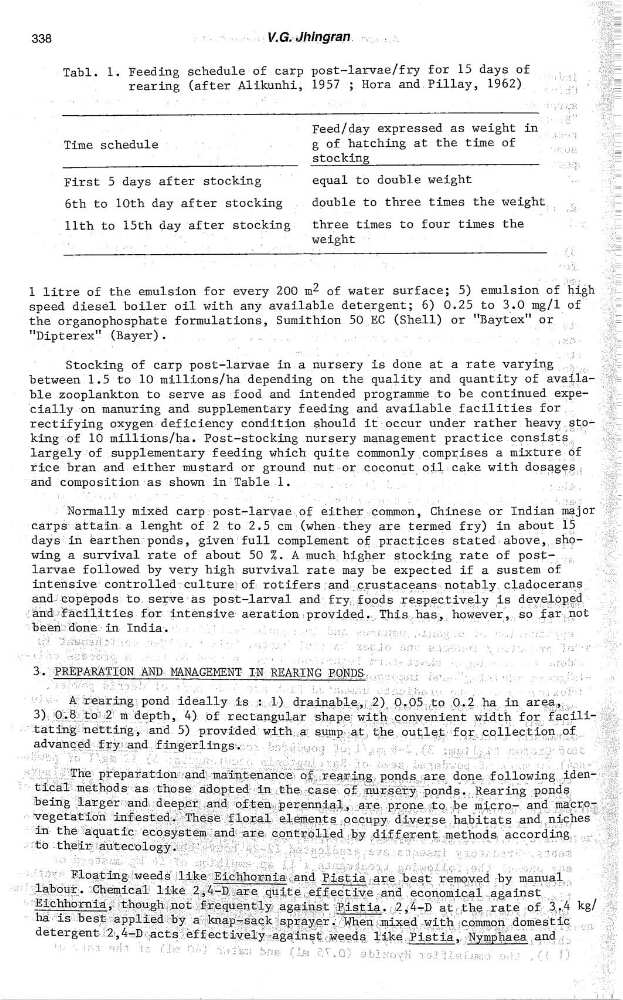
Tabl.
1. Feeding schedule of carp post—larvae/fry for 15 days of
rearing (after Alikunhi, 1957 ; Hora and Pillay,
____________'
‘
.
"}j È‘ ÉÏÏ
Feed/day expressed as weight in
Time schedule
.
g of hatching at the time of
:
stocking
First 5 days after stocking
'
equal to double weight
6th to 10th day after stocking
double to three times the weight
ÊÎ
llth to 15th day after stocking
three times to four times the
,
jf
_
_
‘
_
weight
1 litre of the emu1sion for every 200 m2 of water surface; 5) emulsion of high
speed diesel boiler oil with any available detergent; 6) 0.25 to
mg/1
the organophosphaté formulations, Sumithion 50 EC (Shell) or "Baytex" or
"Dipterèx" (Bayer).
_
_
-
'
Stocking of carp post—larvae in_a nursery is done at a rate
between 1.5 to 10 millions/ha depending on the quality and quantity of
ble zooplankton to serve as food and intended programme to be continued exPe—
on
manuring and supplementary feeding and available
rectifying oxygen deficiency condition should it occur under rather heavy
of 10 millions/ha. Post—stocking nursery management practice
largely of supplementary feeding which quite common1y comprises a mixture of
rice bran and either mustard or ground nut or coconut oil cake with
and composition as shown in Table 1.
u
mixed carp post—larvae of either common, Chinese or Indian
carps attain a lenght
to
2.5 cm (when they are termed fry) in about 15
in earthen ponds, given full complement of practices
Wing a survival rate of about 50 %. A much higher stocking_rate of
larvae
followed by very high survival rate may be expected if a sustem of
intensive
controlled cultureïof rotifersçand crustaceans notably.cladocerana_
and copepods
to serve as
and fry foods respectively is develgpedw
f0r
,”
:
…
°
Arearmg pond ideal—137
is 1) dramable2>005to 02111 in area
_3)ti
“1
-°f re°t‘angülar Shape? WiËhf 599111111111 Width
fÏ1&ilif
and 5) Pr0Vided
'
“11 1111111 111011
'
adoptedm 1he case 1 nurserypnds Rear i‘n‘g' pnds
11111 11111 11 nd ftnpnnl pnt b;e m ndm
1111111111hf11 1mt upy dv hbtt ana nh
li“
…
,“:to the1rautecology.
‘
" ‘
”1 Cheml 1111 2111 qtfftvnd nm1gnt 1
ËËm—°Œîtmughmtfreq“e“tläï against Plstla 2443 at the rate of 34 kg/
€“ 111111 11___1 thd
»w«
a…
139
Îîm
1î
………
Tabl.
1. Feeding schedule of carp post—larvae/fry for 15 days of
rearing (after Alikunhi, 1957 ; Hora and Pillay,
____________'
‘
.
"}j È‘ ÉÏÏ
Feed/day expressed as weight in
Time schedule
.
g of hatching at the time of
:
stocking
First 5 days after stocking
'
equal to double weight
6th to 10th day after stocking
double to three times the weight
ÊÎ
llth to 15th day after stocking
three times to four times the
,
jf
_
_
‘
_
weight
1 litre of the emu1sion for every 200 m2 of water surface; 5) emulsion of high
speed diesel boiler oil with any available detergent; 6) 0.25 to
mg/1
the organophosphaté formulations, Sumithion 50 EC (Shell) or "Baytex" or
"Dipterèx" (Bayer).
_
_
-
'
Stocking of carp post—larvae in_a nursery is done at a rate
between 1.5 to 10 millions/ha depending on the quality and quantity of
ble zooplankton to serve as food and intended programme to be continued exPe—
on
manuring and supplementary feeding and available
rectifying oxygen deficiency condition should it occur under rather heavy
of 10 millions/ha. Post—stocking nursery management practice
largely of supplementary feeding which quite common1y comprises a mixture of
rice bran and either mustard or ground nut or coconut oil cake with
and composition as shown in Table 1.
u
mixed carp post—larvae of either common, Chinese or Indian
carps attain a lenght
to
2.5 cm (when they are termed fry) in about 15
in earthen ponds, given full complement of practices
Wing a survival rate of about 50 %. A much higher stocking_rate of
larvae
followed by very high survival rate may be expected if a sustem of
intensive
controlled cultureïof rotifersçand crustaceans notably.cladocerana_
and copepods
to serve as
and fry foods respectively is develgpedw
f0r
,”
:
…
°
Arearmg pond ideal—137
is 1) dramable2>005to 02111 in area
_3)ti
“1
-°f re°t‘angülar Shape? WiËhf 599111111111 Width
fÏ1&ilif
and 5) Pr0Vided
'
“11 1111111 111011
'
adoptedm 1he case 1 nurserypnds Rear i‘n‘g' pnds
11111 11111 11 nd ftnpnnl pnt b;e m ndm
1111111111hf11 1mt upy dv hbtt ana nh
li“
…
,“:to the1rautecology.
‘
" ‘
”1 Cheml 1111 2111 qtfftvnd nm1gnt 1
ËËm—°Œîtmughmtfreq“e“tläï against Plstla 2443 at the rate of 34 kg/
€“ 111111 11___1 thd
»w«
a…
139
Îîm
1î
………