

332
R. Suzuki
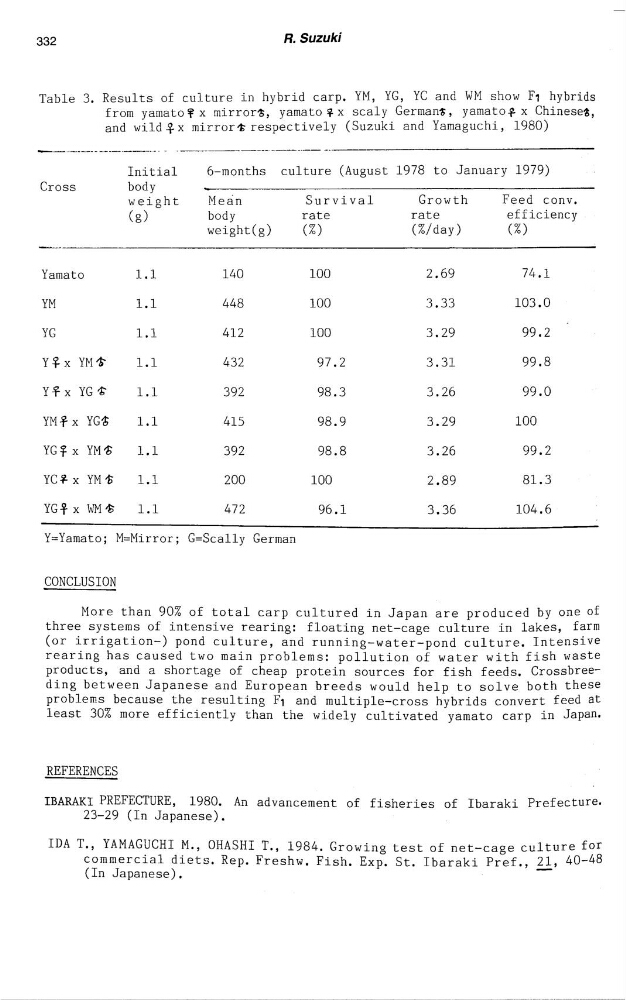
Table 3. Results of culture in hybrid carp. YM, YG, YC and WM show F1 hybrids
from yamato? x mirror'8, yamato $x scaly German3, yamato$ X Ghineseg,
and wild$x mirroræ; respectively (Suzuki and Yamaguchi, 1980)
Initial
6—months
culture (August 1978 to January 1979)
Gross
body
weight
Mean
Survival
Growth
Feed
conv.
(g)
body
rate
rate
efficiency
weight(g)
(%)
(Z/day)
(%)
Yamato
1.1
140
100
2.69
74.1
YM
1.1
448
100
3.33
103.0
YG
1.1
412
100
3.29
99.2
'
Yî—x YM’À‘
1.1
432
97.2
3.31
99.8
Y$x YG’Ë
1.1
392
98.3
3.26
99.0
YM-Ÿx YG'3
1.1
415
98.9
3.29
100
YG$X YM’S
1.1
392
98.8
3.26
99.2
YC3-x YM'B
1.1
200
100
2.89
81.3
YGî-x WM’B
1.1
472
96.1
3.36
104.6
Y=Yamato; M=Mirror; G=Scally German
CONCLUSION
More than 9070 of total carp cultured in Japan are produced by one of
three systems of intensive rearing:
floating net—cage culture in lakes, farm
(or irrigation—) pond culture, and running—water—pond culture. Intensive
rearing has caused two main problems: pollution of water with fish waste
products, and a shortage of cheap protein sources for fish feeds. Crossbree—
ding between Japanese and European breeds would help to solve both these
problems because the resulting F1 and multiple—cross hybrids convert feed at
least 3072 more efficiently than the widely cultivated yamato carp in Japan.
REFERENCES
IBARAKI PREFECTURE,
1980.
An advancement of fisheries of
Ibaraki Prefectur623—29 (In Japanese).
ÏDA T-, YAMAGUCHÏ M-, OHASHI T., 1984. Growing test of net—cage culture for
commercial diets. Rep. Freshw. Fish. Exp. St. Ibaraki Pref., 21, 40—48
(In Japanese).
_
R. Suzuki
Table 3. Results of culture in hybrid carp. YM, YG, YC and WM show F1 hybrids
from yamato? x mirror'8, yamato $x scaly German3, yamato$ X Ghineseg,
and wild$x mirroræ; respectively (Suzuki and Yamaguchi, 1980)
Initial
6—months
culture (August 1978 to January 1979)
Gross
body
weight
Mean
Survival
Growth
Feed
conv.
(g)
body
rate
rate
efficiency
weight(g)
(%)
(Z/day)
(%)
Yamato
1.1
140
100
2.69
74.1
YM
1.1
448
100
3.33
103.0
YG
1.1
412
100
3.29
99.2
'
Yî—x YM’À‘
1.1
432
97.2
3.31
99.8
Y$x YG’Ë
1.1
392
98.3
3.26
99.0
YM-Ÿx YG'3
1.1
415
98.9
3.29
100
YG$X YM’S
1.1
392
98.8
3.26
99.2
YC3-x YM'B
1.1
200
100
2.89
81.3
YGî-x WM’B
1.1
472
96.1
3.36
104.6
Y=Yamato; M=Mirror; G=Scally German
CONCLUSION
More than 9070 of total carp cultured in Japan are produced by one of
three systems of intensive rearing:
floating net—cage culture in lakes, farm
(or irrigation—) pond culture, and running—water—pond culture. Intensive
rearing has caused two main problems: pollution of water with fish waste
products, and a shortage of cheap protein sources for fish feeds. Crossbree—
ding between Japanese and European breeds would help to solve both these
problems because the resulting F1 and multiple—cross hybrids convert feed at
least 3072 more efficiently than the widely cultivated yamato carp in Japan.
REFERENCES
IBARAKI PREFECTURE,
1980.
An advancement of fisheries of
Ibaraki Prefectur623—29 (In Japanese).
ÏDA T-, YAMAGUCHÏ M-, OHASHI T., 1984. Growing test of net—cage culture for
commercial diets. Rep. Freshw. Fish. Exp. St. Ibaraki Pref., 21, 40—48
(In Japanese).
_