

Water quaiity
291
!O:‘
}
MEASUHED
@
î
.
î:
VÂL.UES
î
@\
@?
%
E
\°\
V
\
@\\
Ë
;
\
MEASURED
@
\\
VALUE
g
X
=
\
o
\
?
\\
\
\
>
E
\
\_
$
%
VALUE
@
à
;
»
«
,
,
«
'
-,
.
2000
2400
400
HOURS
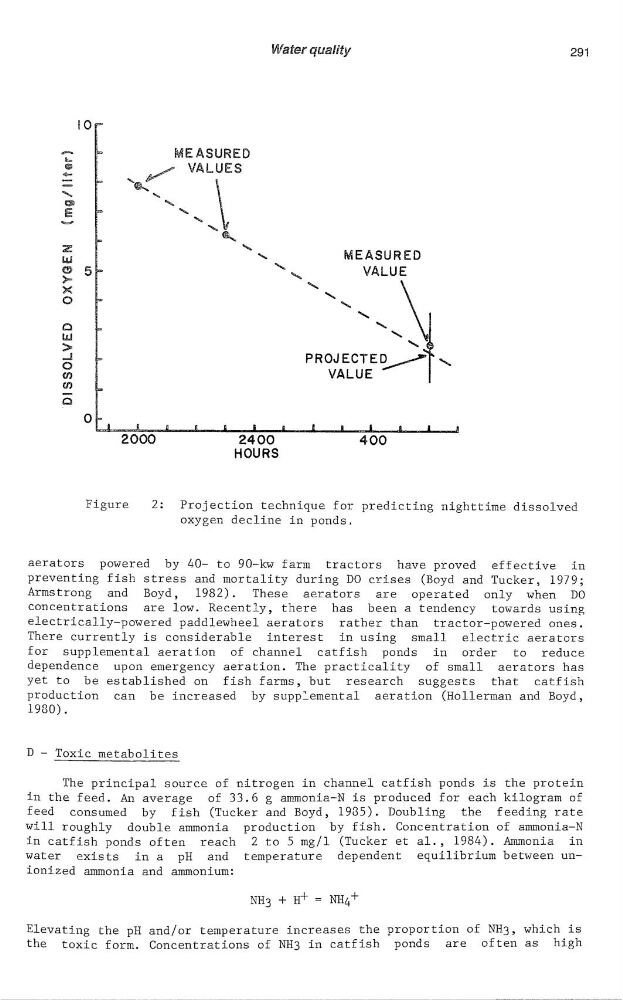
Figure
2:
Projection technique for predicting nighttime dissolved
oxygen decline in ponds.
aerators
powered
by 40— to 90—kw farm
tractors
have proved
effective
in
preventing fish stress and mortality during DO crises (Boyd and Tucker, 1979;
Armstrong
and
Boyd,
1982).
These
aerators
are
operated
only
when
DO
concentrations
are
low.
Recently, there
has
been a tendency
towards using
electrically—powered paddlewheel aerators
rather than
tractor—powered ones.
There currently is considerable
interest
in using
small
electric aerators
for
supplemental aeration
of
channel
catfish
ponds
in
order
to
reduce
dependence
upon emergency aeration.
The practicality
of small
aerators
has
yet to
be established on
fish farms, but
research
suggests
that
catfiSh
production
can
be increased
by supplemental
aeration
(Hollerman and Boyd,
1980).
D — Toxic metabolites
The principal source of nitrogen in channel catfish ponds is the protein
in the feed.
An average
of 33.6 g ammonia—N is produced for each kilogram of
feed
consumed
by
fish
(Tucker and Boyd, 1985). Doubling
the
feeding rate
will roughly
double ammonia
production
by fish. Concentration of ammonia—N
in catfish ponds often
reach
2 to 5 mg/l (Tucker et al., 1984). Ammonia
in
water
exists
in a
pH
and
temperature
dependent
equilibrium between un—
ionized ammonia and ammonium:
NH3 + H+ = NH4+
Elevating the pH and/or temperature increases the proportion of NH3, which is
the
toxic form.
Concentrations
of NH3 in catfish
ponds
are
often as
high
291
!O:‘
}
MEASUHED
@
î
.
î:
VÂL.UES
î
@\
@?
%
E
\°\
V
\
@\\
Ë
;
\
MEASURED
@
\\
VALUE
g
X
=
\
o
\
?
\\
\
\
>
E
\
\_
$
%
VALUE
@
à
;
»
«
,
,
«
'
-,
.
2000
2400
400
HOURS
Figure
2:
Projection technique for predicting nighttime dissolved
oxygen decline in ponds.
aerators
powered
by 40— to 90—kw farm
tractors
have proved
effective
in
preventing fish stress and mortality during DO crises (Boyd and Tucker, 1979;
Armstrong
and
Boyd,
1982).
These
aerators
are
operated
only
when
DO
concentrations
are
low.
Recently, there
has
been a tendency
towards using
electrically—powered paddlewheel aerators
rather than
tractor—powered ones.
There currently is considerable
interest
in using
small
electric aerators
for
supplemental aeration
of
channel
catfish
ponds
in
order
to
reduce
dependence
upon emergency aeration.
The practicality
of small
aerators
has
yet to
be established on
fish farms, but
research
suggests
that
catfiSh
production
can
be increased
by supplemental
aeration
(Hollerman and Boyd,
1980).
D — Toxic metabolites
The principal source of nitrogen in channel catfish ponds is the protein
in the feed.
An average
of 33.6 g ammonia—N is produced for each kilogram of
feed
consumed
by
fish
(Tucker and Boyd, 1985). Doubling
the
feeding rate
will roughly
double ammonia
production
by fish. Concentration of ammonia—N
in catfish ponds often
reach
2 to 5 mg/l (Tucker et al., 1984). Ammonia
in
water
exists
in a
pH
and
temperature
dependent
equilibrium between un—
ionized ammonia and ammonium:
NH3 + H+ = NH4+
Elevating the pH and/or temperature increases the proportion of NH3, which is
the
toxic form.
Concentrations
of NH3 in catfish
ponds
are
often as
high