

‘
Pond ecosystem
_
“
…
251
(Aurea)/ha,
the
feed
conversion ratio (FCR) was
dependent
upon
the concentration of zooplankton larger
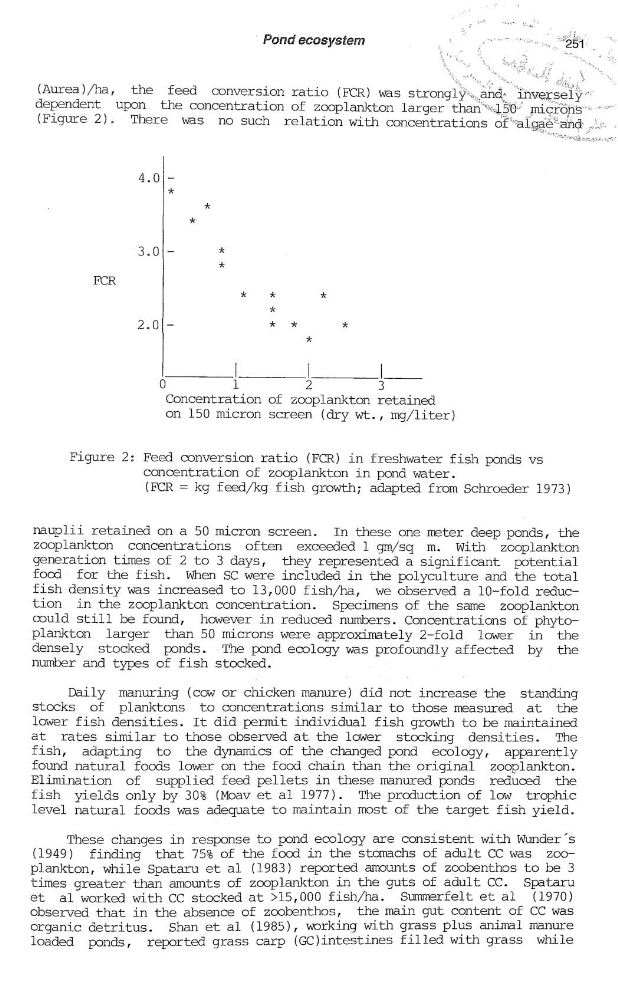
(Figure 2).
There
was
no
such
relation with concentrations
4.0 —
*
,
*
*
3.0 —
*
*
FCR
*
*
*
*
2.0 —
*
*
*
*
l
l
I
0
1
2
3
Concentration of zoop1ankton retained
on
150 micron screen (dry wt., mg/liter)
Figure 2: Feed conversion ratio (PCR) in freshwater fish ponds vs
concentration of zooplankton in pond water.
(FCR = kg feed/kg fish growth; adapted from Schroeder 1973)
naup1ii retained on a 50 micron screen.
In these one neter deep ponds, the
zooplankton
concentrations
often
exceeded 1 gm/sq
Hh
With
zooplankton
generation times of 2 to 3 days,
they represented a significant
potential
food
for the fish.
When SC were included in the polyculture and the total
fish density was increased to 13,000 fish/ha,
we
observed a lO—fold reduc—
tion
in the zooplankton concentration.
Specimens of the same
zooplankton
could still be found,
however in reduced numbers. Concentrations of phyto—
plankton
larger
than 50 microns were approximately 2—fold
lower
in
the
densely
stocked
ponds.
The pond ecology was profoundly affected
by
the
number and types of fish stocked.
Daily
manuring (cow or chicken manure) did not increase the
standing
stocks
of
planktons
to concentrations similar to those neasured
at
the
lower fish densities. It did permit individual fish growth to be maintained
at
rates similar to those observed at the lower
stocking
densities.
The
fish,
adapting
to
the dynamics of the changed pond
ecology,
apparent1y
found natural foods lower on the food chain than the original
zooplankton.
Elimination
of
supplied feed pellets in these manured ponds
reduced
the
fish
yields only by 30% (Moav et al 1977).
The production of low
trophic
level natural foods was adequate to maintain most of the target fish yield.
These changes in response to pond ecology are consistent with WUnder's
(1949)
finding
that 75% of the food in the stomachs of adult CC was
zoo—
p1ankton, while Spataru et al (1983) reported amounts of zoobenthos to be 3
times greater than amounts of zooplankton in the guts of adult CC.
Spataru
et
al worked with.CC stocked at >15,000 fish/ha.
Summerfelt et al
(1970)
observed that in the absence of zoobenthos,
the main gut content of CC was
organic detritus.
Shan et al
(1985), working with grass plus
animal manure
loaded
ponds,
reported grass carp (GC)intestines filled With grass
while
Pond ecosystem
_
“
…
251
(Aurea)/ha,
the
feed
conversion ratio (FCR) was
dependent
upon
the concentration of zooplankton larger
(Figure 2).
There
was
no
such
relation with concentrations
4.0 —
*
,
*
*
3.0 —
*
*
FCR
*
*
*
*
2.0 —
*
*
*
*
l
l
I
0
1
2
3
Concentration of zoop1ankton retained
on
150 micron screen (dry wt., mg/liter)
Figure 2: Feed conversion ratio (PCR) in freshwater fish ponds vs
concentration of zooplankton in pond water.
(FCR = kg feed/kg fish growth; adapted from Schroeder 1973)
naup1ii retained on a 50 micron screen.
In these one neter deep ponds, the
zooplankton
concentrations
often
exceeded 1 gm/sq
Hh
With
zooplankton
generation times of 2 to 3 days,
they represented a significant
potential
food
for the fish.
When SC were included in the polyculture and the total
fish density was increased to 13,000 fish/ha,
we
observed a lO—fold reduc—
tion
in the zooplankton concentration.
Specimens of the same
zooplankton
could still be found,
however in reduced numbers. Concentrations of phyto—
plankton
larger
than 50 microns were approximately 2—fold
lower
in
the
densely
stocked
ponds.
The pond ecology was profoundly affected
by
the
number and types of fish stocked.
Daily
manuring (cow or chicken manure) did not increase the
standing
stocks
of
planktons
to concentrations similar to those neasured
at
the
lower fish densities. It did permit individual fish growth to be maintained
at
rates similar to those observed at the lower
stocking
densities.
The
fish,
adapting
to
the dynamics of the changed pond
ecology,
apparent1y
found natural foods lower on the food chain than the original
zooplankton.
Elimination
of
supplied feed pellets in these manured ponds
reduced
the
fish
yields only by 30% (Moav et al 1977).
The production of low
trophic
level natural foods was adequate to maintain most of the target fish yield.
These changes in response to pond ecology are consistent with WUnder's
(1949)
finding
that 75% of the food in the stomachs of adult CC was
zoo—
p1ankton, while Spataru et al (1983) reported amounts of zoobenthos to be 3
times greater than amounts of zooplankton in the guts of adult CC.
Spataru
et
al worked with.CC stocked at >15,000 fish/ha.
Summerfelt et al
(1970)
observed that in the absence of zoobenthos,
the main gut content of CC was
organic detritus.
Shan et al
(1985), working with grass plus
animal manure
loaded
ponds,
reported grass carp (GC)intestines filled With grass
while