

248
G. Schroeder, E. Semer—Sæmsonov
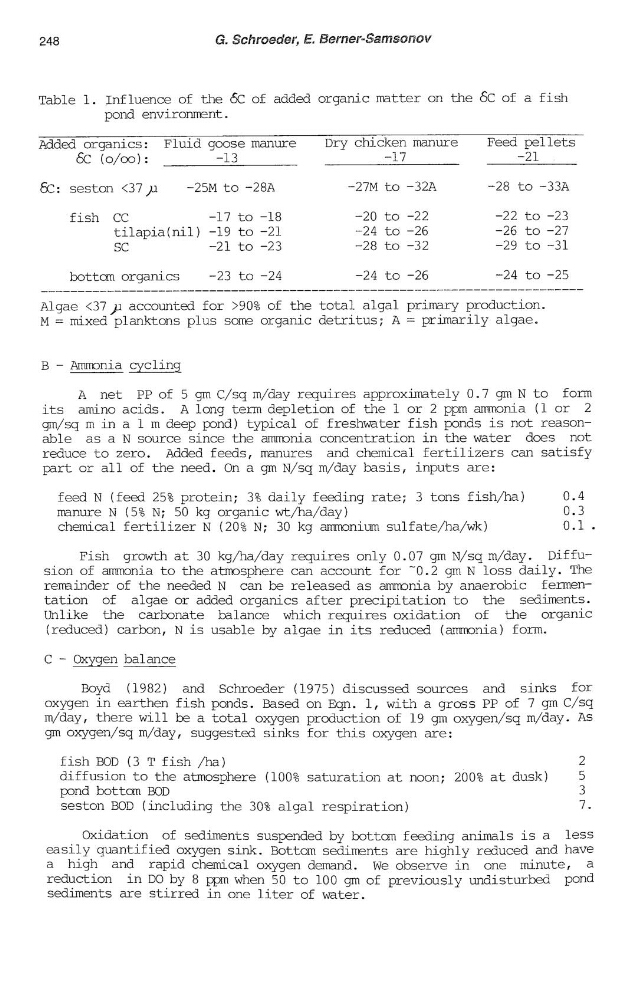
Table 1.
Influence of the 6C of added organic natter on the ôC of a fish
pond environnent.
Added organics:
Fluid goose manure
Dry chicken manure
Feed pellets
SC (0/00):
—13
—17
—21
SC: seston
—25M to
—27M to —32A
—28 to —33A
fish
CC
—17 to —18
—20 to —22
—22 to —23
tilapia(nil) —19 to —21
—24 to —26
—26 to —27
SC
—21 to —23
—28 to —32
—29 to —31
bottom organics
—23 to —24
—24 to —26
—24 to —25
Algae
accounted for >90% of the total algal primary production.
M = nüxed planktons plus some organic detritus; A = primarily algae.
B — Amnonia gycling
A
net
PP of 5 gU1C/sq m/day requires approximately 0.7 gm N to
form
its
amino acids.
A long term depletion of the 1 or 2 ppm ammonia (l or
2
gm/sq m in a 1 m deep pond) typical of freshwater fish ponds is not reason—
able
as
a
N source since the amnonia concentration in the water
does
not
reduce to zero.
Added feeds, manures
and chemical fertilizers can satisfy
part or all of the need. On a gm N/sq m/day basis, inputs are:
feed N (feed 25% protein; 3% daily feeding rate; 3 tons fish/ha)
0.4
nanure
N
(5% N; 50 kg organic wt/ha/day)
0.3
chemical fertilizer N (20% N; 30 kg ammonium sulfate/ha/wk)
0.1 .
Fish
growth at 30 kg/ha/day requires only 0.07 gm N/sq m/day.
Diffu—
sion of ammonia to the atmosphere can account for "0.2 gm N loss daily. The
renainder of the needed N
can
be released as amnonia by anaerobic
fermen—
tation
of
algae or added organics after precipitation to
the
sodiments.
Unlike
the
carbonate
balance
which requires oxidation
of
the
organic
(reduced) carbon, N is usable by algae in its reduced (ammonia) form.
C — Oxygen balance
Boyd
(1982)
and
Schroeder (1975) discussed sources
and
sinks
for
oxygen in earthen fish ponds. Based on Eqn. 1, with a gross FP of 7 gm C/5q
m/day, there will be a total oxygen production of 19 gm oxygen/sq m/day. As
gm oxygen/sq m/day, suggested sinks for this oxygen are:
fish BOD (3 T fish /ha)
2
diffusion to the atmosphere (100% saturation at noon; 200% at dusk)
5
pond bottom BOD
3
seston BOD
(including the 30% algal respiration)
7Oxidation
of sediments suspended by bottom feeding animals is a
less
ea31ly quantified oxygen sink. Bottom sedinents are highly reduced and have
a
high and rapid chemical oxygen demand. We observe in one minute, a
reduction in DO by 8 ppm when 50 to 100 gm of previously undisturbed pond
sed1ments are stirred in one liter of water.
G. Schroeder, E. Semer—Sæmsonov
Table 1.
Influence of the 6C of added organic natter on the ôC of a fish
pond environnent.
Added organics:
Fluid goose manure
Dry chicken manure
Feed pellets
SC (0/00):
—13
—17
—21
SC: seston
—25M to
—27M to —32A
—28 to —33A
fish
CC
—17 to —18
—20 to —22
—22 to —23
tilapia(nil) —19 to —21
—24 to —26
—26 to —27
SC
—21 to —23
—28 to —32
—29 to —31
bottom organics
—23 to —24
—24 to —26
—24 to —25
Algae
accounted for >90% of the total algal primary production.
M = nüxed planktons plus some organic detritus; A = primarily algae.
B — Amnonia gycling
A
net
PP of 5 gU1C/sq m/day requires approximately 0.7 gm N to
form
its
amino acids.
A long term depletion of the 1 or 2 ppm ammonia (l or
2
gm/sq m in a 1 m deep pond) typical of freshwater fish ponds is not reason—
able
as
a
N source since the amnonia concentration in the water
does
not
reduce to zero.
Added feeds, manures
and chemical fertilizers can satisfy
part or all of the need. On a gm N/sq m/day basis, inputs are:
feed N (feed 25% protein; 3% daily feeding rate; 3 tons fish/ha)
0.4
nanure
N
(5% N; 50 kg organic wt/ha/day)
0.3
chemical fertilizer N (20% N; 30 kg ammonium sulfate/ha/wk)
0.1 .
Fish
growth at 30 kg/ha/day requires only 0.07 gm N/sq m/day.
Diffu—
sion of ammonia to the atmosphere can account for "0.2 gm N loss daily. The
renainder of the needed N
can
be released as amnonia by anaerobic
fermen—
tation
of
algae or added organics after precipitation to
the
sodiments.
Unlike
the
carbonate
balance
which requires oxidation
of
the
organic
(reduced) carbon, N is usable by algae in its reduced (ammonia) form.
C — Oxygen balance
Boyd
(1982)
and
Schroeder (1975) discussed sources
and
sinks
for
oxygen in earthen fish ponds. Based on Eqn. 1, with a gross FP of 7 gm C/5q
m/day, there will be a total oxygen production of 19 gm oxygen/sq m/day. As
gm oxygen/sq m/day, suggested sinks for this oxygen are:
fish BOD (3 T fish /ha)
2
diffusion to the atmosphere (100% saturation at noon; 200% at dusk)
5
pond bottom BOD
3
seston BOD
(including the 30% algal respiration)
7Oxidation
of sediments suspended by bottom feeding animals is a
less
ea31ly quantified oxygen sink. Bottom sedinents are highly reduced and have
a
high and rapid chemical oxygen demand. We observe in one minute, a
reduction in DO by 8 ppm when 50 to 100 gm of previously undisturbed pond
sed1ments are stirred in one liter of water.