

Pond ecosysem
245
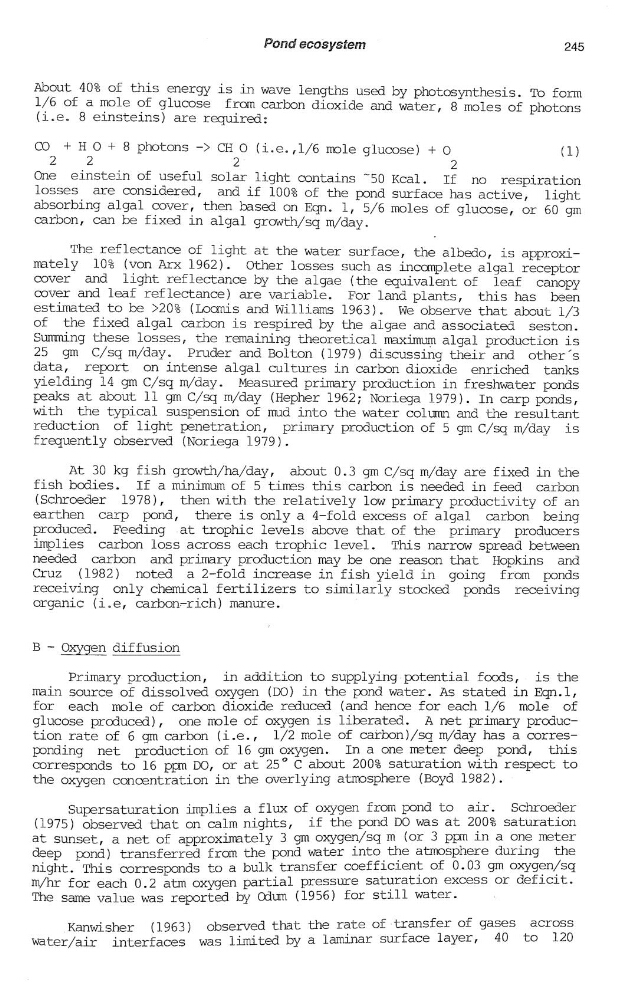
About 40% of this energy is in wave lengths used by photosynthesis. To form
1/6 of a mole of glucose
from carbon dioxide and water, 8 moles of photons
(i.e. 8 einsteins) are required:
CO
+ H O + 8 photons —> CH 0 (i.e.,l/6 Hole glucose) + 0
(l)
2
2
2
2
One
einstein of useful solar light contains "50 Kcal.
If
no
respiration
losses
are
considered,
and if 100% of the pond surface has active,
light
absorbing algal cover, then based on Eqn. 1, 5/6 moles of glucose, or 60 gm
carbon, can be fixed in algal growth/sq m/day.
The reflectance of light at the water surface, the albedo, is approxi—
nately
10%
(von Arx 1962).
Other losses such as incomplete algal receptor
cover
and
light reflectance by the algae (the equivalent of
leaf
canopy
cover
and leaf reflectance) are variable.
For land plants,
this has
been
estimated to be >20% (Loomis and Williams 1963).
We observe that about 1/3
of
the fixed algal carbon is respired by the algae and associated
seston.
Summing these losses, the remaining theoretical maximum algal production is
25
gm
C/sq m/day.
Pruder and Bolton (1979) discussing their and
other's
data,
report
on
intense algal cultures in carbon dioxide
enriched
tanks
yielding 14 gm C/sq m/day.
Measured primary production in freshwater ponds
peaks at about 11 gm C/sq m/day (Hepher 1962; Noriega 1979). In carp ponds,
with
the typical suspension of nmd into the water column and the resultant
reduction
of light penetration,
primary production of 5 gm C/sq m/day
is
frequently observed (Noriega 1979).
At 30 kg fish growth/ha/day,
about 0.3 gm C/sq m/day are fixed in the
fish bodies.
If a minimum of 5 tines this carbon is needed in feed
carbon
(Schroeder
1978),
then with the relatively low primary productivity of an
earthen
carp
pond,
there is only a 4—fold excess of algal
carbon
being
produced.
Feeding
at trophic levels above that of the
primary
producers
implies
carbon loss across each trophic level.
This narrow spread between
needed
carbon
and primary production may be one reason that
Hopkins
and
Cruz
(1982)
noted
a
2—fold increase in fish yield in
going
fr0m
ponds
receiving
only chemical fertilizers to similarly stocked
ponds
receiving
organic (i.e, carbonrrich) manure.
B — Oxygen diffusion
Primary production,
in addition to supplying potential foods,
is the
main source of dissolved oxygen (DO) in the pond water. As stated in Eqn.l,
for
each
mole of carbon dioxide reduced (and hence for each 1/6
mole
of
glucose produced),
one Hole of oxygen is liberated.
A net primary produc—
tion rate of 6 gm carbon (i.e.,
1/2 mole of carbon)/sq m/day has a corres—
ponding
net
production of 16 gntoxygen.
In a one neter deep pond, thlS
corresponds to 16 ppm DO, or at 25° C about 200% saturation With respect to
the oxygen concentration in the over1ying atnDsphere (Boyd 1982)Supersaturation implies a flux of oxygen from pond to
air.
Schroeder
(1975) observed that on calm nights,
if the pond DO was at 200%
saturation
at sunset, a net of approximately 3 gm oxygen/sq m (or 3 ppm ln a one
meter
deep
pond) transferred from the pond water into the atmosphere during the
night. This corresponds to a bulk transfer coeff1c1ent
of 0.03 gn10xygen/sq
m/hr for each 0_2 atm oxygen partial pressure saturation
excess
or
def1c1t.
The same value was reported by Cum (1956) for 5tlll water.
Kanwisher
(1963)
observed that the rate of transfer of gases
across
water/air
interfaces
was
1indted by a 1andnar surface layer,
40
to
120
245
About 40% of this energy is in wave lengths used by photosynthesis. To form
1/6 of a mole of glucose
from carbon dioxide and water, 8 moles of photons
(i.e. 8 einsteins) are required:
CO
+ H O + 8 photons —> CH 0 (i.e.,l/6 Hole glucose) + 0
(l)
2
2
2
2
One
einstein of useful solar light contains "50 Kcal.
If
no
respiration
losses
are
considered,
and if 100% of the pond surface has active,
light
absorbing algal cover, then based on Eqn. 1, 5/6 moles of glucose, or 60 gm
carbon, can be fixed in algal growth/sq m/day.
The reflectance of light at the water surface, the albedo, is approxi—
nately
10%
(von Arx 1962).
Other losses such as incomplete algal receptor
cover
and
light reflectance by the algae (the equivalent of
leaf
canopy
cover
and leaf reflectance) are variable.
For land plants,
this has
been
estimated to be >20% (Loomis and Williams 1963).
We observe that about 1/3
of
the fixed algal carbon is respired by the algae and associated
seston.
Summing these losses, the remaining theoretical maximum algal production is
25
gm
C/sq m/day.
Pruder and Bolton (1979) discussing their and
other's
data,
report
on
intense algal cultures in carbon dioxide
enriched
tanks
yielding 14 gm C/sq m/day.
Measured primary production in freshwater ponds
peaks at about 11 gm C/sq m/day (Hepher 1962; Noriega 1979). In carp ponds,
with
the typical suspension of nmd into the water column and the resultant
reduction
of light penetration,
primary production of 5 gm C/sq m/day
is
frequently observed (Noriega 1979).
At 30 kg fish growth/ha/day,
about 0.3 gm C/sq m/day are fixed in the
fish bodies.
If a minimum of 5 tines this carbon is needed in feed
carbon
(Schroeder
1978),
then with the relatively low primary productivity of an
earthen
carp
pond,
there is only a 4—fold excess of algal
carbon
being
produced.
Feeding
at trophic levels above that of the
primary
producers
implies
carbon loss across each trophic level.
This narrow spread between
needed
carbon
and primary production may be one reason that
Hopkins
and
Cruz
(1982)
noted
a
2—fold increase in fish yield in
going
fr0m
ponds
receiving
only chemical fertilizers to similarly stocked
ponds
receiving
organic (i.e, carbonrrich) manure.
B — Oxygen diffusion
Primary production,
in addition to supplying potential foods,
is the
main source of dissolved oxygen (DO) in the pond water. As stated in Eqn.l,
for
each
mole of carbon dioxide reduced (and hence for each 1/6
mole
of
glucose produced),
one Hole of oxygen is liberated.
A net primary produc—
tion rate of 6 gm carbon (i.e.,
1/2 mole of carbon)/sq m/day has a corres—
ponding
net
production of 16 gntoxygen.
In a one neter deep pond, thlS
corresponds to 16 ppm DO, or at 25° C about 200% saturation With respect to
the oxygen concentration in the over1ying atnDsphere (Boyd 1982)Supersaturation implies a flux of oxygen from pond to
air.
Schroeder
(1975) observed that on calm nights,
if the pond DO was at 200%
saturation
at sunset, a net of approximately 3 gm oxygen/sq m (or 3 ppm ln a one
meter
deep
pond) transferred from the pond water into the atmosphere during the
night. This corresponds to a bulk transfer coeff1c1ent
of 0.03 gn10xygen/sq
m/hr for each 0_2 atm oxygen partial pressure saturation
excess
or
def1c1t.
The same value was reported by Cum (1956) for 5tlll water.
Kanwisher
(1963)
observed that the rate of transfer of gases
across
water/air
interfaces
was
1indted by a 1andnar surface layer,
40
to
120