

Larva! nu?riäionaf physi0£ogy
217
Considerable
intra—specific differences in the utilization of
endogenous substrates available for embryo— and organogenesis
seem
to
exist.
This
variability in the relative proportions
of
non—protein
to
protein substrates
utilized
as
energy
sources
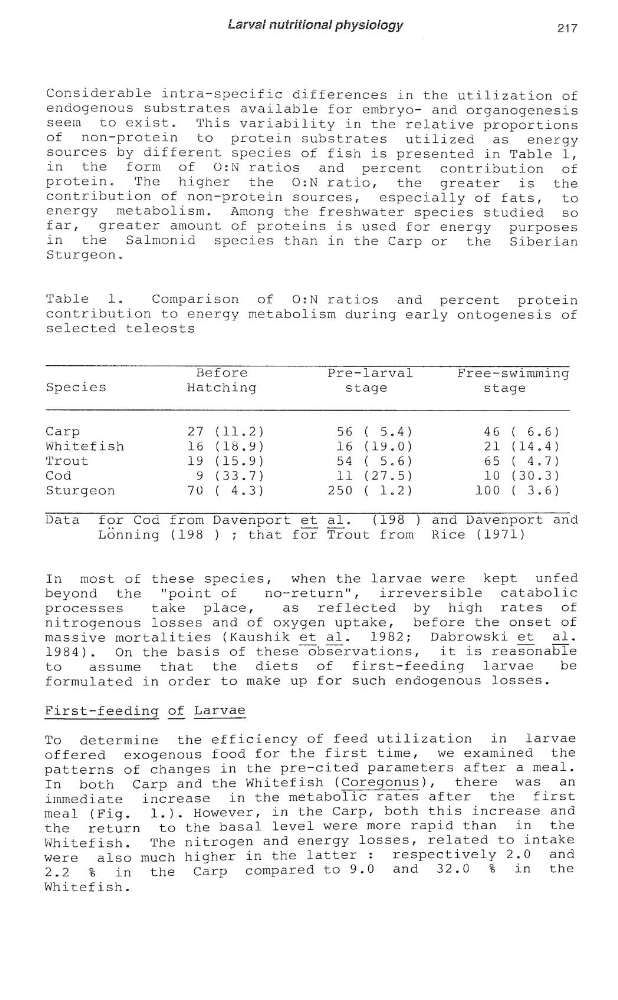
by different species of fish is presented in Table 1,
in
the
form
of
O:N
ratios
and
percent
contribution
of
protein°
The
higher
the
O:N
ratio,
the
greater
is
the
contribution
of
non—protein sources,
especially of fats,
to
energy
metabolism°
Among the freshwater species studied
so
far,
greater amount of proteins is used for energy
purposes
in
the
Salmonid
species than in the Carp or
the
Siberian
Sturgeon°
Table
la
Comparison
of
O:N
ratios
and
percent
protein
contribution
to
energy metabolism during early ontogenesis of
selected
teleosts
Before
Pre—larval
Free—swimming
Species
Hatching
stage
stage
Carp
27
56
(
5°4)
46
(
6…6)
Whitefish
16
(18…9)
16
(19.0)
21
Trout
19
(15.9)
54
(
5…6)
65
(
Cod
9
(33.7)
11
10
Sturgeon
70
(
250
(
1…2)
100
(
3…6)
Data
for
Cod
from
Davenport et
(198
)
and
Davenport and
Lônning (198 ) ; that f5Ë TÎout from
Rice
(1971)
In
most
of
these
species,
when
the
larvae
were
kept
unfed
beyond
the
"point of
no—return",
irreversible
catabolic
processes
take
place,
as
reflected
by
high
rates
of
nitrogenous losses and of oxygen uptake,
before
the
onset
of
massive
mortalities
(Kaushik et al.
1982;
Dabrowski et
al.
1984).
On
the
basis
of
these—observations,
it
is
reasonable
to
assume
that
the
diets
of
first—feeding
larvae
be
formulated
in
order
to
make
up
for
such
endogenous losses.
First—feeding of Larvae
To
determine
the
efficiency of feed utilization
in
larvae
offered
exogenous
food
for
the
first
time,
we
examined
the
patterns of changes in the pre—Cited parameters after a meal.
In
both
Carp and the Whitefish
(Coregonus),
there
an
immediate
increase
in
the
metabolic
rates
after
the
first
meal
(Fig.
l.).
However,
in
the
Carp,
both
this
increase
and
the
return
to
the
basal
level
were
more
rapid than
in
the
Whitefish.
The
nitrogen and energy losses,
related
to
intake
were
also
much
higher in the latter
:
respectively
and
2.2
%
in
the
Carp
compared to 9.0
and
32.0
%
in
the
Whitefish.
217
Considerable
intra—specific differences in the utilization of
endogenous substrates available for embryo— and organogenesis
seem
to
exist.
This
variability in the relative proportions
of
non—protein
to
protein substrates
utilized
as
energy
sources
by different species of fish is presented in Table 1,
in
the
form
of
O:N
ratios
and
percent
contribution
of
protein°
The
higher
the
O:N
ratio,
the
greater
is
the
contribution
of
non—protein sources,
especially of fats,
to
energy
metabolism°
Among the freshwater species studied
so
far,
greater amount of proteins is used for energy
purposes
in
the
Salmonid
species than in the Carp or
the
Siberian
Sturgeon°
Table
la
Comparison
of
O:N
ratios
and
percent
protein
contribution
to
energy metabolism during early ontogenesis of
selected
teleosts
Before
Pre—larval
Free—swimming
Species
Hatching
stage
stage
Carp
27
56
(
5°4)
46
(
6…6)
Whitefish
16
(18…9)
16
(19.0)
21
Trout
19
(15.9)
54
(
5…6)
65
(
Cod
9
(33.7)
11
10
Sturgeon
70
(
250
(
1…2)
100
(
3…6)
Data
for
Cod
from
Davenport et
(198
)
and
Davenport and
Lônning (198 ) ; that f5Ë TÎout from
Rice
(1971)
In
most
of
these
species,
when
the
larvae
were
kept
unfed
beyond
the
"point of
no—return",
irreversible
catabolic
processes
take
place,
as
reflected
by
high
rates
of
nitrogenous losses and of oxygen uptake,
before
the
onset
of
massive
mortalities
(Kaushik et al.
1982;
Dabrowski et
al.
1984).
On
the
basis
of
these—observations,
it
is
reasonable
to
assume
that
the
diets
of
first—feeding
larvae
be
formulated
in
order
to
make
up
for
such
endogenous losses.
First—feeding of Larvae
To
determine
the
efficiency of feed utilization
in
larvae
offered
exogenous
food
for
the
first
time,
we
examined
the
patterns of changes in the pre—Cited parameters after a meal.
In
both
Carp and the Whitefish
(Coregonus),
there
an
immediate
increase
in
the
metabolic
rates
after
the
first
meal
(Fig.
l.).
However,
in
the
Carp,
both
this
increase
and
the
return
to
the
basal
level
were
more
rapid than
in
the
Whitefish.
The
nitrogen and energy losses,
related
to
intake
were
also
much
higher in the latter
:
respectively
and
2.2
%
in
the
Carp
compared to 9.0
and
32.0
%
in
the
Whitefish.