

\
156
R. Biliard et ai.
}
Egg
SWF“
,;
@
80£
/Î
__
07
@
+!
î
î
«e—
Ï
$—
'
"\
3
?
/
0
o\
= _ .
ein vivo
eln viîro
'
A In vitro
O
2
4
6
O
24
48
h. post ovulaîion
h. of storage
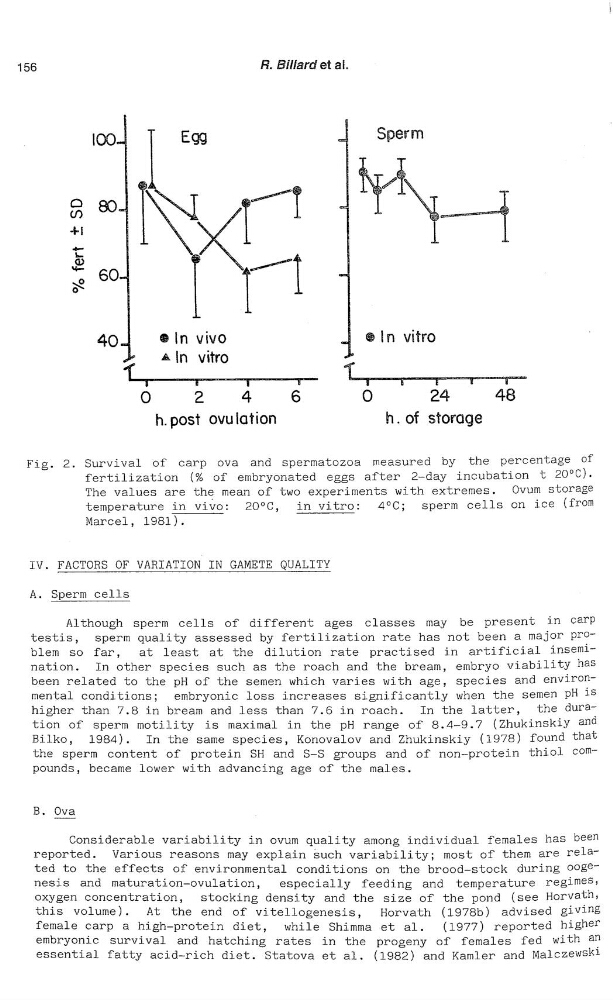
Fig. 2. Survival
of‘
carp
ova
and
spermatozoa
measured
by‘
the
percentage of
fertilization
(% of embryonated eggs after
2—day incubation t
The values
are
the mean of two experiments with extremes.
Ovum storage
temperature in vivo:
20°C,
in vitro:
4°C;
sperm
cells on
ice
(from
Marcel, 1981).
IV.
FACTORS OF VARIATION IN GAMETE
QUALITY
A.
Sperm cells
Although sperm cells
of
different
ages
classes
may
be
present
in
carp
testis,
sperm quality assessed by fertilization rate has not been a major Pr?“
blem
so
far,
at
least
at
the
dilution
rate
practised in
artificial
inseml—
nation.
In other
species such as the roach and the bream, embryo viability has
been related to the pH of the semen which varies with age,
species and environ—
mental conditions;
embryonic loss increases significantly when the semen pH 15
higher than 7.8 in bream and less than 7.6 in reach.
In the
latter,
the dura—
tion
of
sperm
motility
is
maximal
in
the
pH range of 8.4—9.7
(Zhukinskiy
and
Bilko,
1984).
In the same
species, Konovalov and Zhukinskiy (1978) found that
the
sperm
content
of
protein SH and S—S groups and of non—protein thiol com—
pounds, became lower with advancing age of the males.
B.
Ova
Considerable variability in ovum quality among individual females has been
reported.
Various reasons may explain Such variability; most of them are relâted to
the
effects
of environmental
conditions on
the brood—stock
during 008€”
nesis
and
maturation—ovulation,
especially
feeding and
temperature
regimes
oxygen concentration,
stocking density and the size of the pond
(see Horvath,
this
volume).
At
the
end
of
vitellogenesis,
Horvath
(1978b)
advised giving
female carp
a
high—protein diet,
while
Shimma
et
al.
(1977) reported higher
embryonic
survival
and
hatehing rates
in
the
progeny
of
females
fed
with
essential
fatty acid—rich diet. Statova et al.
(1982) and Kamler and Malczewskl
156
R. Biliard et ai.
}
Egg
SWF“
,;
@
80£
/Î
__
07
@
+!
î
î
«e—
Ï
$—
'
"\
3
?
/
0
o\
= _ .
ein vivo
eln viîro
'
A In vitro
O
2
4
6
O
24
48
h. post ovulaîion
h. of storage
Fig. 2. Survival
of‘
carp
ova
and
spermatozoa
measured
by‘
the
percentage of
fertilization
(% of embryonated eggs after
2—day incubation t
The values
are
the mean of two experiments with extremes.
Ovum storage
temperature in vivo:
20°C,
in vitro:
4°C;
sperm
cells on
ice
(from
Marcel, 1981).
IV.
FACTORS OF VARIATION IN GAMETE
QUALITY
A.
Sperm cells
Although sperm cells
of
different
ages
classes
may
be
present
in
carp
testis,
sperm quality assessed by fertilization rate has not been a major Pr?“
blem
so
far,
at
least
at
the
dilution
rate
practised in
artificial
inseml—
nation.
In other
species such as the roach and the bream, embryo viability has
been related to the pH of the semen which varies with age,
species and environ—
mental conditions;
embryonic loss increases significantly when the semen pH 15
higher than 7.8 in bream and less than 7.6 in reach.
In the
latter,
the dura—
tion
of
sperm
motility
is
maximal
in
the
pH range of 8.4—9.7
(Zhukinskiy
and
Bilko,
1984).
In the same
species, Konovalov and Zhukinskiy (1978) found that
the
sperm
content
of
protein SH and S—S groups and of non—protein thiol com—
pounds, became lower with advancing age of the males.
B.
Ova
Considerable variability in ovum quality among individual females has been
reported.
Various reasons may explain Such variability; most of them are relâted to
the
effects
of environmental
conditions on
the brood—stock
during 008€”
nesis
and
maturation—ovulation,
especially
feeding and
temperature
regimes
oxygen concentration,
stocking density and the size of the pond
(see Horvath,
this
volume).
At
the
end
of
vitellogenesis,
Horvath
(1978b)
advised giving
female carp
a
high—protein diet,
while
Shimma
et
al.
(1977) reported higher
embryonic
survival
and
hatehing rates
in
the
progeny
of
females
fed
with
essential
fatty acid—rich diet. Statova et al.
(1982) and Kamler and Malczewskl