

i54
H. Billard et ai
.
changes over a 24—hour period after ovulation when there is a significantele—
vation of glucose and protein and a decrease in amino acids°
The
pH values æœ
high: 8.5 î 11 for carp and 9.1 t 0.5 for silver carp.
III.
GAMETE
SURVIVAL
A.
Spermatozoa
In vivo.
In
temperate zones, carp spermatogenesis occurs in the summer
the
spermatozoa are already formed in the testes in autumn;
spontaneous
miation may
then be
observed.
The
spermatozoa remain there until the spawnùæ
season
in
the
following spring or
summer.
Not
all
spermatozoa
are
relæmed
during spawning and some
remain
in
the
testis
until
the
following autumn so
that
two generations of sperm cells are present in males undertaking the secw
spawning season (Weil,
1981).
This
is very different from trout or pike where
non—released intra testicular spermatozoa are resorbed after spawning and
re
the new
spermatogenetic cycle
starts
(Billard,
1985). Sperm resorption has
also
been
reported.
in
the
bream
(Grechanov
and
Volodin,
1981).
However,
Zhukinskiy and Bilko (1984) reported sperm degeneration in carp as the spawnhæ
season
progressed,
but
this
seemed
to
apply only to sperm cells in the awrm
duct.
In these
conditions, spermatozoa can be collected from carp all
round
within the
limits of
spermatogenetic production which is about 2.10l
spermatozoa/kg of body weight/year (Saad et al.,
this
volume).
Spontaneous spermia—
tion
usually yields
a
limited
amount
of
sperm
cells
and
”hypophysation" is
necessary
for
higher spermiation yields
(see
review
by
Weil,
this
Under our laboratory conditions,
males kept constantly at 20°C or stored at 5—
18°C
and brought to 20°C for hypophysation, routinely yields viable sperm cells
all year round; this indicates satisfactory in vivo survival.
In vitro.
After intact sperm is
stored for
2
days at 2—5°C, good motility
is
initiated
(Belova,
1981
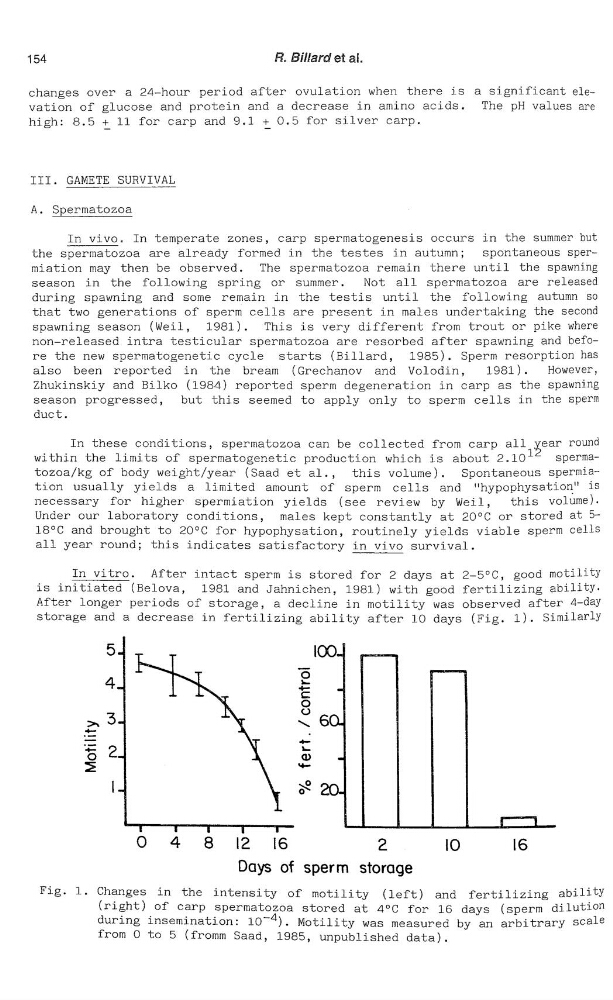
and Jahnichen, 1981) with good fertilizing abilitYAfter longer periods of storage, a decline in motility was observed after 4—day
storage and a decrease in fertilizing ability after 10 days (Fig. 1). Similarly
5
100
a
r
=
4
À:
L
‘ :
î
'
C
‘
'
‘
-
8
:
>
3
\
60
:
‘
à:
.
.
.
:
4—
*5 2
‘5
'
‘
‘
‘
2
u—
!
o\°
‘
O
4
8
l2
IS
2
IO
l6
Days of sperm storage
Fig- 1. Changes
in
the
intensity of motility
(left)
and
fertilizing ability
(right)
of
carp spermatoäoa
stored
at
4°C
for
16
days
(sperm diluti©n
during 1nsem1nation: IO_ ). Motility was measured by an arbitrary scale
from 0 to
5
(fromm Saad, 1985, unpublished data).
H. Billard et ai
.
changes over a 24—hour period after ovulation when there is a significantele—
vation of glucose and protein and a decrease in amino acids°
The
pH values æœ
high: 8.5 î 11 for carp and 9.1 t 0.5 for silver carp.
III.
GAMETE
SURVIVAL
A.
Spermatozoa
In vivo.
In
temperate zones, carp spermatogenesis occurs in the summer
the
spermatozoa are already formed in the testes in autumn;
spontaneous
miation may
then be
observed.
The
spermatozoa remain there until the spawnùæ
season
in
the
following spring or
summer.
Not
all
spermatozoa
are
relæmed
during spawning and some
remain
in
the
testis
until
the
following autumn so
that
two generations of sperm cells are present in males undertaking the secw
spawning season (Weil,
1981).
This
is very different from trout or pike where
non—released intra testicular spermatozoa are resorbed after spawning and
re
the new
spermatogenetic cycle
starts
(Billard,
1985). Sperm resorption has
also
been
reported.
in
the
bream
(Grechanov
and
Volodin,
1981).
However,
Zhukinskiy and Bilko (1984) reported sperm degeneration in carp as the spawnhæ
season
progressed,
but
this
seemed
to
apply only to sperm cells in the awrm
duct.
In these
conditions, spermatozoa can be collected from carp all
round
within the
limits of
spermatogenetic production which is about 2.10l
spermatozoa/kg of body weight/year (Saad et al.,
this
volume).
Spontaneous spermia—
tion
usually yields
a
limited
amount
of
sperm
cells
and
”hypophysation" is
necessary
for
higher spermiation yields
(see
review
by
Weil,
this
Under our laboratory conditions,
males kept constantly at 20°C or stored at 5—
18°C
and brought to 20°C for hypophysation, routinely yields viable sperm cells
all year round; this indicates satisfactory in vivo survival.
In vitro.
After intact sperm is
stored for
2
days at 2—5°C, good motility
is
initiated
(Belova,
1981
and Jahnichen, 1981) with good fertilizing abilitYAfter longer periods of storage, a decline in motility was observed after 4—day
storage and a decrease in fertilizing ability after 10 days (Fig. 1). Similarly
5
100
a
r
=
4
À:
L
‘ :
î
'
C
‘
'
‘
-
8
:
>
3
\
60
:
‘
à:
.
.
.
:
4—
*5 2
‘5
'
‘
‘
‘
2
u—
!
o\°
‘
O
4
8
l2
IS
2
IO
l6
Days of sperm storage
Fig- 1. Changes
in
the
intensity of motility
(left)
and
fertilizing ability
(right)
of
carp spermatoäoa
stored
at
4°C
for
16
days
(sperm diluti©n
during 1nsem1nation: IO_ ). Motility was measured by an arbitrary scale
from 0 to
5
(fromm Saad, 1985, unpublished data).