

1-14 Review: the canonical criteria 81
If an isometric mapping f : M
2
l → M
2
r were existing for an arbitrary left and right two-dimensional
Riemann manifold, we would have met an ideal situation. Let us therefore ask: when does an isometric
mapping f : M
2
l → M
2
r exist? Unfortunately, we can only sketch the existence proof here which is
based upon the intrinsic measure of curvature of a surface, namely Gaussian curvature, computed
k = det [K] =
det [H]
det [G]
,
K := −HG
−1
∈ R
2×2 .
(1.292)
The curvature matrix K of a surface is the negative product of the Hesse matrix H and the inverse of
the Gauss matrix G defined as follows.
Box 1.45 (Curvature matrix of a surface).
G =
3
X
I=1
∂X
I
∂U M
∂X
I
∂U N =
»
e f
f g
–
,
(1.293)
H =
3
X
I=1
∂
2 X
I
∂U M ∂U N N
I =
»
l m
m n
–
,
(1.294)
K =
1
eg − f 2 =
» −gl + fm fl − em
−gm + fn fm − en
–
.
(1.295)
N
I denotes the coordinates of the surface normal vector N ∈ N M
2
l with respect to the basis
{E 1 , E 2 , E 3 , O} fixed to the origin O and assumed to be orthonormal. N = E 1 N
1 + E 1 N
2 + E 3 N
3
and X
I (U, V ) are the representers of Φ
−1
l , which are also called embedding functions M
2
l ⊂ R
3 if we exclude self-intersections and singular points (corners) of M
2
l . The “Theorema Egregium” of C. F. Gauss
states that the determinant of the curvature matrix, in short Gaussian curvature, depends only on
(i) the metric coefficients e, f, g, (ii) their first derivatives e U , e V , f U , f V , g U , g V , and (iii) their second
derivatives e UU , e UV , e V V , . . . , g UU , g UV , g V V . The fundamental theorem of an isometric mapping can
now be formulated as follows.
Theorem 1.17 (Isometric mapping).
If a left curvature is isometrically mapped to a right surface, then corresponding points X ∈ M
2
l and
x ∈ M
2
r have identical Gaussian curvature.
End of Theorem.
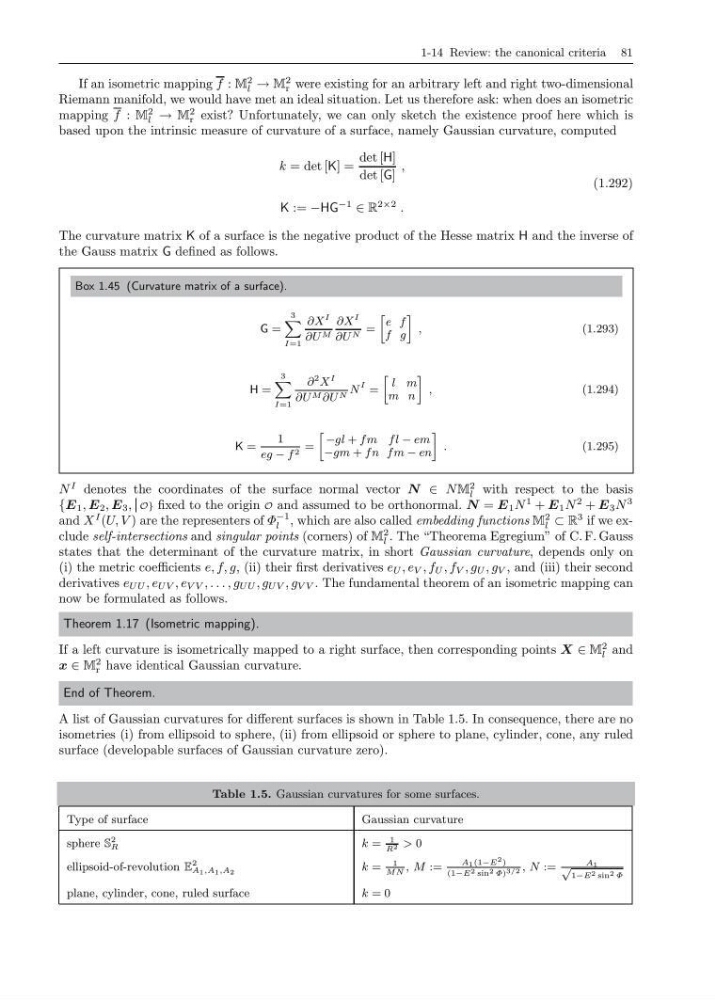
A list of Gaussian curvatures for different surfaces is shown in Table 1.5. In consequence, there are no
isometries (i) from ellipsoid to sphere, (ii) from ellipsoid or sphere to plane, cylinder, cone, any ruled
surface (developable surfaces of Gaussian curvature zero).
Table 1.5. Gaussian curvatures for some surfaces.
Type of surface
Gaussian curvature
sphere S
2
R
k =
1
R 2 > 0
ellipsoid-of-revolution E
2
A 1 ,A 1 ,A 2
k =
1
MN
, M :=
A 1 (1−E
2 )
(1−E 2 sin 2 Φ) 3/2 , N :=
A 1
√
1−E 2 sin 2 Φ
plane, cylinder, cone, ruled surface
k = 0
If an isometric mapping f : M
2
l → M
2
r were existing for an arbitrary left and right two-dimensional
Riemann manifold, we would have met an ideal situation. Let us therefore ask: when does an isometric
mapping f : M
2
l → M
2
r exist? Unfortunately, we can only sketch the existence proof here which is
based upon the intrinsic measure of curvature of a surface, namely Gaussian curvature, computed
k = det [K] =
det [H]
det [G]
,
K := −HG
−1
∈ R
2×2 .
(1.292)
The curvature matrix K of a surface is the negative product of the Hesse matrix H and the inverse of
the Gauss matrix G defined as follows.
Box 1.45 (Curvature matrix of a surface).
G =
3
X
I=1
∂X
I
∂U M
∂X
I
∂U N =
»
e f
f g
–
,
(1.293)
H =
3
X
I=1
∂
2 X
I
∂U M ∂U N N
I =
»
l m
m n
–
,
(1.294)
K =
1
eg − f 2 =
» −gl + fm fl − em
−gm + fn fm − en
–
.
(1.295)
N
I denotes the coordinates of the surface normal vector N ∈ N M
2
l with respect to the basis
{E 1 , E 2 , E 3 , O} fixed to the origin O and assumed to be orthonormal. N = E 1 N
1 + E 1 N
2 + E 3 N
3
and X
I (U, V ) are the representers of Φ
−1
l , which are also called embedding functions M
2
l ⊂ R
3 if we exclude self-intersections and singular points (corners) of M
2
l . The “Theorema Egregium” of C. F. Gauss
states that the determinant of the curvature matrix, in short Gaussian curvature, depends only on
(i) the metric coefficients e, f, g, (ii) their first derivatives e U , e V , f U , f V , g U , g V , and (iii) their second
derivatives e UU , e UV , e V V , . . . , g UU , g UV , g V V . The fundamental theorem of an isometric mapping can
now be formulated as follows.
Theorem 1.17 (Isometric mapping).
If a left curvature is isometrically mapped to a right surface, then corresponding points X ∈ M
2
l and
x ∈ M
2
r have identical Gaussian curvature.
End of Theorem.
A list of Gaussian curvatures for different surfaces is shown in Table 1.5. In consequence, there are no
isometries (i) from ellipsoid to sphere, (ii) from ellipsoid or sphere to plane, cylinder, cone, any ruled
surface (developable surfaces of Gaussian curvature zero).
Table 1.5. Gaussian curvatures for some surfaces.
Type of surface
Gaussian curvature
sphere S
2
R
k =
1
R 2 > 0
ellipsoid-of-revolution E
2
A 1 ,A 1 ,A 2
k =
1
MN
, M :=
A 1 (1−E
2 )
(1−E 2 sin 2 Φ) 3/2 , N :=
A 1
√
1−E 2 sin 2 Φ
plane, cylinder, cone, ruled surface
k = 0