

52
1 From Riemann manifolds to Riemann manifolds
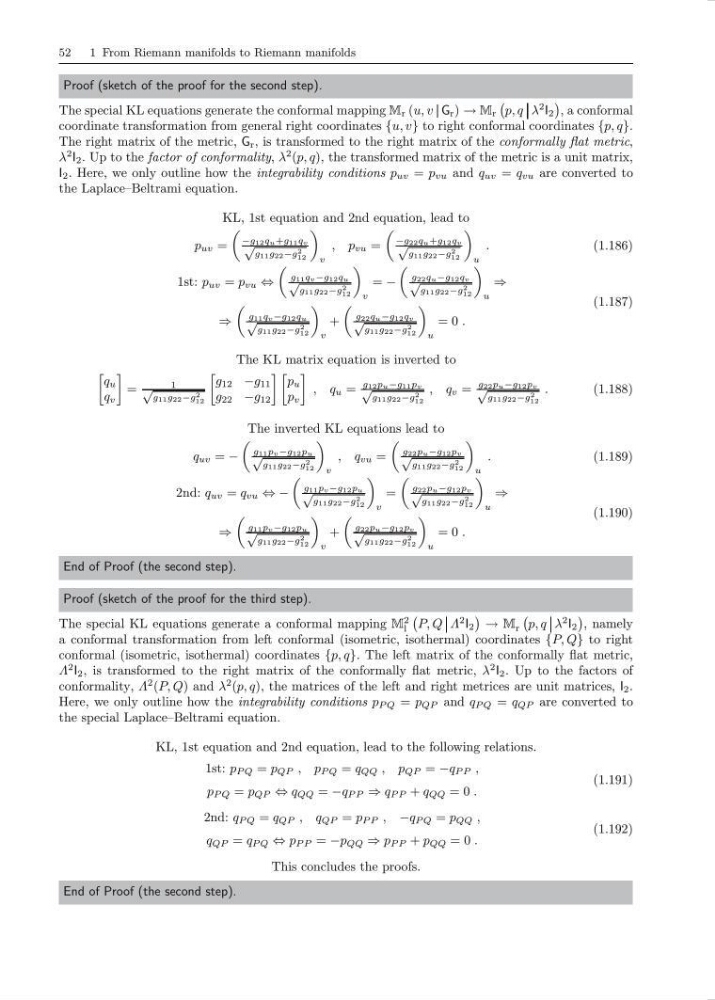
Proof (sketch of the proof for the second step).
The special KL equations generate the conformal mapping M r (u, v G r ) → M r
p, q λ
2 I 2
, a conformal
coordinate transformation from general right coordinates {u, v} to right conformal coordinates {p, q}.
The right matrix of the metric, G r , is transformed to the right matrix of the conformally flat metric,
λ
2 I 2 . Up to the factor of conformality, λ
2 (p, q), the transformed matrix of the metric is a unit matrix,
I 2 . Here, we only outline how the integrability conditions p uv = p vu and q uv = q vu are converted to
the Laplace–Beltrami equation.
KL, 1st equation and 2nd equation, lead to
p uv =
−g 12 q u +g 11 q v
√
g 11 g 22 −g 2
12
v
, p vu =
−g 22 q u +g 12 q v
√
g 11 g 22 −g 2
12
u
.
(1.186)
1st: p uv = p vu ⇔
g 11 q v −g 12 q u
√
g 11 g 22 −g 2
12
v
= −
g 22 q u −g 12 q v
√
g 11 g 22 −g 2
12
u
⇒
⇒
g 11 q v −g 12 q u
√
g 11 g 22 −g 2
12
v
+
g 22 q u −g 12 q v
√
g 11 g 22 −g 2
12
u
= 0 .
(1.187)
The KL matrix equation is inverted to
q u
q v
=
1
√
g 11 g 22 −g 2
12
g 12 −g 11
g 22 −g 12
p u
p v
, q u =
g 12 p u −g 11 p v
√
g 11 g 22 −g 2
12
, q v =
g 22 p u −g 12 p v
√
g 11 g 22 −g 2
12
.
(1.188)
The inverted KL equations lead to
q uv = −
g 11 p v −g 12 p u
√
g 11 g 22 −g 2
12
v
, q vu =
g 22 p u −g 12 p v
√
g 11 g 22 −g 2
12
u
.
(1.189)
2nd: q uv = q vu ⇔ −
g 11 p v −g 12 p u
√
g 11 g 22 −g 2
12
v
=
g 22 p u −g 12 p v
√
g 11 g 22 −g 2
12
u
⇒
⇒
g 11 p v −g 12 p u
√
g 11 g 22 −g 2
12
v
+
g 22 p u −g 12 p v
√
g 11 g 22 −g 2
12
u
= 0 .
(1.190)
End of Proof (the second step).
Proof (sketch of the proof for the third step).
The special KL equations generate a conformal mapping M
2
l
P, Q Λ
2 I 2
→ M r
p, q λ
2 I 2
, namely
a conformal transformation from left conformal (isometric, isothermal) coordinates {P, Q} to right
conformal (isometric, isothermal) coordinates {p, q}. The left matrix of the conformally flat metric,
Λ
2 I 2 , is transformed to the right matrix of the conformally flat metric, λ
2 I 2 . Up to the factors of
conformality, Λ
2 (P, Q) and λ
2 (p, q), the matrices of the left and right metrices are unit matrices, I 2 .
Here, we only outline how the integrability conditions p P Q = p QP and q P Q = q QP are converted to
the special Laplace–Beltrami equation.
KL, 1st equation and 2nd equation, lead to the following relations.
1st: p P Q = p QP , p P Q = q QQ , p QP = −q P P ,
p P Q = p QP ⇔ q QQ = −q P P ⇒ q P P + q QQ = 0 .
(1.191)
2nd: q P Q = q QP , q QP = p P P , −q P Q = p QQ ,
q QP = q P Q ⇔ p P P = −p QQ ⇒ p P P + p QQ = 0 .
(1.192)
This concludes the proofs.
End of Proof (the second step).
1 From Riemann manifolds to Riemann manifolds
Proof (sketch of the proof for the second step).
The special KL equations generate the conformal mapping M r (u, v G r ) → M r
p, q λ
2 I 2
, a conformal
coordinate transformation from general right coordinates {u, v} to right conformal coordinates {p, q}.
The right matrix of the metric, G r , is transformed to the right matrix of the conformally flat metric,
λ
2 I 2 . Up to the factor of conformality, λ
2 (p, q), the transformed matrix of the metric is a unit matrix,
I 2 . Here, we only outline how the integrability conditions p uv = p vu and q uv = q vu are converted to
the Laplace–Beltrami equation.
KL, 1st equation and 2nd equation, lead to
p uv =
−g 12 q u +g 11 q v
√
g 11 g 22 −g 2
12
v
, p vu =
−g 22 q u +g 12 q v
√
g 11 g 22 −g 2
12
u
.
(1.186)
1st: p uv = p vu ⇔
g 11 q v −g 12 q u
√
g 11 g 22 −g 2
12
v
= −
g 22 q u −g 12 q v
√
g 11 g 22 −g 2
12
u
⇒
⇒
g 11 q v −g 12 q u
√
g 11 g 22 −g 2
12
v
+
g 22 q u −g 12 q v
√
g 11 g 22 −g 2
12
u
= 0 .
(1.187)
The KL matrix equation is inverted to
q u
q v
=
1
√
g 11 g 22 −g 2
12
g 12 −g 11
g 22 −g 12
p u
p v
, q u =
g 12 p u −g 11 p v
√
g 11 g 22 −g 2
12
, q v =
g 22 p u −g 12 p v
√
g 11 g 22 −g 2
12
.
(1.188)
The inverted KL equations lead to
q uv = −
g 11 p v −g 12 p u
√
g 11 g 22 −g 2
12
v
, q vu =
g 22 p u −g 12 p v
√
g 11 g 22 −g 2
12
u
.
(1.189)
2nd: q uv = q vu ⇔ −
g 11 p v −g 12 p u
√
g 11 g 22 −g 2
12
v
=
g 22 p u −g 12 p v
√
g 11 g 22 −g 2
12
u
⇒
⇒
g 11 p v −g 12 p u
√
g 11 g 22 −g 2
12
v
+
g 22 p u −g 12 p v
√
g 11 g 22 −g 2
12
u
= 0 .
(1.190)
End of Proof (the second step).
Proof (sketch of the proof for the third step).
The special KL equations generate a conformal mapping M
2
l
P, Q Λ
2 I 2
→ M r
p, q λ
2 I 2
, namely
a conformal transformation from left conformal (isometric, isothermal) coordinates {P, Q} to right
conformal (isometric, isothermal) coordinates {p, q}. The left matrix of the conformally flat metric,
Λ
2 I 2 , is transformed to the right matrix of the conformally flat metric, λ
2 I 2 . Up to the factors of
conformality, Λ
2 (P, Q) and λ
2 (p, q), the matrices of the left and right metrices are unit matrices, I 2 .
Here, we only outline how the integrability conditions p P Q = p QP and q P Q = q QP are converted to
the special Laplace–Beltrami equation.
KL, 1st equation and 2nd equation, lead to the following relations.
1st: p P Q = p QP , p P Q = q QQ , p QP = −q P P ,
p P Q = p QP ⇔ q QQ = −q P P ⇒ q P P + q QQ = 0 .
(1.191)
2nd: q P Q = q QP , q QP = p P P , −q P Q = p QQ ,
q QP = q P Q ⇔ p P P = −p QQ ⇒ p P P + p QQ = 0 .
(1.192)
This concludes the proofs.
End of Proof (the second step).