

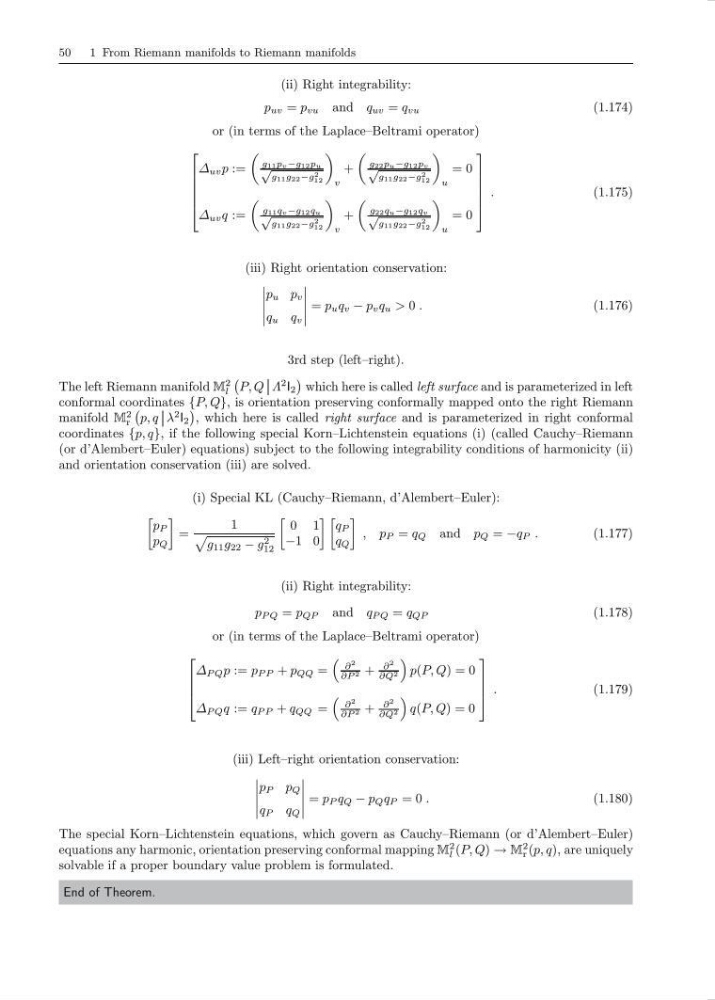
50
1 From Riemann manifolds to Riemann manifolds
(ii) Right integrability:
p uv = p vu and q uv = q vu
(1.174)
or (in terms of the Laplace–Beltrami operator)
⎡
⎢
⎢
⎢
⎢
⎣
∆ uv p :=
g 11 p v −g 12 p u
√
g 11 g 22 −g 2
12
v
+
g 22 p u −g 12 p v
√
g 11 g 22 −g 2
12
u
= 0
∆ uv q :=
g 11 q v −g 12 q u
√
g 11 g 22 −g 2
12
v
+
g 22 q u −g 12 q v
√
g 11 g 22 −g 2
12
u
= 0
⎤
⎥
⎥
⎥
⎥
⎦
.
(1.175)
(iii) Right orientation conservation:
p u p v
q u q v
= p u q v − p v q u > 0 .
(1.176)
3rd step (left–right).
The left Riemann manifold M
2
l
P, Q Λ
2 I 2
which here is called left surface and is parameterized in left
conformal coordinates {P, Q}, is orientation preserving conformally mapped onto the right Riemann
manifold M
2
r
p, q λ
2 I 2
, which here is called right surface and is parameterized in right conformal
coordinates {p, q}, if the following special Korn–Lichtenstein equations (i) (called Cauchy–Riemann
(or d’Alembert–Euler) equations) subject to the following integrability conditions of harmonicity (ii)
and orientation conservation (iii) are solved.
(i) Special KL (Cauchy–Riemann, d’Alembert–Euler):
p P
p Q
=
1
g 11 g 22 − g 2
12
0 1
−1 0
q P
q Q
, p P = q Q and p Q = −q P .
(1.177)
(ii) Right integrability:
p P Q = p QP and q P Q = q QP
(1.178)
or (in terms of the Laplace–Beltrami operator)
⎡
⎢
⎢
⎣
∆ P Q p := p P P + p QQ =
∂
2
∂P 2 +
∂
2
∂Q 2
p(P, Q) = 0
∆ P Q q := q P P + q QQ =
∂
2
∂P 2 +
∂
2
∂Q 2
q(P, Q) = 0
⎤
⎥
⎥
⎦ .
(1.179)
(iii) Left–right orientation conservation:
p P p Q
q P q Q
= p P q Q − p Q q P = 0 .
(1.180)
The special Korn–Lichtenstein equations, which govern as Cauchy–Riemann (or d’Alembert–Euler)
equations any harmonic, orientation preserving conformal mapping M
2
l (P, Q) → M
2
r (p, q), are uniquely
solvable if a proper boundary value problem is formulated.
End of Theorem.
1 From Riemann manifolds to Riemann manifolds
(ii) Right integrability:
p uv = p vu and q uv = q vu
(1.174)
or (in terms of the Laplace–Beltrami operator)
⎡
⎢
⎢
⎢
⎢
⎣
∆ uv p :=
g 11 p v −g 12 p u
√
g 11 g 22 −g 2
12
v
+
g 22 p u −g 12 p v
√
g 11 g 22 −g 2
12
u
= 0
∆ uv q :=
g 11 q v −g 12 q u
√
g 11 g 22 −g 2
12
v
+
g 22 q u −g 12 q v
√
g 11 g 22 −g 2
12
u
= 0
⎤
⎥
⎥
⎥
⎥
⎦
.
(1.175)
(iii) Right orientation conservation:
p u p v
q u q v
= p u q v − p v q u > 0 .
(1.176)
3rd step (left–right).
The left Riemann manifold M
2
l
P, Q Λ
2 I 2
which here is called left surface and is parameterized in left
conformal coordinates {P, Q}, is orientation preserving conformally mapped onto the right Riemann
manifold M
2
r
p, q λ
2 I 2
, which here is called right surface and is parameterized in right conformal
coordinates {p, q}, if the following special Korn–Lichtenstein equations (i) (called Cauchy–Riemann
(or d’Alembert–Euler) equations) subject to the following integrability conditions of harmonicity (ii)
and orientation conservation (iii) are solved.
(i) Special KL (Cauchy–Riemann, d’Alembert–Euler):
p P
p Q
=
1
g 11 g 22 − g 2
12
0 1
−1 0
q P
q Q
, p P = q Q and p Q = −q P .
(1.177)
(ii) Right integrability:
p P Q = p QP and q P Q = q QP
(1.178)
or (in terms of the Laplace–Beltrami operator)
⎡
⎢
⎢
⎣
∆ P Q p := p P P + p QQ =
∂
2
∂P 2 +
∂
2
∂Q 2
p(P, Q) = 0
∆ P Q q := q P P + q QQ =
∂
2
∂P 2 +
∂
2
∂Q 2
q(P, Q) = 0
⎤
⎥
⎥
⎦ .
(1.179)
(iii) Left–right orientation conservation:
p P p Q
q P q Q
= p P q Q − p Q q P = 0 .
(1.180)
The special Korn–Lichtenstein equations, which govern as Cauchy–Riemann (or d’Alembert–Euler)
equations any harmonic, orientation preserving conformal mapping M
2
l (P, Q) → M
2
r (p, q), are uniquely
solvable if a proper boundary value problem is formulated.
End of Theorem.