

48
1 From Riemann manifolds to Riemann manifolds
Here is the remark relating to G l being diagonal, not unity, of course. An obvious generalization for
solving (γ) and (δ) for g 12 = 0 would be the
“Ansatz” x 1 = G l Xx 2 , X =
y x
−x −y
,
(1.168)
the superposition of a diagonal trace-free matrix diag [y, −y] and an antisymmetric matrix Ax. Indeed,
we succeed in determining the unknowns x and y according to the above steps, but fail to arrive at
linear relations between the partials {u U , u V , v U , v V }.
M
2
l
`
U
1 , U
2 G l
´
,
˘
U
1 , U
2
¯
or
˘
U, V
¯
,
general parameters
(general left coordinates).
M
2
r
`
u
1 , u
2 Gr
´
,
˘
u
1 , u
2
¯
or
˘
u, v
¯
,
general parameters
(general right coordinates).
Left conformal coordinates
(left isometric, left isothermal),
˘
Q
1 , Q
2
¯
or
˘
P, Q
¯
.
Right conformal coordinates
(right isometric, right isothermal),
˘
q
1 , q
2
¯
or
˘
p, q
¯
.
Special Korn–Lichtenstein equations,
Cauchy–Riemann equations
(d’Alembert–Euler equations).
Special left
Korn–Lichtenstein
equations.
Special right
Korn–Lichtenstein
equations.
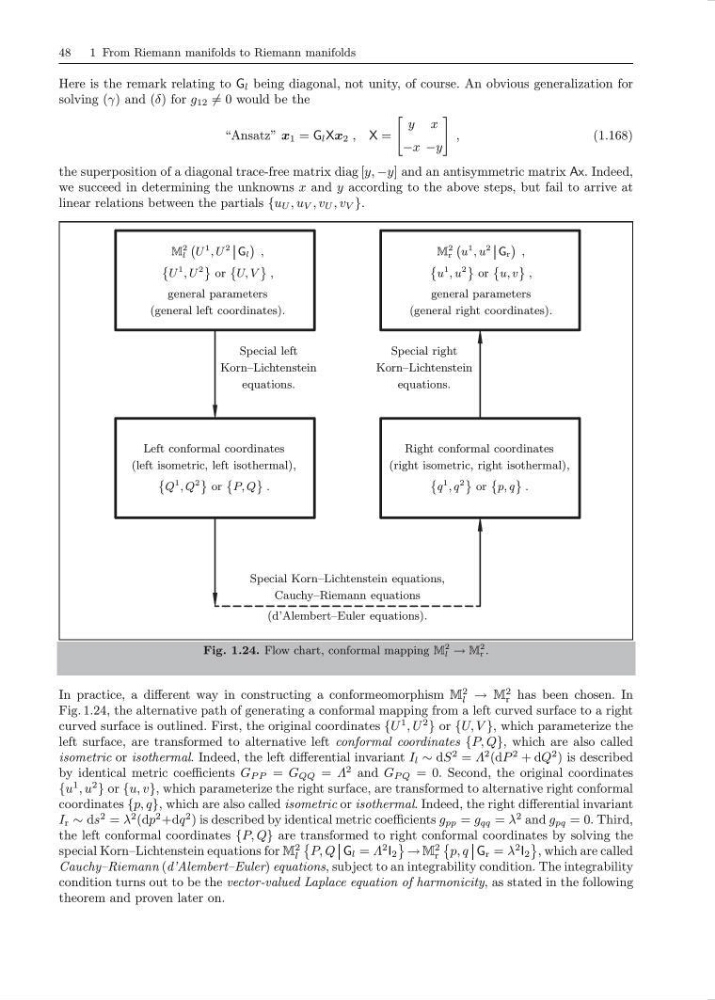
Fig. 1.24. Flow chart, conformal mapping M
2
l → M
2
r .
In practice, a different way in constructing a conformeomorphism M
2
l → M
2
r has been chosen. In
Fig. 1.24, the alternative path of generating a conformal mapping from a left curved surface to a right
curved surface is outlined. First, the original coordinates {U
1 , U
2
} or {U, V }, which parameterize the
left surface, are transformed to alternative left conformal coordinates {P, Q}, which are also called
isometric or isothermal. Indeed, the left differential invariant I l ∼ dS
2 = Λ
2 (dP
2 + dQ
2 ) is described
by identical metric coefficients G P P = G QQ = Λ
2 and G P Q = 0. Second, the original coordinates
{u
1 , u
2
} or {u, v}, which parameterize the right surface, are transformed to alternative right conformal
coordinates {p, q}, which are also called isometric or isothermal. Indeed, the right differential invariant
I r ∼ ds
2 = λ
2 (dp
2 +dq
2 ) is described by identical metric coefficients g pp = g qq = λ
2 and g pq = 0. Third,
the left conformal coordinates {P, Q} are transformed to right conformal coordinates by solving the
special Korn–Lichtenstein equations for M
2
l
P, Q G l = Λ
2 I 2
→ M
2
r
p, q G r = λ
2 I 2
, which are called
Cauchy–Riemann (d’Alembert–Euler) equations, subject to an integrability condition. The integrability
condition turns out to be the vector-valued Laplace equation of harmonicity, as stated in the following
theorem and proven later on.
1 From Riemann manifolds to Riemann manifolds
Here is the remark relating to G l being diagonal, not unity, of course. An obvious generalization for
solving (γ) and (δ) for g 12 = 0 would be the
“Ansatz” x 1 = G l Xx 2 , X =
y x
−x −y
,
(1.168)
the superposition of a diagonal trace-free matrix diag [y, −y] and an antisymmetric matrix Ax. Indeed,
we succeed in determining the unknowns x and y according to the above steps, but fail to arrive at
linear relations between the partials {u U , u V , v U , v V }.
M
2
l
`
U
1 , U
2 G l
´
,
˘
U
1 , U
2
¯
or
˘
U, V
¯
,
general parameters
(general left coordinates).
M
2
r
`
u
1 , u
2 Gr
´
,
˘
u
1 , u
2
¯
or
˘
u, v
¯
,
general parameters
(general right coordinates).
Left conformal coordinates
(left isometric, left isothermal),
˘
Q
1 , Q
2
¯
or
˘
P, Q
¯
.
Right conformal coordinates
(right isometric, right isothermal),
˘
q
1 , q
2
¯
or
˘
p, q
¯
.
Special Korn–Lichtenstein equations,
Cauchy–Riemann equations
(d’Alembert–Euler equations).
Special left
Korn–Lichtenstein
equations.
Special right
Korn–Lichtenstein
equations.
Fig. 1.24. Flow chart, conformal mapping M
2
l → M
2
r .
In practice, a different way in constructing a conformeomorphism M
2
l → M
2
r has been chosen. In
Fig. 1.24, the alternative path of generating a conformal mapping from a left curved surface to a right
curved surface is outlined. First, the original coordinates {U
1 , U
2
} or {U, V }, which parameterize the
left surface, are transformed to alternative left conformal coordinates {P, Q}, which are also called
isometric or isothermal. Indeed, the left differential invariant I l ∼ dS
2 = Λ
2 (dP
2 + dQ
2 ) is described
by identical metric coefficients G P P = G QQ = Λ
2 and G P Q = 0. Second, the original coordinates
{u
1 , u
2
} or {u, v}, which parameterize the right surface, are transformed to alternative right conformal
coordinates {p, q}, which are also called isometric or isothermal. Indeed, the right differential invariant
I r ∼ ds
2 = λ
2 (dp
2 +dq
2 ) is described by identical metric coefficients g pp = g qq = λ
2 and g pq = 0. Third,
the left conformal coordinates {P, Q} are transformed to right conformal coordinates by solving the
special Korn–Lichtenstein equations for M
2
l
P, Q G l = Λ
2 I 2
→ M
2
r
p, q G r = λ
2 I 2
, which are called
Cauchy–Riemann (d’Alembert–Euler) equations, subject to an integrability condition. The integrability
condition turns out to be the vector-valued Laplace equation of harmonicity, as stated in the following
theorem and proven later on.