

590 G Generalized Mollweide projection
X ∈ E
2
A 1 ,A 2
:=
:=
X ∈ R
3 X
2 + Y
2
A 2
1
+
Z
2
A 2
2
= 1, A 1 ∈ R
+ , A 2 ∈ R
+ , A 1 > A 2
,
(G.1)
X(L, B) =
= e 1
A 1 cos Φ cos Λ
1 − E 2 sin
2 Φ
+ e 2
A 1 cos Φ sin Λ
1 − E 2 sin
2 Φ
+ e 3
A 1 (1 − E
2 ) sin Φ
1 − E 2 sin
2 Φ
.
(G.2)
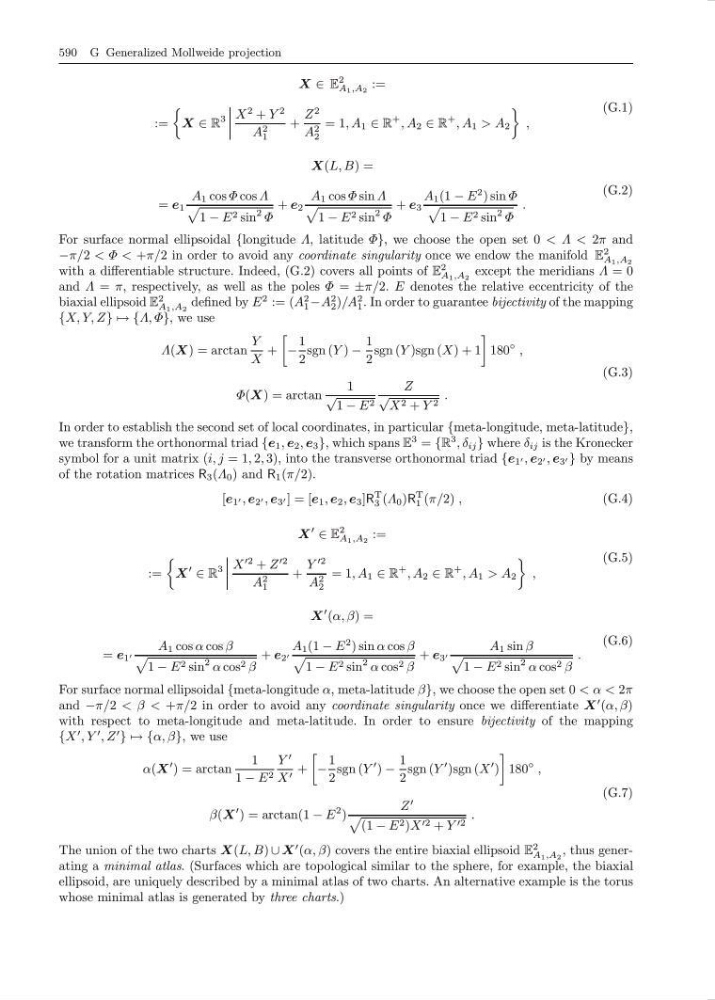
For surface normal ellipsoidal {longitude Λ, latitude Φ}, we choose the open set 0 < Λ < 2π and
−π/2 < Φ < +π/2 in order to avoid any coordinate singularity once we endow the manifold E
2
A 1 ,A 2
with a differentiable structure. Indeed, (G.2) covers all points of E
2
A 1 ,A 2
except the meridians Λ = 0
and Λ = π, respectively, as well as the poles Φ = ±π/2. E denotes the relative eccentricity of the
biaxial ellipsoid E
2
A 1 ,A 2
defined by E
2 := (A
2
1 −A
2
2 )/A
2
1 . In order to guarantee bijectivity of the mapping
{X, Y, Z} → {Λ, Φ}, we use
Λ(X) = arctan
Y
X
+
−
1
2
sgn (Y ) −
1
2
sgn (Y )sgn (X) + 1
180
◦ ,
Φ(X) = arctan
1
√
1 − E 2
Z
√
X 2 + Y 2
.
(G.3)
In order to establish the second set of local coordinates, in particular {meta-longitude, meta-latitude},
we transform the orthonormal triad {e 1 , e 2 , e 3 }, which spans E
3 = {R
3 , δ ij } where δ ij is the Kronecker
symbol for a unit matrix (i, j = 1, 2, 3), into the transverse orthonormal triad {e 1 , e 2 , e 3 } by means
of the rotation matrices R 3 (Λ 0 ) and R 1 (π/2).
[e 1 , e 2 , e 3 ] = [e 1 , e 2 , e 3 ]R
T
3 (Λ 0 )R
T
1 (π/2) ,
(G.4)
X
∈ E
2
A 1 ,A 2 :=
:=
X
∈ R
3 X
2 + Z
2
A 2
1
+
Y
2
A 2
2
= 1, A 1 ∈ R
+ , A 2 ∈ R
+ , A 1 > A 2
,
(G.5)
X
(α, β) =
= e 1
A 1 cos α cos β
1 − E 2 sin
2 α cos 2 β
+ e 2
A 1 (1 − E
2 ) sin α cos β
1 − E 2 sin
2 α cos 2 β
+ e 3
A 1 sin β
1 − E 2 sin
2 α cos 2 β
.
(G.6)
For surface normal ellipsoidal {meta-longitude α, meta-latitude β}, we choose the open set 0 < α < 2π
and −π/2 < β < +π/2 in order to avoid any coordinate singularity once we differentiate X
(α, β)
with respect to meta-longitude and meta-latitude. In order to ensure bijectivity of the mapping
{X
, Y
, Z
} → {α, β}, we use
α(X
) = arctan
1
1 − E 2
Y
X +
−
1
2
sgn (Y
) −
1
2
sgn (Y
)sgn (X
)
180
◦ ,
β(X
) = arctan(1 − E
2 )
Z
(1 − E 2 )X 2 + Y 2
.
(G.7)
The union of the two charts X(L, B) ∪ X
(α, β) covers the entire biaxial ellipsoid E
2
A 1 ,A 2
, thus generating a minimal atlas. (Surfaces which are topological similar to the sphere, for example, the biaxial
ellipsoid, are uniquely described by a minimal atlas of two charts. An alternative example is the torus
whose minimal atlas is generated by three charts.)