

570 F Mixed cylindric map projections
F-1 Pseudo-cylindrical mapping: biaxial ellipsoid onto plane
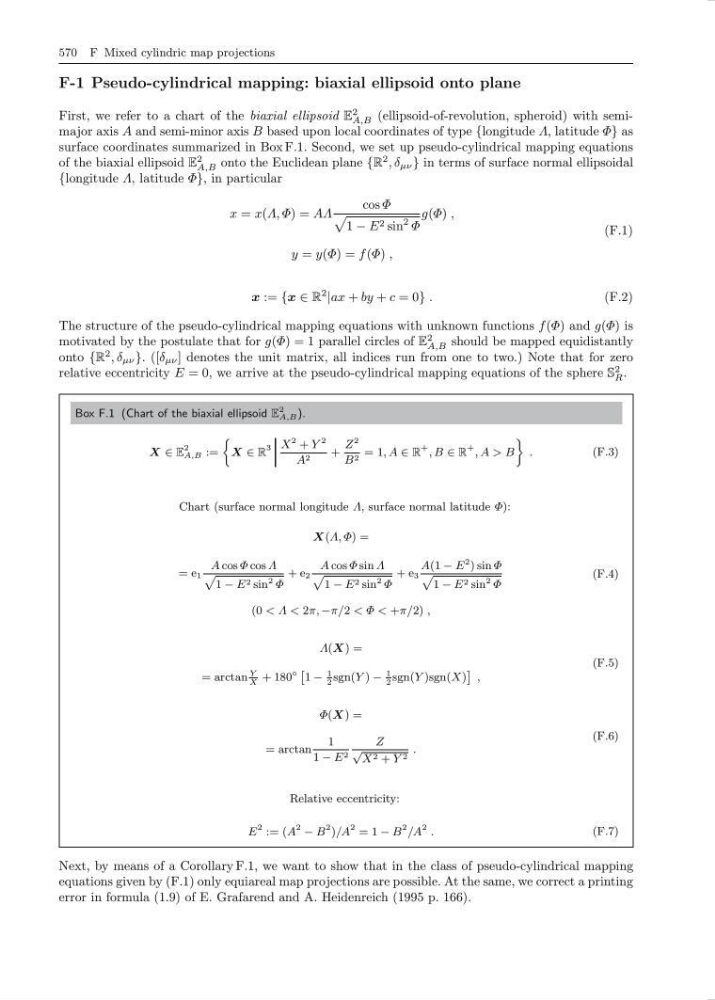
First, we refer to a chart of the biaxial ellipsoid E
2
A,B (ellipsoid-of-revolution, spheroid) with semimajor axis A and semi-minor axis B based upon local coordinates of type {longitude Λ, latitude Φ} as
surface coordinates summarized in Box F.1. Second, we set up pseudo-cylindrical mapping equations
of the biaxial ellipsoid E
2
A,B onto the Euclidean plane {R
2 , δ µν } in terms of surface normal ellipsoidal
{longitude Λ, latitude Φ}, in particular
x = x(Λ, Φ) = AΛ
cos Φ
1 − E 2 sin
2 Φ
g(Φ) ,
y = y(Φ) = f (Φ) ,
(F.1)
x := {x ∈ R
2
|ax + by + c = 0} .
(F.2)
The structure of the pseudo-cylindrical mapping equations with unknown functions f (Φ) and g(Φ) is
motivated by the postulate that for g(Φ) = 1 parallel circles of E
2
A,B should be mapped equidistantly
onto {R
2 , δ µν }. ([δ µν ] denotes the unit matrix, all indices run from one to two.) Note that for zero
relative eccentricity E = 0, we arrive at the pseudo-cylindrical mapping equations of the sphere S
2
R .
Box F.1 (Chart of the biaxial ellipsoid E
2
A,B ).
X ∈ E
2
A,B :=
j
X ∈ R
3 X
2 + Y
2
A 2
+
Z
2
B 2 = 1, A ∈ R
+ , B ∈ R
+ , A > B
ff
.
(F.3)
Chart (surface normal longitude Λ, surface normal latitude Φ):
X (Λ, Φ) =
= e 1
A cos Φ cos Λ
p
1 − E 2 sin
2 Φ
+ e 2
A cos Φ sin Λ
p
1 − E 2 sin
2 Φ
+ e 3
A(1 − E
2 ) sin Φ
p
1 − E 2 sin
2 Φ
(0 < Λ < 2π, −π/2 < Φ < +π/2) ,
(F.4)
Λ(X ) =
= arctan
Y
X
+ 180
◦
ˆ
1 −
1
2
sgn(Y ) −
1
2
sgn(Y )sgn(X)
˜
,
(F.5)
Φ(X ) =
= arctan
1
1 − E 2
Z
√
X 2 + Y 2
.
(F.6)
Relative eccentricity:
E
2 := (A
2 − B
2 )/A
2 = 1 − B
2 /A
2 .
(F.7)
Next, by means of a Corollary F.1, we want to show that in the class of pseudo-cylindrical mapping
equations given by (F.1) only equiareal map projections are possible. At the same, we correct a printing
error in formula (1.9) of E. Grafarend and A. Heidenreich (1995 p. 166).
F-1 Pseudo-cylindrical mapping: biaxial ellipsoid onto plane
First, we refer to a chart of the biaxial ellipsoid E
2
A,B (ellipsoid-of-revolution, spheroid) with semimajor axis A and semi-minor axis B based upon local coordinates of type {longitude Λ, latitude Φ} as
surface coordinates summarized in Box F.1. Second, we set up pseudo-cylindrical mapping equations
of the biaxial ellipsoid E
2
A,B onto the Euclidean plane {R
2 , δ µν } in terms of surface normal ellipsoidal
{longitude Λ, latitude Φ}, in particular
x = x(Λ, Φ) = AΛ
cos Φ
1 − E 2 sin
2 Φ
g(Φ) ,
y = y(Φ) = f (Φ) ,
(F.1)
x := {x ∈ R
2
|ax + by + c = 0} .
(F.2)
The structure of the pseudo-cylindrical mapping equations with unknown functions f (Φ) and g(Φ) is
motivated by the postulate that for g(Φ) = 1 parallel circles of E
2
A,B should be mapped equidistantly
onto {R
2 , δ µν }. ([δ µν ] denotes the unit matrix, all indices run from one to two.) Note that for zero
relative eccentricity E = 0, we arrive at the pseudo-cylindrical mapping equations of the sphere S
2
R .
Box F.1 (Chart of the biaxial ellipsoid E
2
A,B ).
X ∈ E
2
A,B :=
j
X ∈ R
3 X
2 + Y
2
A 2
+
Z
2
B 2 = 1, A ∈ R
+ , B ∈ R
+ , A > B
ff
.
(F.3)
Chart (surface normal longitude Λ, surface normal latitude Φ):
X (Λ, Φ) =
= e 1
A cos Φ cos Λ
p
1 − E 2 sin
2 Φ
+ e 2
A cos Φ sin Λ
p
1 − E 2 sin
2 Φ
+ e 3
A(1 − E
2 ) sin Φ
p
1 − E 2 sin
2 Φ
(0 < Λ < 2π, −π/2 < Φ < +π/2) ,
(F.4)
Λ(X ) =
= arctan
Y
X
+ 180
◦
ˆ
1 −
1
2
sgn(Y ) −
1
2
sgn(Y )sgn(X)
˜
,
(F.5)
Φ(X ) =
= arctan
1
1 − E 2
Z
√
X 2 + Y 2
.
(F.6)
Relative eccentricity:
E
2 := (A
2 − B
2 )/A
2 = 1 − B
2 /A
2 .
(F.7)
Next, by means of a Corollary F.1, we want to show that in the class of pseudo-cylindrical mapping
equations given by (F.1) only equiareal map projections are possible. At the same, we correct a printing
error in formula (1.9) of E. Grafarend and A. Heidenreich (1995 p. 166).