

520 C Elliptic integrals
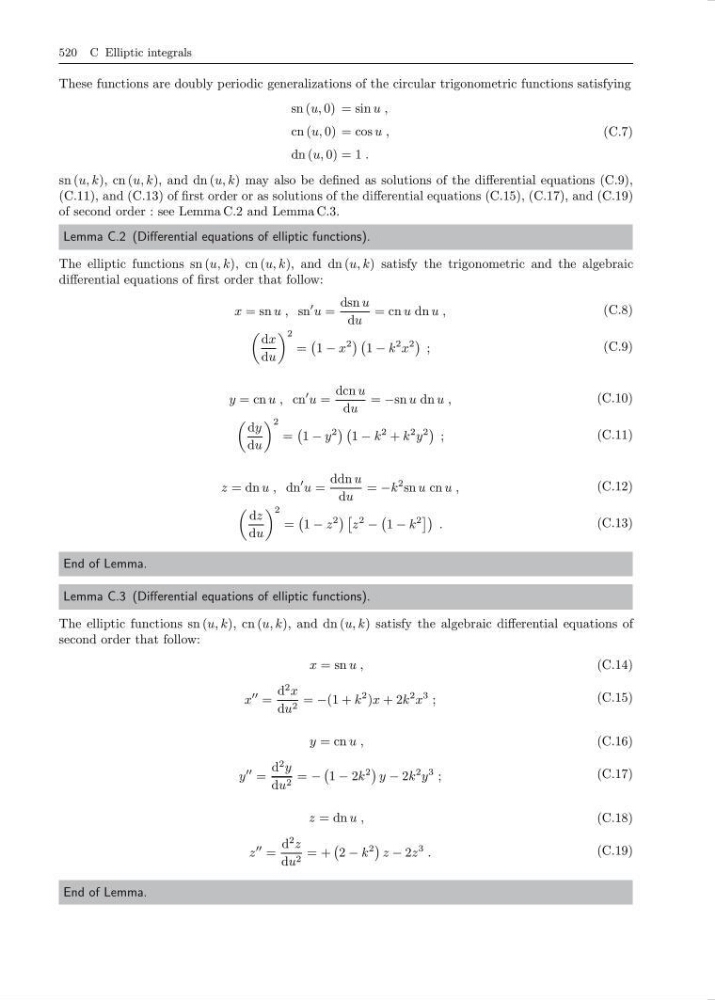
These functions are doubly periodic generalizations of the circular trigonometric functions satisfying
sn (u, 0) = sin u ,
cn (u, 0) = cos u ,
dn (u, 0) = 1 .
(C.7)
sn (u, k), cn (u, k), and dn (u, k) may also be defined as solutions of the differential equations (C.9),
(C.11), and (C.13) of first order or as solutions of the differential equations (C.15), (C.17), and (C.19)
of second order : see Lemma C.2 and Lemma C.3.
Lemma C.2 (Differential equations of elliptic functions).
The elliptic functions sn (u, k), cn (u, k), and dn (u, k) satisfy the trigonometric and the algebraic
differential equations of first order that follow:
x = sn u , sn
u =
dsn u
du
= cn u dn u ,
(C.8)
dx
du
2
=
1 − x
2
1 − k
2 x
2
;
(C.9)
y = cn u , cn
u =
dcn u
du
= −sn u dn u ,
(C.10)
dy
du
2
=
1 − y
2
1 − k
2 + k
2 y
2
;
(C.11)
z = dn u , dn
u =
ddn u
du
= −k
2 sn u cn u ,
(C.12)
dz
du
2
=
1 − z
2
z
2
−
1 − k
2
.
(C.13)
End of Lemma.
Lemma C.3 (Differential equations of elliptic functions).
The elliptic functions sn (u, k), cn (u, k), and dn (u, k) satisfy the algebraic differential equations of
second order that follow:
x = sn u ,
(C.14)
x
=
d
2 x
du 2 = −(1 + k
2 )x + 2k
2 x
3 ;
(C.15)
y = cn u ,
(C.16)
y
=
d
2 y
du 2 = −
1 − 2k
2
y − 2k
2 y
3 ;
(C.17)
z = dn u ,
(C.18)
z
=
d
2 z
du 2 = +
2 − k
2
z − 2z
3 .
(C.19)
End of Lemma.
These functions are doubly periodic generalizations of the circular trigonometric functions satisfying
sn (u, 0) = sin u ,
cn (u, 0) = cos u ,
dn (u, 0) = 1 .
(C.7)
sn (u, k), cn (u, k), and dn (u, k) may also be defined as solutions of the differential equations (C.9),
(C.11), and (C.13) of first order or as solutions of the differential equations (C.15), (C.17), and (C.19)
of second order : see Lemma C.2 and Lemma C.3.
Lemma C.2 (Differential equations of elliptic functions).
The elliptic functions sn (u, k), cn (u, k), and dn (u, k) satisfy the trigonometric and the algebraic
differential equations of first order that follow:
x = sn u , sn
u =
dsn u
du
= cn u dn u ,
(C.8)
dx
du
2
=
1 − x
2
1 − k
2 x
2
;
(C.9)
y = cn u , cn
u =
dcn u
du
= −sn u dn u ,
(C.10)
dy
du
2
=
1 − y
2
1 − k
2 + k
2 y
2
;
(C.11)
z = dn u , dn
u =
ddn u
du
= −k
2 sn u cn u ,
(C.12)
dz
du
2
=
1 − z
2
z
2
−
1 − k
2
.
(C.13)
End of Lemma.
Lemma C.3 (Differential equations of elliptic functions).
The elliptic functions sn (u, k), cn (u, k), and dn (u, k) satisfy the algebraic differential equations of
second order that follow:
x = sn u ,
(C.14)
x
=
d
2 x
du 2 = −(1 + k
2 )x + 2k
2 x
3 ;
(C.15)
y = cn u ,
(C.16)
y
=
d
2 y
du 2 = −
1 − 2k
2
y − 2k
2 y
3 ;
(C.17)
z = dn u ,
(C.18)
z
=
d
2 z
du 2 = +
2 − k
2
z − 2z
3 .
(C.19)
End of Lemma.