

498 A Law and order
b 1
b 2
a 1
a 2
a 3
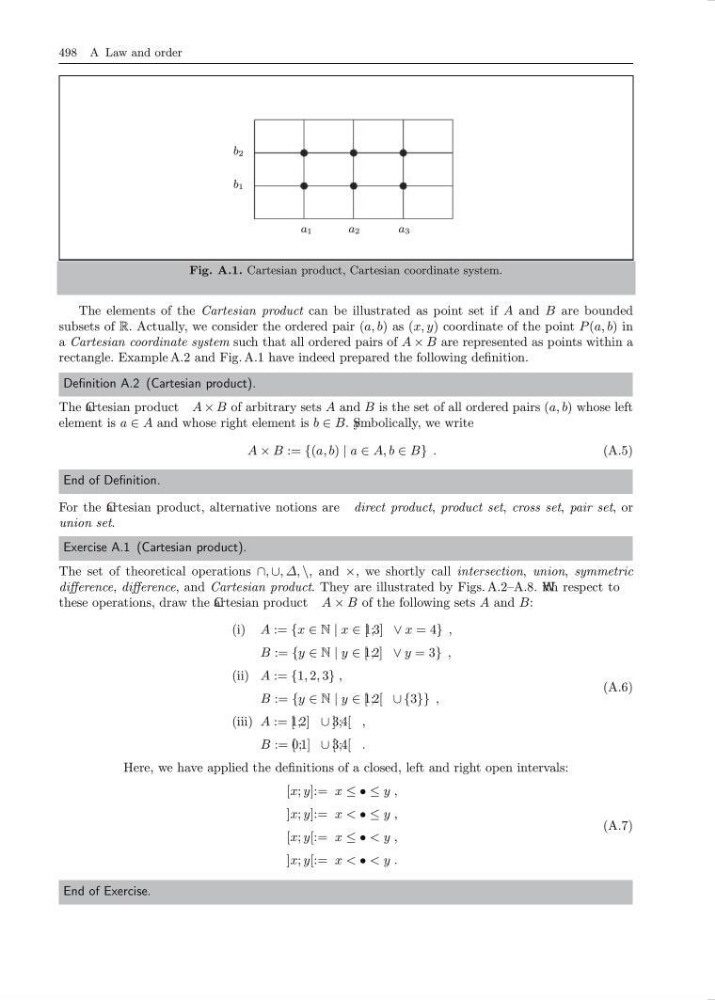
Fig. A.1. Cartesian product, Cartesian coordinate system.
The elements of the Cartesian product can be illustrated as point set if A and B are bounded
subsets of R. Actually, we consider the ordered pair (a, b) as (x, y) coordinate of the point P (a, b) in
a Cartesian coordinate system such that all ordered pairs of A × B are represented as points within a
rectangle. Example A.2 and Fig. A.1 have indeed prepared the following definition.
Definition A.2 (Cartesian product).
The C artesian product A × B of arbitrary sets A and B is the set of all ordered pairs (a, b) whose left
element is a ∈ A and whose right element is b ∈ B. S ymbolically, we write
A × B := {(a, b) | a ∈ A, b ∈ B} .
(A.5)
End of Definition.
For the C artesian product, alternative notions are direct product, product set, cross set, pair set, or
union set.
Exercise A.1 (Cartesian product).
The set of theoretical operations ∩, ∪, ∆, \, and ×, we shortly call intersection, union, symmetric
difference, difference, and Cartesian product. They are illustrated by Figs. A.2–A.8. W ith respect to
these operations, draw the C
artesian product A × B of the following sets A and B:
(i) A := {x ∈ N | x ∈ [ 1;3] ∨ x = 4} ,
B := {y ∈ N | y ∈ [ 1;2] ∨ y = 3} ,
(ii) A := {1, 2, 3} ,
B := {y ∈ N | y ∈ [ 1;2[ ∪ {3}} ,
(iii) A := [ 1;2] ∪ ] 3;4[ ,
B := [ 0;1] ∪ [ 3;4[ .
(A.6)
Here, we have applied the definitions of a closed, left and right open intervals:
[x; y]:= x ≤ • ≤ y ,
]x; y]:= x < • ≤ y ,
[x; y[:= x ≤ • < y ,
]x; y[:= x < • < y .
(A.7)
End of Exercise.
b 1
b 2
a 1
a 2
a 3
Fig. A.1. Cartesian product, Cartesian coordinate system.
The elements of the Cartesian product can be illustrated as point set if A and B are bounded
subsets of R. Actually, we consider the ordered pair (a, b) as (x, y) coordinate of the point P (a, b) in
a Cartesian coordinate system such that all ordered pairs of A × B are represented as points within a
rectangle. Example A.2 and Fig. A.1 have indeed prepared the following definition.
Definition A.2 (Cartesian product).
The C artesian product A × B of arbitrary sets A and B is the set of all ordered pairs (a, b) whose left
element is a ∈ A and whose right element is b ∈ B. S ymbolically, we write
A × B := {(a, b) | a ∈ A, b ∈ B} .
(A.5)
End of Definition.
For the C artesian product, alternative notions are direct product, product set, cross set, pair set, or
union set.
Exercise A.1 (Cartesian product).
The set of theoretical operations ∩, ∪, ∆, \, and ×, we shortly call intersection, union, symmetric
difference, difference, and Cartesian product. They are illustrated by Figs. A.2–A.8. W ith respect to
these operations, draw the C
artesian product A × B of the following sets A and B:
(i) A := {x ∈ N | x ∈ [ 1;3] ∨ x = 4} ,
B := {y ∈ N | y ∈ [ 1;2] ∨ y = 3} ,
(ii) A := {1, 2, 3} ,
B := {y ∈ N | y ∈ [ 1;2[ ∪ {3}} ,
(iii) A := [ 1;2] ∪ ] 3;4[ ,
B := [ 0;1] ∪ [ 3;4[ .
(A.6)
Here, we have applied the definitions of a closed, left and right open intervals:
[x; y]:= x ≤ • ≤ y ,
]x; y]:= x < • ≤ y ,
[x; y[:= x ≤ • < y ,
]x; y[:= x < • < y .
(A.7)
End of Exercise.