

21-4 Gauss–Krueger/UTM coordinates: from a local to a global datum 469
21-4 Gauss–Krueger/UTM coordinates: from a local to a global datum
Transformation of conformal coordinates of type Gauss–Krueger or UTM from a local datum (regional,
National, European) to a global datum (WGS 84).
A key problem of contemporary geodetic positioning is the transformation of mega data sets of conformal coordinates of type Gauss–Krueger or UTM from a local datum, also called regional, National,
European etc., to a global datum, for instance, the World Geodetic System 1984 (WGS 84) with reference to M. J. Boyle (1987). As an example, let us refer to the mega data sets of more than 150 Mio.
Gauss–Krueger conformal coordinates of Germany, where the West German conformal coordinates
relate to the Bessel reference ellipsoid, while the East German conformal coordinates relate to the
Krassowsky reference ellipsoid. Thanks to the satellite Global Positioning System (“global problem
solver”: GPS) and advanced computer software, geodetic positions are given as conformal coordinates
of type Gauss–Krueger or UTM relating to the reference ellipsoid of the World Geodetic System (WGS
84). In connection with a chart, GPS-derived conformal coordinates of type Gauss–Krueger or UTM
can only be used when they are transformed from the global datum to the local datum, which the chart
is based upon. Or vice versa: the conformal coordinates of type Gauss–Krueger or UTM which are
presented in a chart of local datum have to be transformed to the global datum. The transformation
of conformal coordinates (Gauss–Krueger or UTM) from a local datum to a global one and vice versa
is the objective of our contribution.
coordinate transformation
coordinate transformation
conformal mapping of E
2
a 1 ,a 2
conformal mapping of E
2
A 1 ,A 2
curvilinear
datum transformation
nonlinear affine
datum transformation
conformal group C 7 (3)
local conformal coordinates
(Gauss–Krueger, UTM)
global conformal coordinates
(Gauss–Krueger, UTM)
{x
1 , x
2 , x
3 }
{ X
1 , X
2 , X
3 }
{l, b, h}
{ L, B, H}
{x, y}
{ X, Y }
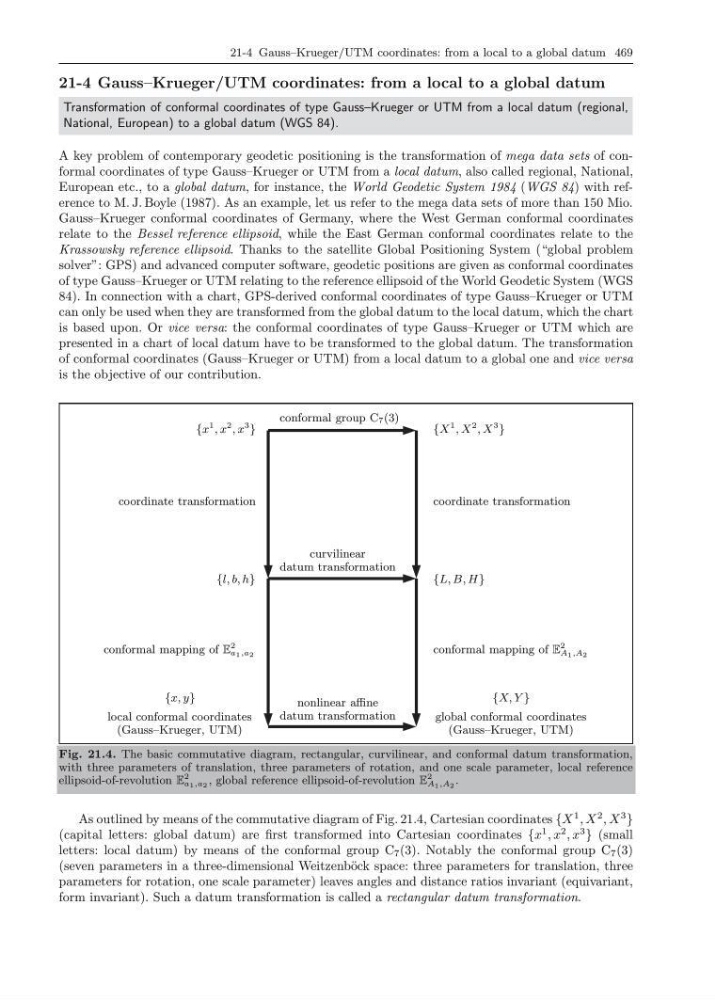
Fig. 21.4. The basic commutative diagram, rectangular, curvilinear, and conformal datum transformation,
with three parameters of translation, three parameters of rotation, and one scale parameter, local reference
ellipsoid-of-revolution E
2
a 1 ,a 2 , global reference ellipsoid-of-revolution E
2
A 1 ,A 2 .
As outlined by means of the commutative diagram of Fig. 21.4, Cartesian coordinates {X
1 , X
2 , X
3
}
(capital letters: global datum) are first transformed into Cartesian coordinates {x
1 , x
2 , x
3
} (small
letters: local datum) by means of the conformal group C 7 (3). Notably the conformal group C 7 (3)
(seven parameters in a three-dimensional Weitzenb¨ ock space: three parameters for translation, three
parameters for rotation, one scale parameter) leaves angles and distance ratios invariant (equivariant,
form invariant). Such a datum transformation is called a rectangular datum transformation.
21-4 Gauss–Krueger/UTM coordinates: from a local to a global datum
Transformation of conformal coordinates of type Gauss–Krueger or UTM from a local datum (regional,
National, European) to a global datum (WGS 84).
A key problem of contemporary geodetic positioning is the transformation of mega data sets of conformal coordinates of type Gauss–Krueger or UTM from a local datum, also called regional, National,
European etc., to a global datum, for instance, the World Geodetic System 1984 (WGS 84) with reference to M. J. Boyle (1987). As an example, let us refer to the mega data sets of more than 150 Mio.
Gauss–Krueger conformal coordinates of Germany, where the West German conformal coordinates
relate to the Bessel reference ellipsoid, while the East German conformal coordinates relate to the
Krassowsky reference ellipsoid. Thanks to the satellite Global Positioning System (“global problem
solver”: GPS) and advanced computer software, geodetic positions are given as conformal coordinates
of type Gauss–Krueger or UTM relating to the reference ellipsoid of the World Geodetic System (WGS
84). In connection with a chart, GPS-derived conformal coordinates of type Gauss–Krueger or UTM
can only be used when they are transformed from the global datum to the local datum, which the chart
is based upon. Or vice versa: the conformal coordinates of type Gauss–Krueger or UTM which are
presented in a chart of local datum have to be transformed to the global datum. The transformation
of conformal coordinates (Gauss–Krueger or UTM) from a local datum to a global one and vice versa
is the objective of our contribution.
coordinate transformation
coordinate transformation
conformal mapping of E
2
a 1 ,a 2
conformal mapping of E
2
A 1 ,A 2
curvilinear
datum transformation
nonlinear affine
datum transformation
conformal group C 7 (3)
local conformal coordinates
(Gauss–Krueger, UTM)
global conformal coordinates
(Gauss–Krueger, UTM)
{x
1 , x
2 , x
3 }
{ X
1 , X
2 , X
3 }
{l, b, h}
{ L, B, H}
{x, y}
{ X, Y }
Fig. 21.4. The basic commutative diagram, rectangular, curvilinear, and conformal datum transformation,
with three parameters of translation, three parameters of rotation, and one scale parameter, local reference
ellipsoid-of-revolution E
2
a 1 ,a 2 , global reference ellipsoid-of-revolution E
2
A 1 ,A 2 .
As outlined by means of the commutative diagram of Fig. 21.4, Cartesian coordinates {X
1 , X
2 , X
3
}
(capital letters: global datum) are first transformed into Cartesian coordinates {x
1 , x
2 , x
3
} (small
letters: local datum) by means of the conformal group C 7 (3). Notably the conformal group C 7 (3)
(seven parameters in a three-dimensional Weitzenb¨ ock space: three parameters for translation, three
parameters for rotation, one scale parameter) leaves angles and distance ratios invariant (equivariant,
form invariant). Such a datum transformation is called a rectangular datum transformation.