

454 21 Datum problems
21-1 Analysis of a datum problem
Datum transformation, datum parameters (translation, rotation, scale). General conformal group, special
orthogonal group. Jacobi matrix, chain Jacobi matrix.
Analysis is understood as the determination of datum parameters between two sets of curvilinear coordinates of identical points which cover R
3 equipped with an Euclidean metric. The datum parameters
like translation t, rotation R, and scale 1 + s characterize a datum transformation (“Kartenwechsel”)
which leaves (as a passive transformation) angles and distance ratios equivariant. In its linear variant, they are the parameters of the conformal group C 7 (3), the seven-parameter transformation in
R
3 . The general conformal group C 10 (3), in contrast, includes three parameters more, as outlined in
E. Grafarend and G. Kampmann (1996), for instance. As soon as we cover R
3 by Cartesian coordinates (say {x, y, z} in the local reference system versus {X, Y, Z} in the global reference system), we
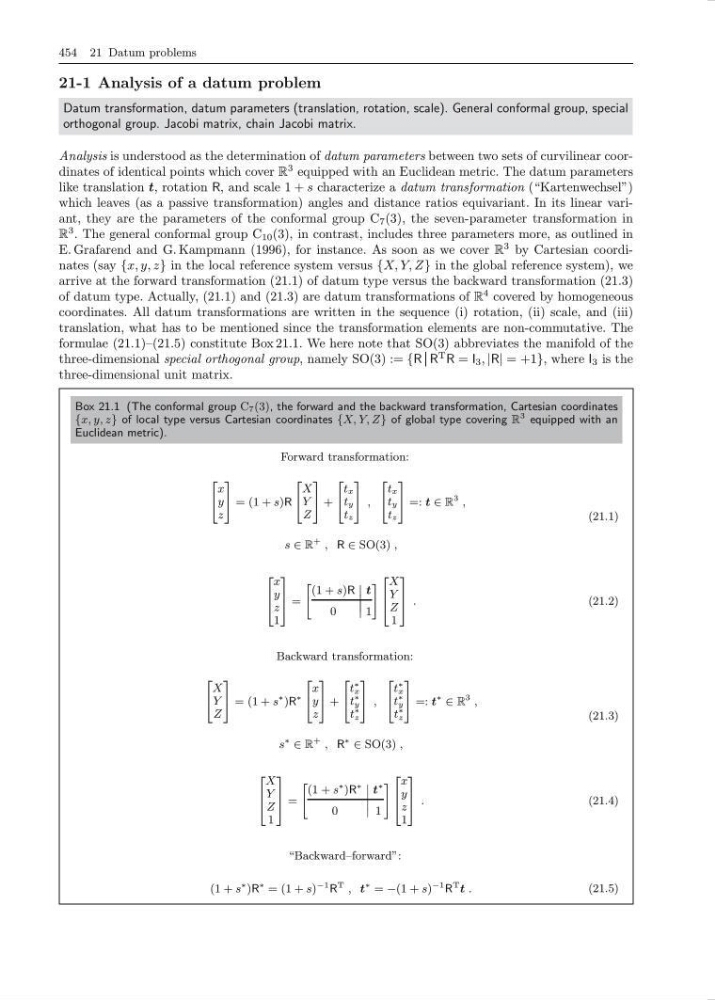
arrive at the forward transformation (21.1) of datum type versus the backward transformation (21.3)
of datum type. Actually, (21.1) and (21.3) are datum transformations of R
4 covered by homogeneous
coordinates. All datum transformations are written in the sequence (i) rotation, (ii) scale, and (iii)
translation, what has to be mentioned since the transformation elements are non-commutative. The
formulae (21.1)–(21.5) constitute Box 21.1. We here note that SO(3) abbreviates the manifold of the
three-dimensional special orthogonal group, namely SO(3) := {R R
T R = I 3 , |R| = +1}, where I 3 is the
three-dimensional unit matrix.
Box 21.1 (The conformal group C 7 (3), the forward and the backward transformation, Cartesian coordinates
{x, y, z} of local type versus Cartesian coordinates {X, Y, Z} of global type covering R
3 equipped with an
Euclidean metric).
Forward transformation:
2
4
x
y
z
3
5 = (1 + s)R
2
4
X
Y
Z
3
5 +
2
4
t x
t y
t z
3
5 ,
2
4
t x
t y
t z
3
5 =: t ∈ R
3 ,
s ∈ R
+ , R ∈ SO(3) ,
(21.1)
2
6
4
x
y
z
1
3
7
5 =
"
(1 + s)R | t
|
|
0
| 1
#
2
6
4
X
Y
Z
1
3
7
5 .
(21.2)
Backward transformation:
2
4
X
Y
Z
3
5 = (1 + s
∗ )R
∗
2
4
x
y
z
3
5 +
2
4
t
∗
x
t
∗
y
t
∗
z
3
5 ,
2
4
t
∗
x
t
∗
y
t
∗
z
3
5 =: t
∗ ∈ R
3 ,
s
∗ ∈ R
+ , R
∗ ∈ SO(3) ,
(21.3)
2
6
4
X
Y
Z
1
3
7
5 =
"
(1 + s
∗ )R
∗ | t
∗
|
|
0
| 1
#
2
6
4
x
y
z
1
3
7
5 .
(21.4)
“Backward–forward”:
(1 + s
∗ )R
∗ = (1 + s)
−1 R
T , t
∗ = −(1 + s)
−1 R
T t .
(21.5)
21-1 Analysis of a datum problem
Datum transformation, datum parameters (translation, rotation, scale). General conformal group, special
orthogonal group. Jacobi matrix, chain Jacobi matrix.
Analysis is understood as the determination of datum parameters between two sets of curvilinear coordinates of identical points which cover R
3 equipped with an Euclidean metric. The datum parameters
like translation t, rotation R, and scale 1 + s characterize a datum transformation (“Kartenwechsel”)
which leaves (as a passive transformation) angles and distance ratios equivariant. In its linear variant, they are the parameters of the conformal group C 7 (3), the seven-parameter transformation in
R
3 . The general conformal group C 10 (3), in contrast, includes three parameters more, as outlined in
E. Grafarend and G. Kampmann (1996), for instance. As soon as we cover R
3 by Cartesian coordinates (say {x, y, z} in the local reference system versus {X, Y, Z} in the global reference system), we
arrive at the forward transformation (21.1) of datum type versus the backward transformation (21.3)
of datum type. Actually, (21.1) and (21.3) are datum transformations of R
4 covered by homogeneous
coordinates. All datum transformations are written in the sequence (i) rotation, (ii) scale, and (iii)
translation, what has to be mentioned since the transformation elements are non-commutative. The
formulae (21.1)–(21.5) constitute Box 21.1. We here note that SO(3) abbreviates the manifold of the
three-dimensional special orthogonal group, namely SO(3) := {R R
T R = I 3 , |R| = +1}, where I 3 is the
three-dimensional unit matrix.
Box 21.1 (The conformal group C 7 (3), the forward and the backward transformation, Cartesian coordinates
{x, y, z} of local type versus Cartesian coordinates {X, Y, Z} of global type covering R
3 equipped with an
Euclidean metric).
Forward transformation:
2
4
x
y
z
3
5 = (1 + s)R
2
4
X
Y
Z
3
5 +
2
4
t x
t y
t z
3
5 ,
2
4
t x
t y
t z
3
5 =: t ∈ R
3 ,
s ∈ R
+ , R ∈ SO(3) ,
(21.1)
2
6
4
x
y
z
1
3
7
5 =
"
(1 + s)R | t
|
|
0
| 1
#
2
6
4
X
Y
Z
1
3
7
5 .
(21.2)
Backward transformation:
2
4
X
Y
Z
3
5 = (1 + s
∗ )R
∗
2
4
x
y
z
3
5 +
2
4
t
∗
x
t
∗
y
t
∗
z
3
5 ,
2
4
t
∗
x
t
∗
y
t
∗
z
3
5 =: t
∗ ∈ R
3 ,
s
∗ ∈ R
+ , R
∗ ∈ SO(3) ,
(21.3)
2
6
4
X
Y
Z
1
3
7
5 =
"
(1 + s
∗ )R
∗ | t
∗
|
|
0
| 1
#
2
6
4
x
y
z
1
3
7
5 .
(21.4)
“Backward–forward”:
(1 + s
∗ )R
∗ = (1 + s)
−1 R
T , t
∗ = −(1 + s)
−1 R
T t .
(21.5)