

19 “Ellipsoid-of-revolution to cone”: polar aspect
Mapping the ellipsoid-of-revolution E
2
A 1 ,A 2
to a cone: polar aspect. Lambert conformal conic mapping
and Albers equal area conic mapping.
Section 19-1, Section 19-2.
First, in Section 19-1, we review the general equations of a conic mapping to the ellipsoid-of-revolution,
the polar aspect only. Second, in Section 19-2, we treat a special set of conic mappings, namely three
types and special aspects. Indeed, the detailed computations are rather elaborate.
19-1 General mapping equations of the ellipsoid-of-revolution to the cone
Deformation tensor of first order, the meridian radius, the radius of curvature in the prime vertical, the
principal stretches.
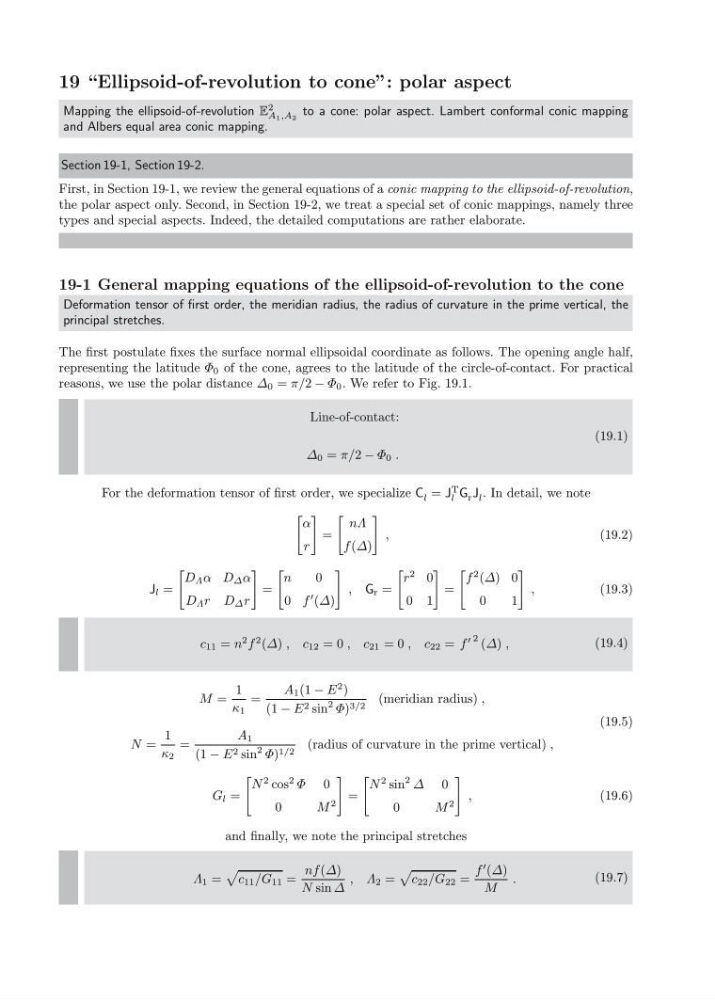
The first postulate fixes the surface normal ellipsoidal coordinate as follows. The opening angle half,
representing the latitude Φ 0 of the cone, agrees to the latitude of the circle-of-contact. For practical
reasons, we use the polar distance ∆ 0 = π/2 − Φ 0 . We refer to Fig. 19.1.
Line-of-contact:
∆ 0 = π/2 − Φ 0 .
(19.1)
For the deformation tensor of first order, we specialize C l = J
T
l G r J l . In detail, we note
α
r
=
nΛ
f (∆)
,
(19.2)
J l =
D Λ α D ∆ α
D Λ r D ∆ r
=
n
0
0 f
(∆)
, G r =
r
2 0
0 1
=
f
2 (∆) 0
0
1
,
(19.3)
c 11 = n
2 f
2 (∆) , c 12 = 0 , c 21 = 0 , c 22 = f
2 (∆) ,
(19.4)
M =
1
κ 1
=
A 1 (1 − E
2 )
(1 − E 2 sin
2 Φ) 3/2 (meridian radius) ,
N =
1
κ 2
=
A 1
(1 − E 2 sin
2 Φ) 1/2 (radius of curvature in the prime vertical) ,
(19.5)
G l =
N
2 cos
2 Φ 0
0
M
2
=
N
2 sin
2 ∆ 0
0
M
2
,
(19.6)
and finally, we note the principal stretches
Λ 1 =
c 11 /G 11 =
nf (∆)
N sin ∆
, Λ 2 =
c 22 /G 22 =
f
(∆)
M
.
(19.7)
Mapping the ellipsoid-of-revolution E
2
A 1 ,A 2
to a cone: polar aspect. Lambert conformal conic mapping
and Albers equal area conic mapping.
Section 19-1, Section 19-2.
First, in Section 19-1, we review the general equations of a conic mapping to the ellipsoid-of-revolution,
the polar aspect only. Second, in Section 19-2, we treat a special set of conic mappings, namely three
types and special aspects. Indeed, the detailed computations are rather elaborate.
19-1 General mapping equations of the ellipsoid-of-revolution to the cone
Deformation tensor of first order, the meridian radius, the radius of curvature in the prime vertical, the
principal stretches.
The first postulate fixes the surface normal ellipsoidal coordinate as follows. The opening angle half,
representing the latitude Φ 0 of the cone, agrees to the latitude of the circle-of-contact. For practical
reasons, we use the polar distance ∆ 0 = π/2 − Φ 0 . We refer to Fig. 19.1.
Line-of-contact:
∆ 0 = π/2 − Φ 0 .
(19.1)
For the deformation tensor of first order, we specialize C l = J
T
l G r J l . In detail, we note
α
r
=
nΛ
f (∆)
,
(19.2)
J l =
D Λ α D ∆ α
D Λ r D ∆ r
=
n
0
0 f
(∆)
, G r =
r
2 0
0 1
=
f
2 (∆) 0
0
1
,
(19.3)
c 11 = n
2 f
2 (∆) , c 12 = 0 , c 21 = 0 , c 22 = f
2 (∆) ,
(19.4)
M =
1
κ 1
=
A 1 (1 − E
2 )
(1 − E 2 sin
2 Φ) 3/2 (meridian radius) ,
N =
1
κ 2
=
A 1
(1 − E 2 sin
2 Φ) 1/2 (radius of curvature in the prime vertical) ,
(19.5)
G l =
N
2 cos
2 Φ 0
0
M
2
=
N
2 sin
2 ∆ 0
0
M
2
,
(19.6)
and finally, we note the principal stretches
Λ 1 =
c 11 /G 11 =
nf (∆)
N sin ∆
, Λ 2 =
c 22 /G 22 =
f
(∆)
M
.
(19.7)