

18-2 Special pseudo-conic projections based upon the sphere 403
Exercise 18.2 (Bonne projection).
Until recently, the pseudo-conic equal area Bonne projection (R. Bonne, 1727–1795) was frequently
used for atlas maps of continents. The mapping equations are specified through polar coordinates α
and r or Cartesian coordinates x and y as follows. (Λ and Φ describe spherical longitude and spherical
latitude. Φ 0 = 60
◦ N is the parallel circle which is mapped isometrically, i. e. without any distortion.)
α = Λ
cos Φ
Φ 0 − Φ + cot Φ 0
, r = R(Φ 0 − Φ) + R cot Φ 0 ,
(18.41)
x = R(Φ 0 − Φ + cot Φ 0 ) cos
Λ
cos Φ
Φ 0 − Φ + cot Φ 0
,
y = R(Φ 0 − Φ + cot Φ 0 ) sin
Λ
cos Φ
Φ 0 − Φ + cot Φ 0
.
(18.42)
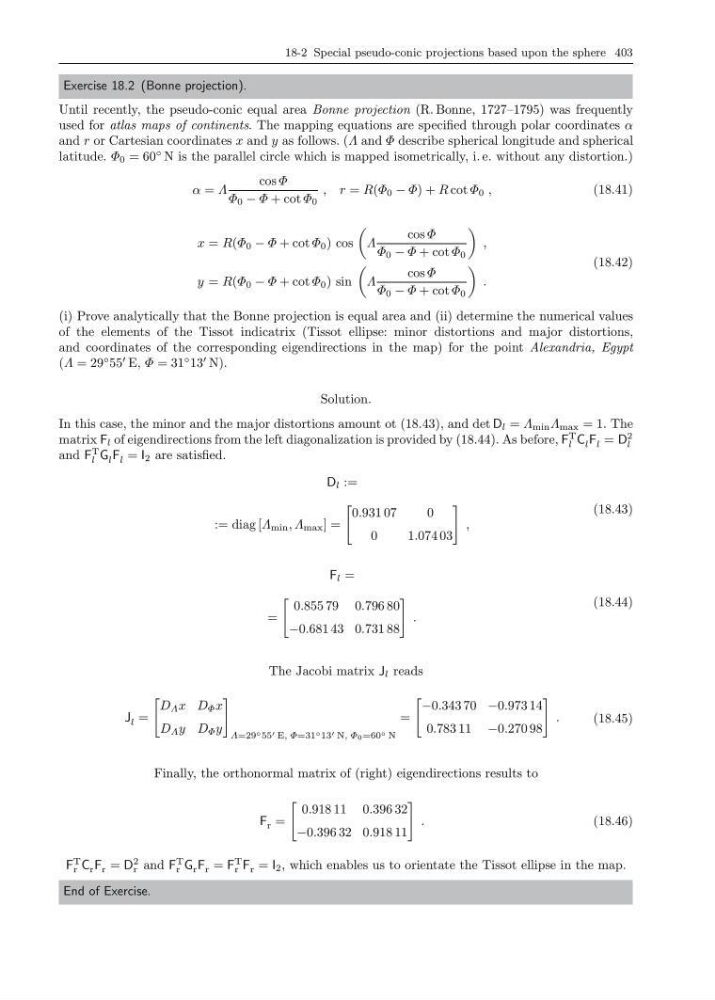
(i) Prove analytically that the Bonne projection is equal area and (ii) determine the numerical values
of the elements of the Tissot indicatrix (Tissot ellipse: minor distortions and major distortions,
and coordinates of the corresponding eigendirections in the map) for the point Alexandria, Egypt
(Λ = 29
◦ 55
E, Φ = 31
◦ 13
N).
Solution.
In this case, the minor and the major distortions amount ot (18.43), and det D l = Λ min Λ max = 1. The
matrix F l of eigendirections from the left diagonalization is provided by (18.44). As before, F
T
l C l F l = D
2
l
and F
T
l G l F l = I 2 are satisfied.
D l :=
:= diag [Λ min , Λ max ] =
0.931 07
0
0
1.074 03
,
(18.43)
F l =
=
0.855 79 0.796 80
−0.681 43 0.731 88
.
(18.44)
The Jacobi matrix J l reads
J l =
D Λ x D Φ x
D Λ y D Φ y
Λ=29 ◦ 55 E, Φ=31 ◦ 13 N, Φ 0 =60 ◦ N
=
−0.343 70 −0.973 14
0.783 11 −0.270 98
.
(18.45)
Finally, the orthonormal matrix of (right) eigendirections results to
F r =
0.918 11 0.396 32
−0.396 32 0.918 11
.
(18.46)
F
T
r C r F r = D
2
r and F
T
r G r F r = F
T
r F r = I 2 , which enables us to orientate the Tissot ellipse in the map.
End of Exercise.
Exercise 18.2 (Bonne projection).
Until recently, the pseudo-conic equal area Bonne projection (R. Bonne, 1727–1795) was frequently
used for atlas maps of continents. The mapping equations are specified through polar coordinates α
and r or Cartesian coordinates x and y as follows. (Λ and Φ describe spherical longitude and spherical
latitude. Φ 0 = 60
◦ N is the parallel circle which is mapped isometrically, i. e. without any distortion.)
α = Λ
cos Φ
Φ 0 − Φ + cot Φ 0
, r = R(Φ 0 − Φ) + R cot Φ 0 ,
(18.41)
x = R(Φ 0 − Φ + cot Φ 0 ) cos
Λ
cos Φ
Φ 0 − Φ + cot Φ 0
,
y = R(Φ 0 − Φ + cot Φ 0 ) sin
Λ
cos Φ
Φ 0 − Φ + cot Φ 0
.
(18.42)
(i) Prove analytically that the Bonne projection is equal area and (ii) determine the numerical values
of the elements of the Tissot indicatrix (Tissot ellipse: minor distortions and major distortions,
and coordinates of the corresponding eigendirections in the map) for the point Alexandria, Egypt
(Λ = 29
◦ 55
E, Φ = 31
◦ 13
N).
Solution.
In this case, the minor and the major distortions amount ot (18.43), and det D l = Λ min Λ max = 1. The
matrix F l of eigendirections from the left diagonalization is provided by (18.44). As before, F
T
l C l F l = D
2
l
and F
T
l G l F l = I 2 are satisfied.
D l :=
:= diag [Λ min , Λ max ] =
0.931 07
0
0
1.074 03
,
(18.43)
F l =
=
0.855 79 0.796 80
−0.681 43 0.731 88
.
(18.44)
The Jacobi matrix J l reads
J l =
D Λ x D Φ x
D Λ y D Φ y
Λ=29 ◦ 55 E, Φ=31 ◦ 13 N, Φ 0 =60 ◦ N
=
−0.343 70 −0.973 14
0.783 11 −0.270 98
.
(18.45)
Finally, the orthonormal matrix of (right) eigendirections results to
F r =
0.918 11 0.396 32
−0.396 32 0.918 11
.
(18.46)
F
T
r C r F r = D
2
r and F
T
r G r F r = F
T
r F r = I 2 , which enables us to orientate the Tissot ellipse in the map.
End of Exercise.