

17 “Sphere to cone”: polar aspect
Mapping the sphere to a cone: polar aspect. Equidistant, conformal, and equal area mappings. Ptolemy,
de L’Isle, Lambert, and Albers projections. Point-like North Pole. Tangent cones, secant cones, and
circles-of-contact.
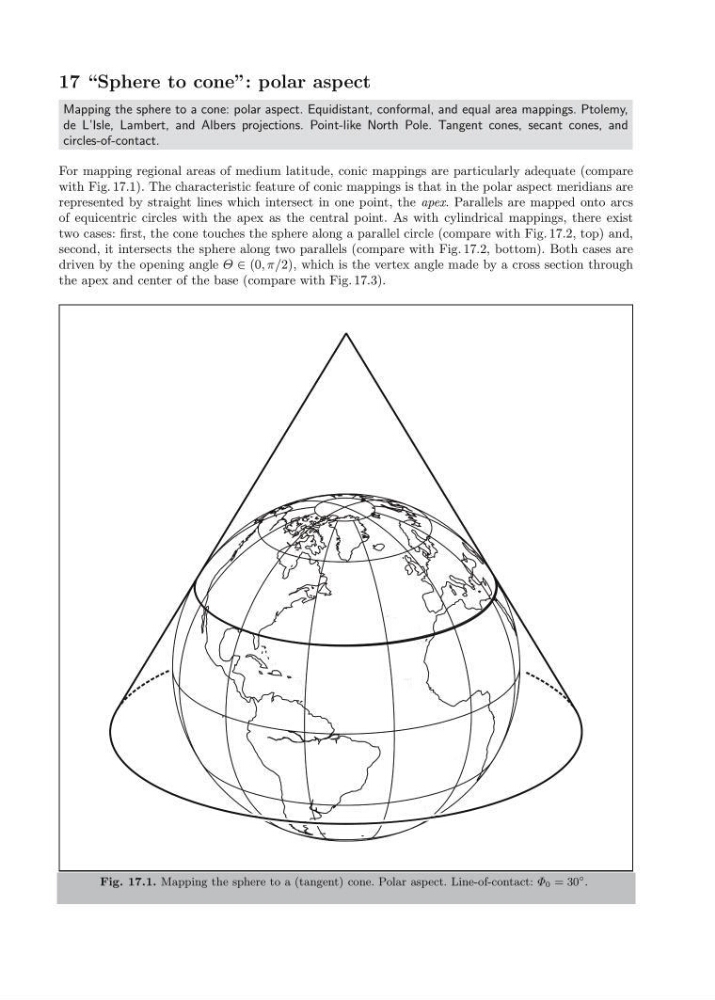
For mapping regional areas of medium latitude, conic mappings are particularly adequate (compare
with Fig. 17.1). The characteristic feature of conic mappings is that in the polar aspect meridians are
represented by straight lines which intersect in one point, the apex. Parallels are mapped onto arcs
of equicentric circles with the apex as the central point. As with cylindrical mappings, there exist
two cases: first, the cone touches the sphere along a parallel circle (compare with Fig. 17.2, top) and,
second, it intersects the sphere along two parallels (compare with Fig. 17.2, bottom). Both cases are
driven by the opening angle Θ ∈ (0, π/2), which is the vertex angle made by a cross section through
the apex and center of the base (compare with Fig. 17.3).
Fig. 17.1. Mapping the sphere to a (tangent) cone. Polar aspect. Line-of-contact: Φ 0 = 30
◦ .
Mapping the sphere to a cone: polar aspect. Equidistant, conformal, and equal area mappings. Ptolemy,
de L’Isle, Lambert, and Albers projections. Point-like North Pole. Tangent cones, secant cones, and
circles-of-contact.
For mapping regional areas of medium latitude, conic mappings are particularly adequate (compare
with Fig. 17.1). The characteristic feature of conic mappings is that in the polar aspect meridians are
represented by straight lines which intersect in one point, the apex. Parallels are mapped onto arcs
of equicentric circles with the apex as the central point. As with cylindrical mappings, there exist
two cases: first, the cone touches the sphere along a parallel circle (compare with Fig. 17.2, top) and,
second, it intersects the sphere along two parallels (compare with Fig. 17.2, bottom). Both cases are
driven by the opening angle Θ ∈ (0, π/2), which is the vertex angle made by a cross section through
the apex and center of the base (compare with Fig. 17.3).
Fig. 17.1. Mapping the sphere to a (tangent) cone. Polar aspect. Line-of-contact: Φ 0 = 30
◦ .