

1-3 Two examples: pseudo-cylindrical and orthogonal map projections 19
1-3 Two examples: pseudo-cylindrical and orthogonal map projections
Two examples of deformation analysis: pseudo-cylindrical and orthogonal map projections (Cauchy–Green
deformation tensor, its eigenspace, Tissot ellipses of distortion).
The general eigenspace analysis of the Cauchy–Green deformation tensor visualized by the Tissot
ellipses of distortion is the heart of any map projection. It is for this reason that we present to you
the pseudo-cylindrical map projection called Eckert II as Example 1.5 and the orthogonal projection of
the northern hemisphere onto the equatorial plane as Example 1.6. We recommend to go through all
details with “paper and pencil”.
Example 1.5 (Pseudo-cylindric map projection of type Eckert II, left Cauchy–Green deformation tensor).
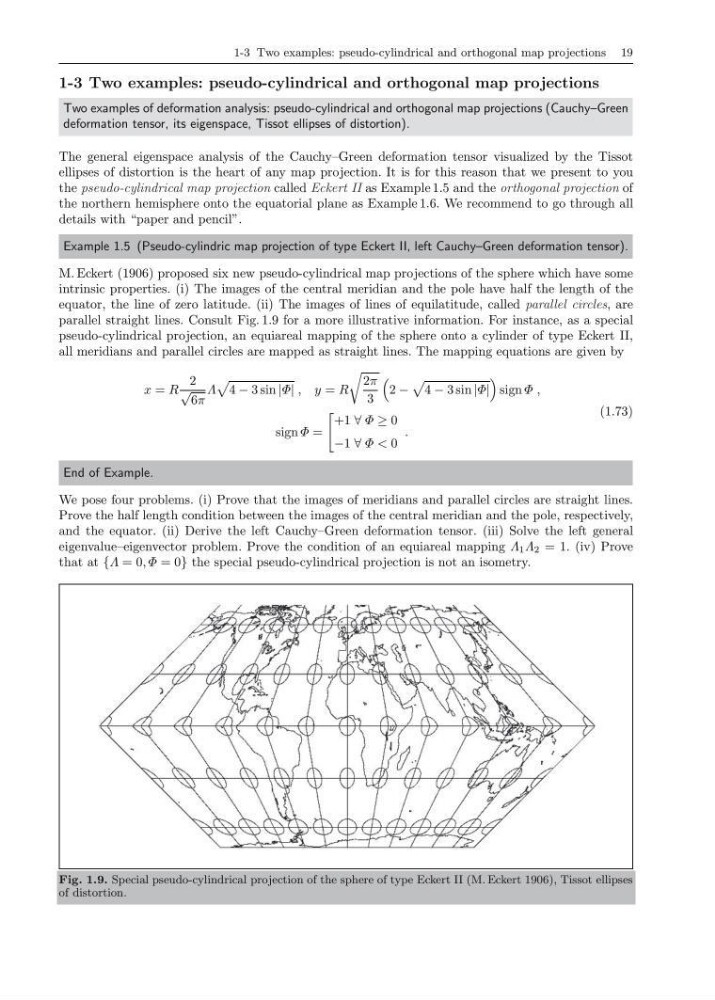
M. Eckert (1906) proposed six new pseudo-cylindrical map projections of the sphere which have some
intrinsic properties. (i) The images of the central meridian and the pole have half the length of the
equator, the line of zero latitude. (ii) The images of lines of equilatitude, called parallel circles, are
parallel straight lines. Consult Fig. 1.9 for a more illustrative information. For instance, as a special
pseudo-cylindrical projection, an equiareal mapping of the sphere onto a cylinder of type Eckert II,
all meridians and parallel circles are mapped as straight lines. The mapping equations are given by
x = R
2
√
6π
Λ
4 − 3 sin |Φ| , y = R
2π
3
2 −
4 − 3 sin |Φ|
sign Φ ,
sign Φ =
+1 ∀ Φ ≥ 0
−1 ∀ Φ < 0
.
(1.73)
End of Example.
We pose four problems. (i) Prove that the images of meridians and parallel circles are straight lines.
Prove the half length condition between the images of the central meridian and the pole, respectively,
and the equator. (ii) Derive the left Cauchy–Green deformation tensor. (iii) Solve the left general
eigenvalue–eigenvector problem. Prove the condition of an equiareal mapping Λ 1 Λ 2 = 1. (iv) Prove
that at {Λ = 0, Φ = 0} the special pseudo-cylindrical projection is not an isometry.
Fig. 1.9. Special pseudo-cylindrical projection of the sphere of type Eckert II (M. Eckert 1906), Tissot ellipses
of distortion.
1-3 Two examples: pseudo-cylindrical and orthogonal map projections
Two examples of deformation analysis: pseudo-cylindrical and orthogonal map projections (Cauchy–Green
deformation tensor, its eigenspace, Tissot ellipses of distortion).
The general eigenspace analysis of the Cauchy–Green deformation tensor visualized by the Tissot
ellipses of distortion is the heart of any map projection. It is for this reason that we present to you
the pseudo-cylindrical map projection called Eckert II as Example 1.5 and the orthogonal projection of
the northern hemisphere onto the equatorial plane as Example 1.6. We recommend to go through all
details with “paper and pencil”.
Example 1.5 (Pseudo-cylindric map projection of type Eckert II, left Cauchy–Green deformation tensor).
M. Eckert (1906) proposed six new pseudo-cylindrical map projections of the sphere which have some
intrinsic properties. (i) The images of the central meridian and the pole have half the length of the
equator, the line of zero latitude. (ii) The images of lines of equilatitude, called parallel circles, are
parallel straight lines. Consult Fig. 1.9 for a more illustrative information. For instance, as a special
pseudo-cylindrical projection, an equiareal mapping of the sphere onto a cylinder of type Eckert II,
all meridians and parallel circles are mapped as straight lines. The mapping equations are given by
x = R
2
√
6π
Λ
4 − 3 sin |Φ| , y = R
2π
3
2 −
4 − 3 sin |Φ|
sign Φ ,
sign Φ =
+1 ∀ Φ ≥ 0
−1 ∀ Φ < 0
.
(1.73)
End of Example.
We pose four problems. (i) Prove that the images of meridians and parallel circles are straight lines.
Prove the half length condition between the images of the central meridian and the pole, respectively,
and the equator. (ii) Derive the left Cauchy–Green deformation tensor. (iii) Solve the left general
eigenvalue–eigenvector problem. Prove the condition of an equiareal mapping Λ 1 Λ 2 = 1. (iv) Prove
that at {Λ = 0, Φ = 0} the special pseudo-cylindrical projection is not an isometry.
Fig. 1.9. Special pseudo-cylindrical projection of the sphere of type Eckert II (M. Eckert 1906), Tissot ellipses
of distortion.