

316 15 “Ellipsoid-of-revolution to cylinder”: transverse aspect
15-1 The equations governing conformal mapping
The equations governing conformal mapping and their fundamental solution. The Korn–Lichtenstein
equations, the Laplace–Beltrami equations.
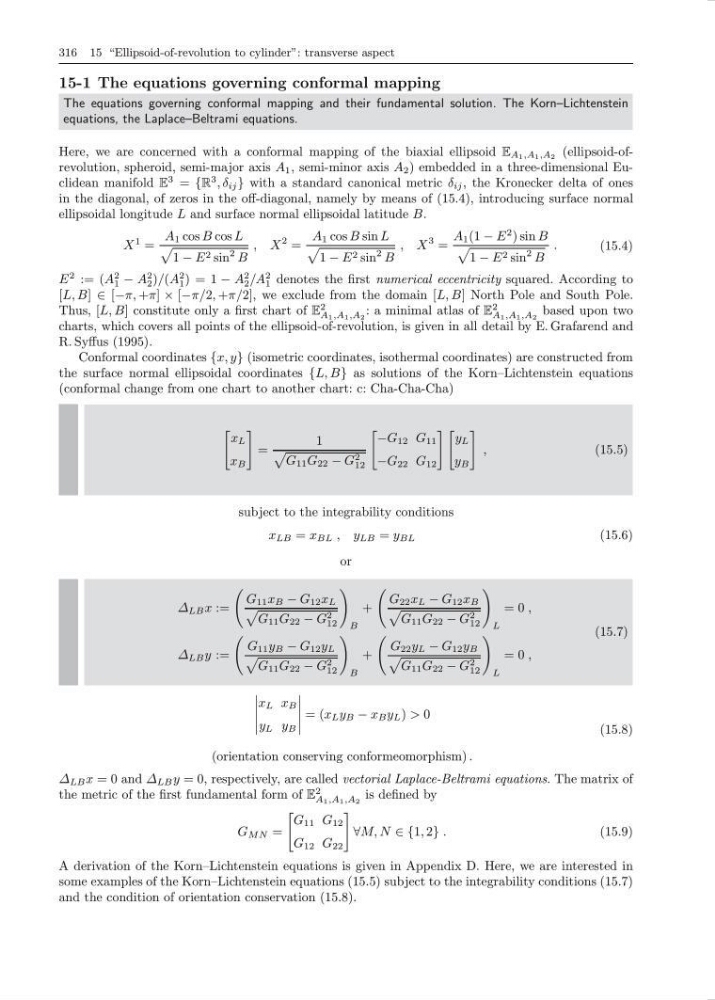
Here, we are concerned with a conformal mapping of the biaxial ellipsoid E A 1 ,A 1 ,A 2 (ellipsoid-ofrevolution, spheroid, semi-major axis A 1 , semi-minor axis A 2 ) embedded in a three-dimensional Euclidean manifold E
3 = {R
3 , δ ij } with a standard canonical metric δ ij , the Kronecker delta of ones
in the diagonal, of zeros in the off-diagonal, namely by means of (15.4), introducing surface normal
ellipsoidal longitude L and surface normal ellipsoidal latitude B.
X
1 =
A 1 cos B cos L
1 − E 2 sin
2 B
, X
2 =
A 1 cos B sin L
1 − E 2 sin
2 B
, X
3 =
A 1 (1 − E
2 ) sin B
1 − E 2 sin
2 B
.
(15.4)
E
2 := (A
2
1 − A
2
2 )/(A
2
1 ) = 1 − A
2
2 /A
2
1 denotes the first numerical eccentricity squared. According to
[L, B] ∈ [−π, +π] × [−π/2, +π/2], we exclude from the domain [L, B] North Pole and South Pole.
Thus, [L, B] constitute only a first chart of E
2
A 1 ,A 1 ,A 2
: a minimal atlas of E
2
A 1 ,A 1 ,A 2
based upon two
charts, which covers all points of the ellipsoid-of-revolution, is given in all detail by E. Grafarend and
R. Syffus (1995).
Conformal coordinates {x, y} (isometric coordinates, isothermal coordinates) are constructed from
the surface normal ellipsoidal coordinates {L, B} as solutions of the Korn–Lichtenstein equations
(conformal change from one chart to another chart: c: Cha-Cha-Cha)
x L
x B
=
1
G 11 G 22 − G 2
12
−G 12 G 11
−G 22 G 12
y L
y B
,
(15.5)
subject to the integrability conditions
x LB = x BL , y LB = y BL
(15.6)
or
∆ LB x :=
G 11 x B − G 12 x L
G 11 G 22 − G 2
12
B
+
G 22 x L − G 12 x B
G 11 G 22 − G 2
12
L
= 0 ,
∆ LB y :=
G 11 y B − G 12 y L
G 11 G 22 − G 2
12
B
+
G 22 y L − G 12 y B
G 11 G 22 − G 2
12
L
= 0 ,
(15.7)
x L x B
y L y B
= (x L y B − x B y L ) > 0
(orientation conserving conformeomorphism) .
(15.8)
∆ LB x = 0 and ∆ LB y = 0, respectively, are called vectorial Laplace-Beltrami equations. The matrix of
the metric of the first fundamental form of E
2
A 1 ,A 1 ,A 2
is defined by
G MN =
G 11 G 12
G 12 G 22
∀M, N ∈ {1, 2} .
(15.9)
A derivation of the Korn–Lichtenstein equations is given in Appendix D. Here, we are interested in
some examples of the Korn–Lichtenstein equations (15.5) subject to the integrability conditions (15.7)
and the condition of orientation conservation (15.8).
15-1 The equations governing conformal mapping
The equations governing conformal mapping and their fundamental solution. The Korn–Lichtenstein
equations, the Laplace–Beltrami equations.
Here, we are concerned with a conformal mapping of the biaxial ellipsoid E A 1 ,A 1 ,A 2 (ellipsoid-ofrevolution, spheroid, semi-major axis A 1 , semi-minor axis A 2 ) embedded in a three-dimensional Euclidean manifold E
3 = {R
3 , δ ij } with a standard canonical metric δ ij , the Kronecker delta of ones
in the diagonal, of zeros in the off-diagonal, namely by means of (15.4), introducing surface normal
ellipsoidal longitude L and surface normal ellipsoidal latitude B.
X
1 =
A 1 cos B cos L
1 − E 2 sin
2 B
, X
2 =
A 1 cos B sin L
1 − E 2 sin
2 B
, X
3 =
A 1 (1 − E
2 ) sin B
1 − E 2 sin
2 B
.
(15.4)
E
2 := (A
2
1 − A
2
2 )/(A
2
1 ) = 1 − A
2
2 /A
2
1 denotes the first numerical eccentricity squared. According to
[L, B] ∈ [−π, +π] × [−π/2, +π/2], we exclude from the domain [L, B] North Pole and South Pole.
Thus, [L, B] constitute only a first chart of E
2
A 1 ,A 1 ,A 2
: a minimal atlas of E
2
A 1 ,A 1 ,A 2
based upon two
charts, which covers all points of the ellipsoid-of-revolution, is given in all detail by E. Grafarend and
R. Syffus (1995).
Conformal coordinates {x, y} (isometric coordinates, isothermal coordinates) are constructed from
the surface normal ellipsoidal coordinates {L, B} as solutions of the Korn–Lichtenstein equations
(conformal change from one chart to another chart: c: Cha-Cha-Cha)
x L
x B
=
1
G 11 G 22 − G 2
12
−G 12 G 11
−G 22 G 12
y L
y B
,
(15.5)
subject to the integrability conditions
x LB = x BL , y LB = y BL
(15.6)
or
∆ LB x :=
G 11 x B − G 12 x L
G 11 G 22 − G 2
12
B
+
G 22 x L − G 12 x B
G 11 G 22 − G 2
12
L
= 0 ,
∆ LB y :=
G 11 y B − G 12 y L
G 11 G 22 − G 2
12
B
+
G 22 y L − G 12 y B
G 11 G 22 − G 2
12
L
= 0 ,
(15.7)
x L x B
y L y B
= (x L y B − x B y L ) > 0
(orientation conserving conformeomorphism) .
(15.8)
∆ LB x = 0 and ∆ LB y = 0, respectively, are called vectorial Laplace-Beltrami equations. The matrix of
the metric of the first fundamental form of E
2
A 1 ,A 1 ,A 2
is defined by
G MN =
G 11 G 12
G 12 G 22
∀M, N ∈ {1, 2} .
(15.9)
A derivation of the Korn–Lichtenstein equations is given in Appendix D. Here, we are interested in
some examples of the Korn–Lichtenstein equations (15.5) subject to the integrability conditions (15.7)
and the condition of orientation conservation (15.8).