

15 “Ellipsoid-of-revolution to cylinder”: transverse aspect
Mapping the ellipsoid-of-revolution to a cylinder: transverse aspect. Transverse Mercator projection,
Gauss–Krueger/UTM coordinates. Korn–Lichtenstein equations, Laplace–Beltrami equations.
Conventionally, conformal coordinates, also called conformal charts, representing the surface of the
Earth or any other Planet as an ellipsoid-of-revolution, also called the Geodetic Reference Figure,
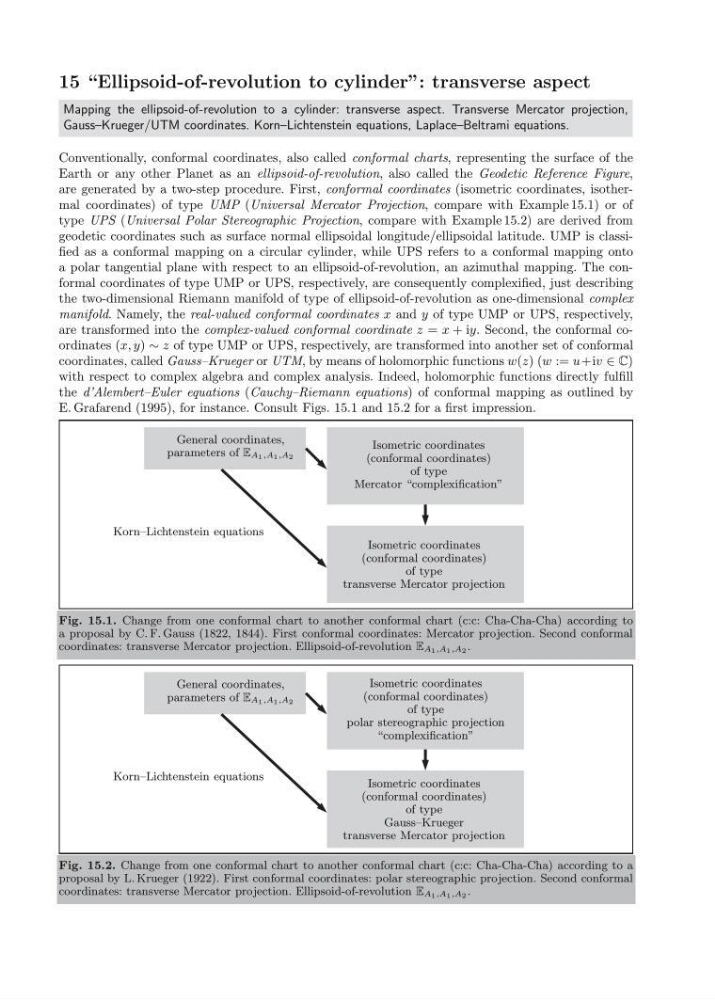
are generated by a two-step procedure. First, conformal coordinates (isometric coordinates, isothermal coordinates) of type UMP (Universal Mercator Projection, compare with Example 15.1) or of
type UPS (Universal Polar Stereographic Projection, compare with Example 15.2) are derived from
geodetic coordinates such as surface normal ellipsoidal longitude/ellipsoidal latitude. UMP is classified as a conformal mapping on a circular cylinder, while UPS refers to a conformal mapping onto
a polar tangential plane with respect to an ellipsoid-of-revolution, an azimuthal mapping. The conformal coordinates of type UMP or UPS, respectively, are consequently complexified, just describing
the two-dimensional Riemann manifold of type of ellipsoid-of-revolution as one-dimensional complex
manifold. Namely, the real-valued conformal coordinates x and y of type UMP or UPS, respectively,
are transformed into the complex-valued conformal coordinate z = x + iy. Second, the conformal coordinates (x, y) ∼ z of type UMP or UPS, respectively, are transformed into another set of conformal
coordinates, called Gauss–Krueger or UTM, by means of holomorphic functions w(z) (w := u+iv ∈ C)
with respect to complex algebra and complex analysis. Indeed, holomorphic functions directly fulfill
the d’Alembert–Euler equations (Cauchy–Riemann equations) of conformal mapping as outlined by
E. Grafarend (1995), for instance. Consult Figs. 15.1 and 15.2 for a first impression.
General coordinates,
parameters of E A 1 ,A 1 ,A 2
Isometric coordinates
(conformal coordinates)
of type
Mercator “complexification”
Isometric coordinates
(conformal coordinates)
of type
transverse Mercator projection
Korn–Lichtenstein equations
Fig. 15.1. Change from one conformal chart to another conformal chart (c:c: Cha-Cha-Cha) according to
a proposal by C. F. Gauss (1822, 1844). First conformal coordinates: Mercator projection. Second conformal
coordinates: transverse Mercator projection. Ellipsoid-of-revolution E A 1 ,A 1 ,A 2 .
General coordinates,
parameters of E A 1 ,A 1 ,A 2
Isometric coordinates
(conformal coordinates)
of type
polar stereographic projection
“complexification”
Isometric coordinates
(conformal coordinates)
of type
Gauss–Krueger
transverse Mercator projection
Korn–Lichtenstein equations
Fig. 15.2. Change from one conformal chart to another conformal chart (c:c: Cha-Cha-Cha) according to a
proposal by L. Krueger (1922). First conformal coordinates: polar stereographic projection. Second conformal
coordinates: transverse Mercator projection. Ellipsoid-of-revolution E A 1 ,A 1 ,A 2 .
Mapping the ellipsoid-of-revolution to a cylinder: transverse aspect. Transverse Mercator projection,
Gauss–Krueger/UTM coordinates. Korn–Lichtenstein equations, Laplace–Beltrami equations.
Conventionally, conformal coordinates, also called conformal charts, representing the surface of the
Earth or any other Planet as an ellipsoid-of-revolution, also called the Geodetic Reference Figure,
are generated by a two-step procedure. First, conformal coordinates (isometric coordinates, isothermal coordinates) of type UMP (Universal Mercator Projection, compare with Example 15.1) or of
type UPS (Universal Polar Stereographic Projection, compare with Example 15.2) are derived from
geodetic coordinates such as surface normal ellipsoidal longitude/ellipsoidal latitude. UMP is classified as a conformal mapping on a circular cylinder, while UPS refers to a conformal mapping onto
a polar tangential plane with respect to an ellipsoid-of-revolution, an azimuthal mapping. The conformal coordinates of type UMP or UPS, respectively, are consequently complexified, just describing
the two-dimensional Riemann manifold of type of ellipsoid-of-revolution as one-dimensional complex
manifold. Namely, the real-valued conformal coordinates x and y of type UMP or UPS, respectively,
are transformed into the complex-valued conformal coordinate z = x + iy. Second, the conformal coordinates (x, y) ∼ z of type UMP or UPS, respectively, are transformed into another set of conformal
coordinates, called Gauss–Krueger or UTM, by means of holomorphic functions w(z) (w := u+iv ∈ C)
with respect to complex algebra and complex analysis. Indeed, holomorphic functions directly fulfill
the d’Alembert–Euler equations (Cauchy–Riemann equations) of conformal mapping as outlined by
E. Grafarend (1995), for instance. Consult Figs. 15.1 and 15.2 for a first impression.
General coordinates,
parameters of E A 1 ,A 1 ,A 2
Isometric coordinates
(conformal coordinates)
of type
Mercator “complexification”
Isometric coordinates
(conformal coordinates)
of type
transverse Mercator projection
Korn–Lichtenstein equations
Fig. 15.1. Change from one conformal chart to another conformal chart (c:c: Cha-Cha-Cha) according to
a proposal by C. F. Gauss (1822, 1844). First conformal coordinates: Mercator projection. Second conformal
coordinates: transverse Mercator projection. Ellipsoid-of-revolution E A 1 ,A 1 ,A 2 .
General coordinates,
parameters of E A 1 ,A 1 ,A 2
Isometric coordinates
(conformal coordinates)
of type
polar stereographic projection
“complexification”
Isometric coordinates
(conformal coordinates)
of type
Gauss–Krueger
transverse Mercator projection
Korn–Lichtenstein equations
Fig. 15.2. Change from one conformal chart to another conformal chart (c:c: Cha-Cha-Cha) according to a
proposal by L. Krueger (1922). First conformal coordinates: polar stereographic projection. Second conformal
coordinates: transverse Mercator projection. Ellipsoid-of-revolution E A 1 ,A 1 ,A 2 .