

14 “Ellipsoid-of-revolution to cylinder”: polar aspect
Mapping the ellipsoid-of-revolution to a cylinder: polar aspect. Its generalization for general rotationally
symmetric surfaces. Normal equidistant, normal conformal, and normal equiareal mappings. Cylindric
mappings (equidistant) for a rotationally symmetric figure. Torus mapping.
At the beginning of this chapter, let us briefly refer to Chapter 8, where the data of the best fitting “ellipsoid-of-revolution to Earth” are derived in form of a table. Here, we specialize on the
mapping equations and the distortion measures for mapping an ellipsoid-of-revolution E
2
A 1 ,A 2
to a
cylinder, equidistant on the equator. Section 14-1 concentrates on the structure of the mapping equations, while Section 14-2 gives special cylindric mappings of the ellipsoid-of-revolution, equidistant
on the equator. At the end, we shortly review in Section 14-3 the general mapping equations of a
rotationally symmetric figure different from an ellipsoid-of-revolution, namely the torus.
14-1 General mapping equations
General mapping equations of an ellipsoid-of-revolution to a cylinder: the polar aspect. Applications.
Deformation tensor. Principal stretches.
The first postulate fixes the image coordinate y by the assumption of an exclusive dependence on
the ellipsoidal latitude Φ. In contrast, the image coordinate x is only dependent on the longitude Λ,
especially assuming that the equator is mapped equidistantly.
Postulate.
x = A 1 Λ , y = f (Φ) .
(14.1)
End of Postulate.
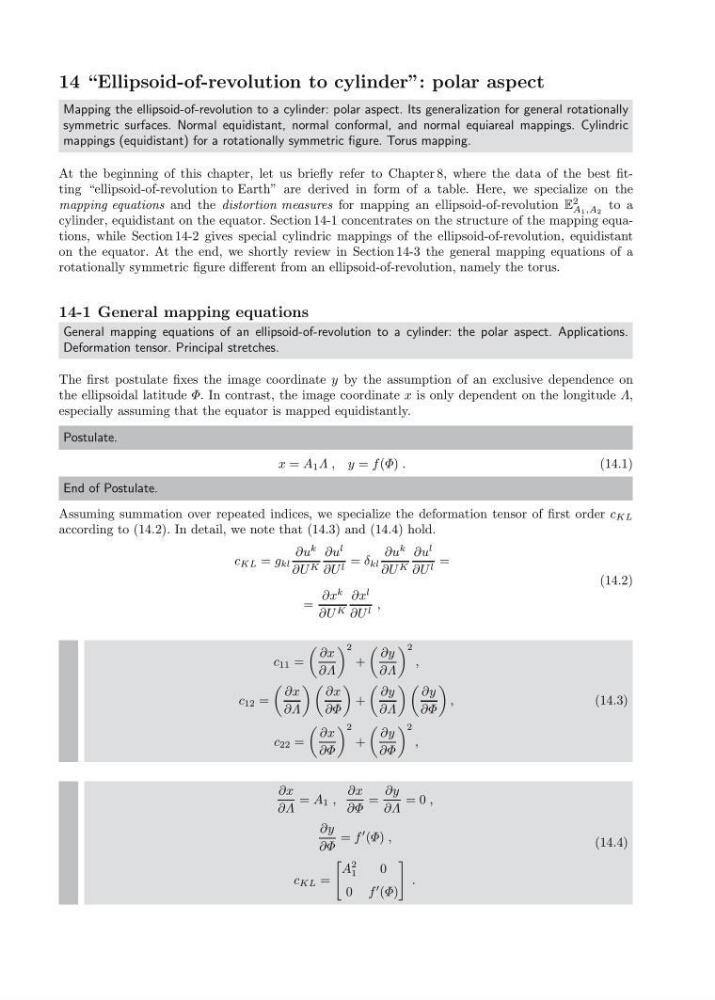
Assuming summation over repeated indices, we specialize the deformation tensor of first order c KL
according to (14.2). In detail, we note that (14.3) and (14.4) hold.
c KL = g kl
∂u
k
∂U K
∂u
l
∂U l = δ kl
∂u
k
∂U K
∂u
l
∂U l =
=
∂x
k
∂U K
∂x
l
∂U l ,
(14.2)
c 11 =
∂x
∂Λ
2
+
∂y
∂Λ
2
,
c 12 =
∂x
∂Λ
∂x
∂Φ
+
∂y
∂Λ
∂y
∂Φ
,
c 22 =
∂x
∂Φ
2
+
∂y
∂Φ
2
,
(14.3)
∂x
∂Λ
= A 1 ,
∂x
∂Φ
=
∂y
∂Λ
= 0 ,
∂y
∂Φ
= f
(Φ) ,
c KL =
A
2
1
0
0 f
(Φ)
.
(14.4)
Mapping the ellipsoid-of-revolution to a cylinder: polar aspect. Its generalization for general rotationally
symmetric surfaces. Normal equidistant, normal conformal, and normal equiareal mappings. Cylindric
mappings (equidistant) for a rotationally symmetric figure. Torus mapping.
At the beginning of this chapter, let us briefly refer to Chapter 8, where the data of the best fitting “ellipsoid-of-revolution to Earth” are derived in form of a table. Here, we specialize on the
mapping equations and the distortion measures for mapping an ellipsoid-of-revolution E
2
A 1 ,A 2
to a
cylinder, equidistant on the equator. Section 14-1 concentrates on the structure of the mapping equations, while Section 14-2 gives special cylindric mappings of the ellipsoid-of-revolution, equidistant
on the equator. At the end, we shortly review in Section 14-3 the general mapping equations of a
rotationally symmetric figure different from an ellipsoid-of-revolution, namely the torus.
14-1 General mapping equations
General mapping equations of an ellipsoid-of-revolution to a cylinder: the polar aspect. Applications.
Deformation tensor. Principal stretches.
The first postulate fixes the image coordinate y by the assumption of an exclusive dependence on
the ellipsoidal latitude Φ. In contrast, the image coordinate x is only dependent on the longitude Λ,
especially assuming that the equator is mapped equidistantly.
Postulate.
x = A 1 Λ , y = f (Φ) .
(14.1)
End of Postulate.
Assuming summation over repeated indices, we specialize the deformation tensor of first order c KL
according to (14.2). In detail, we note that (14.3) and (14.4) hold.
c KL = g kl
∂u
k
∂U K
∂u
l
∂U l = δ kl
∂u
k
∂U K
∂u
l
∂U l =
=
∂x
k
∂U K
∂x
l
∂U l ,
(14.2)
c 11 =
∂x
∂Λ
2
+
∂y
∂Λ
2
,
c 12 =
∂x
∂Λ
∂x
∂Φ
+
∂y
∂Λ
∂y
∂Φ
,
c 22 =
∂x
∂Φ
2
+
∂y
∂Φ
2
,
(14.3)
∂x
∂Λ
= A 1 ,
∂x
∂Φ
=
∂y
∂Λ
= 0 ,
∂y
∂Φ
= f
(Φ) ,
c KL =
A
2
1
0
0 f
(Φ)
.
(14.4)