

296 13 “Sphere to cylinder”: pseudo-cylindrical projections
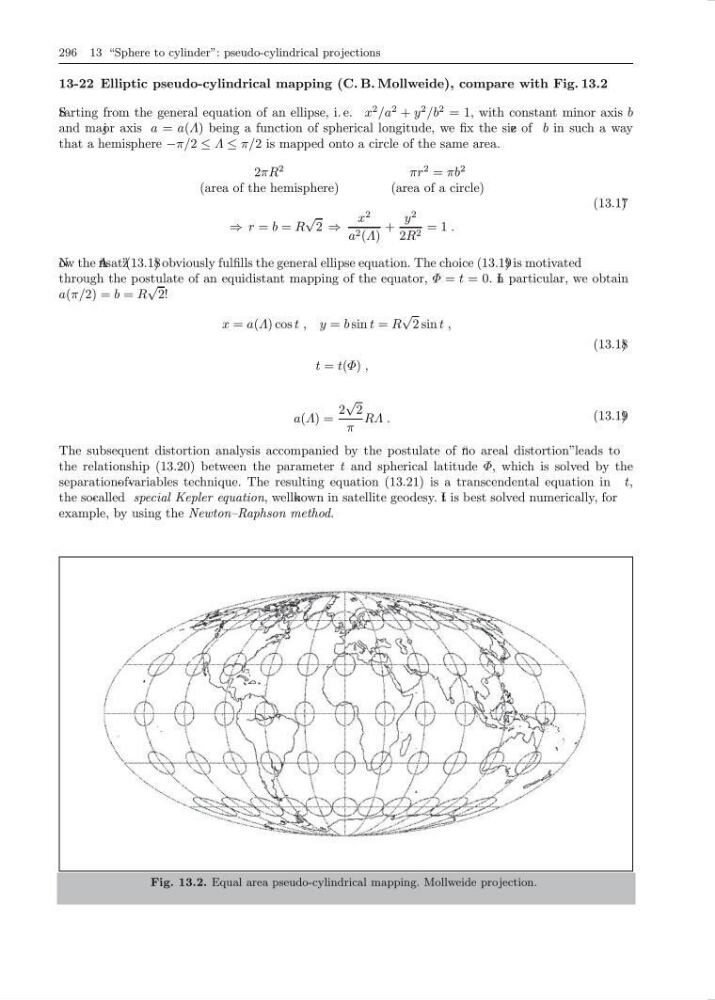
13-22 Elliptic pseudo-cylindrical mapping (C. B. Mollweide), compare with Fig. 13.2
S tarting from the general equation of an ellipse, i. e. x
2 /a
2 + y
2 /b
2 = 1, with constant minor axis b
and maj or axis a = a(Λ) being a function of spherical longitude, we fix the siz e of b in such a way
that a hemisphere −π/2 ≤ Λ ≤ π/2 is mapped onto a circle of the same area.
2πR
2
πr
2 = πb
2
(area of the hemisphere)
(area of a circle)
⇒ r = b = R
√
2 ⇒
x
2
a 2 (Λ)
+
y
2
2R 2 = 1 .
(13.17 )
N ow the “ A nsatz ”(13.18 ) obviously fulfills the general ellipse equation. The choice (13.19 ) is motivated
through the postulate of an equidistant mapping of the equator, Φ = t = 0. I
n particular, we obtain
a(π/2) = b = R
√
2!
x = a(Λ) cos t , y = b sin t = R
√
2 sin t ,
t = t(Φ) ,
(13.18 )
a(Λ) =
2
√
2
π
RΛ .
(13.19 )
The subsequent distortion analysis accompanied by the postulate of “
no areal distortion”leads to
the relationship (13.20) between the parameter t and spherical latitude Φ, which is solved by the
separation- of- variables technique. The resulting equation (13.21) is a transcendental equation in t,
the so- called special Kepler equation, well- k nown in satellite geodesy. I
t is best solved numerically, for
example, by using the Newton–Raphson method.
Fig. 13.2. Equal area pseudo-cylindrical mapping. Mollweide projection.
13-22 Elliptic pseudo-cylindrical mapping (C. B. Mollweide), compare with Fig. 13.2
S tarting from the general equation of an ellipse, i. e. x
2 /a
2 + y
2 /b
2 = 1, with constant minor axis b
and maj or axis a = a(Λ) being a function of spherical longitude, we fix the siz e of b in such a way
that a hemisphere −π/2 ≤ Λ ≤ π/2 is mapped onto a circle of the same area.
2πR
2
πr
2 = πb
2
(area of the hemisphere)
(area of a circle)
⇒ r = b = R
√
2 ⇒
x
2
a 2 (Λ)
+
y
2
2R 2 = 1 .
(13.17 )
N ow the “ A nsatz ”(13.18 ) obviously fulfills the general ellipse equation. The choice (13.19 ) is motivated
through the postulate of an equidistant mapping of the equator, Φ = t = 0. I
n particular, we obtain
a(π/2) = b = R
√
2!
x = a(Λ) cos t , y = b sin t = R
√
2 sin t ,
t = t(Φ) ,
(13.18 )
a(Λ) =
2
√
2
π
RΛ .
(13.19 )
The subsequent distortion analysis accompanied by the postulate of “
no areal distortion”leads to
the relationship (13.20) between the parameter t and spherical latitude Φ, which is solved by the
separation- of- variables technique. The resulting equation (13.21) is a transcendental equation in t,
the so- called special Kepler equation, well- k nown in satellite geodesy. I
t is best solved numerically, for
example, by using the Newton–Raphson method.
Fig. 13.2. Equal area pseudo-cylindrical mapping. Mollweide projection.