

8-3 Perspective mapping equations 245
8-31 The first derivation
The first derivation of the perspective equations is based upon the fundamental perspective graph
denoted by P c P 0 P as illustrated by Fig. 8.11. Here, we take advantage of the basic equations which
are based upon the so-called normal intersection in terms of the curve P 0 P , which coincides with the
intersection line E
2
A 1 ,A 2
and P P c P 0 P . Note that δ is the angle of the cone in the triangle P 0 , P c , P at
P c , Furthermore, note that the point P 0 locates the point of minimal distance with respect to the
point P c and the tangent space T P 0 E
2
A 1 ,A 2
at the point P 0 . Moreover, note that p = π(P ) denotes the
projection point, which is at minimal distance. In addition, G 3 is the normal unit vector extending
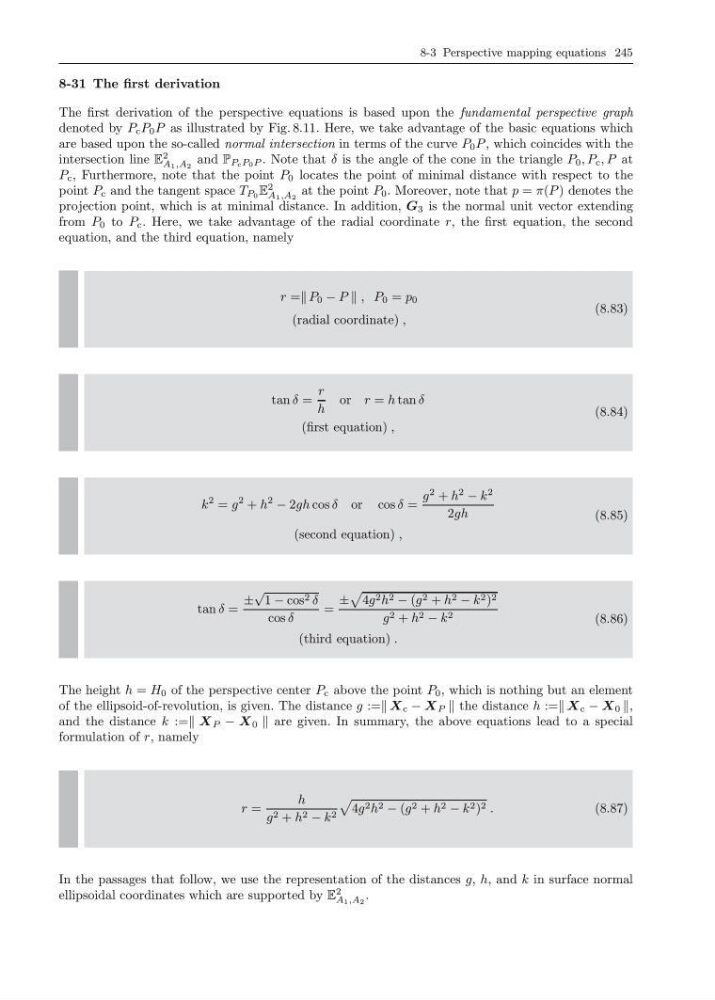
from P 0 to P c . Here, we take advantage of the radial coordinate r, the first equation, the second
equation, and the third equation, namely
r = P 0 − P , P 0 = p 0
(radial coordinate) ,
(8.83)
tan δ =
r
h
or r = h tan δ
(first equation) ,
(8.84)
k
2 = g
2 + h
2
− 2gh cos δ or cos δ =
g
2 + h
2
− k
2
2gh
(second equation) ,
(8.85)
tan δ =
±
√
1 − cos 2 δ
cos δ
=
±
4g 2 h 2 − (g 2 + h 2 − k 2 ) 2
g 2 + h 2 − k 2
(third equation) .
(8.86)
The height h = H 0 of the perspective center P c above the point P 0 , which is nothing but an element
of the ellipsoid-of-revolution, is given. The distance g := X c − X P the distance h := X c − X 0 ,
and the distance k := X P − X 0 are given. In summary, the above equations lead to a special
formulation of r, namely
r =
h
g 2 + h 2 − k 2
4g 2 h 2 − (g 2 + h 2 − k 2 ) 2 .
(8.87)
In the passages that follow, we use the representation of the distances g, h, and k in surface normal
ellipsoidal coordinates which are supported by E
2
A 1 ,A 2
.
8-31 The first derivation
The first derivation of the perspective equations is based upon the fundamental perspective graph
denoted by P c P 0 P as illustrated by Fig. 8.11. Here, we take advantage of the basic equations which
are based upon the so-called normal intersection in terms of the curve P 0 P , which coincides with the
intersection line E
2
A 1 ,A 2
and P P c P 0 P . Note that δ is the angle of the cone in the triangle P 0 , P c , P at
P c , Furthermore, note that the point P 0 locates the point of minimal distance with respect to the
point P c and the tangent space T P 0 E
2
A 1 ,A 2
at the point P 0 . Moreover, note that p = π(P ) denotes the
projection point, which is at minimal distance. In addition, G 3 is the normal unit vector extending
from P 0 to P c . Here, we take advantage of the radial coordinate r, the first equation, the second
equation, and the third equation, namely
r = P 0 − P , P 0 = p 0
(radial coordinate) ,
(8.83)
tan δ =
r
h
or r = h tan δ
(first equation) ,
(8.84)
k
2 = g
2 + h
2
− 2gh cos δ or cos δ =
g
2 + h
2
− k
2
2gh
(second equation) ,
(8.85)
tan δ =
±
√
1 − cos 2 δ
cos δ
=
±
4g 2 h 2 − (g 2 + h 2 − k 2 ) 2
g 2 + h 2 − k 2
(third equation) .
(8.86)
The height h = H 0 of the perspective center P c above the point P 0 , which is nothing but an element
of the ellipsoid-of-revolution, is given. The distance g := X c − X P the distance h := X c − X 0 ,
and the distance k := X P − X 0 are given. In summary, the above equations lead to a special
formulation of r, namely
r =
h
g 2 + h 2 − k 2
4g 2 h 2 − (g 2 + h 2 − k 2 ) 2 .
(8.87)
In the passages that follow, we use the representation of the distances g, h, and k in surface normal
ellipsoidal coordinates which are supported by E
2
A 1 ,A 2
.