

8-2 Special mapping equations 235
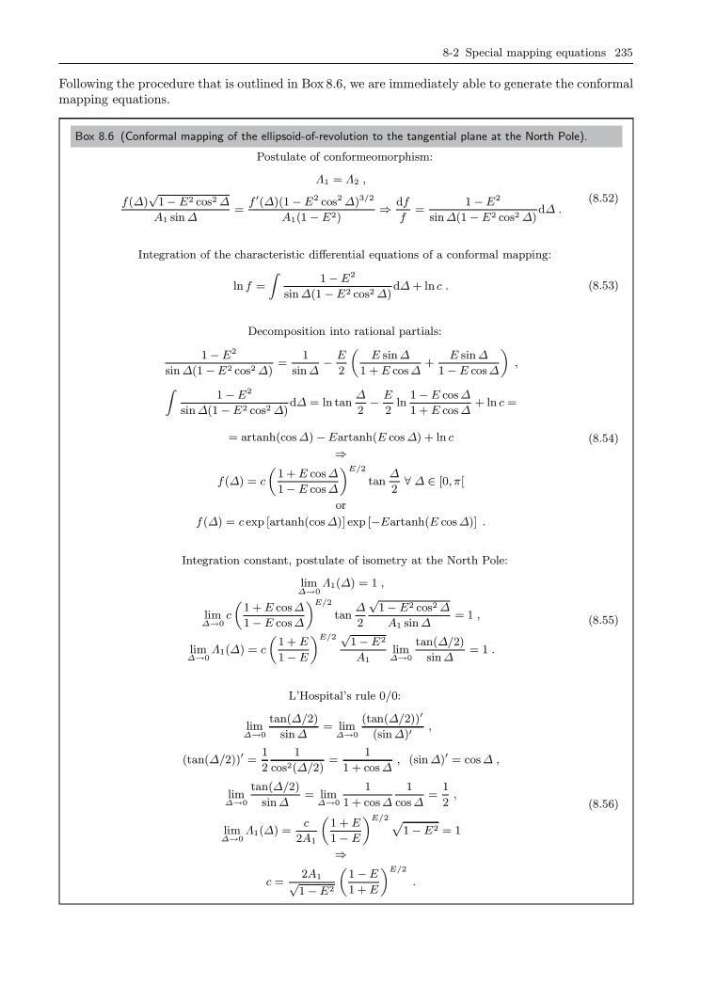
Following the procedure that is outlined in Box 8.6, we are immediately able to generate the conformal
mapping equations.
Box 8.6 (Conformal mapping of the ellipsoid-of-revolution to the tangential plane at the North Pole).
Postulate of conformeomorphism:
Λ 1 = Λ 2 ,
f (∆)
√
1 − E 2 cos 2 ∆
A 1 sin ∆
=
f
(∆)(1 − E
2 cos
2 ∆)
3/2
A 1 (1 − E 2 )
⇒
df
f
=
1 − E
2
sin ∆(1 − E 2 cos 2 ∆)
d∆ .
(8.52)
Integration of the characteristic differential equations of a conformal mapping:
ln f =
Z
1 − E
2
sin ∆(1 − E 2 cos 2 ∆)
d∆ + ln c .
(8.53)
Decomposition into rational partials:
1 − E
2
sin ∆(1 − E 2 cos 2 ∆)
=
1
sin ∆
−
E
2
„
E sin ∆
1 + E cos ∆
+
E sin ∆
1 − E cos ∆
«
,
Z
1 − E
2
sin ∆(1 − E 2 cos 2 ∆)
d∆ = ln tan
∆
2
−
E
2
ln
1 − E cos ∆
1 + E cos ∆
+ ln c =
= artanh(cos ∆) − Eartanh(E cos ∆) + ln c
⇒
f (∆) = c
„
1 + E cos ∆
1 − E cos ∆
« E/2
tan
∆
2
∀ ∆ ∈ [0, π[
or
f (∆) = c exp [artanh(cos ∆)] exp [−Eartanh(E cos ∆)] .
(8.54)
Integration constant, postulate of isometry at the North Pole:
lim
∆→0
Λ 1 (∆) = 1 ,
lim
∆→0
c
„
1 + E cos ∆
1 − E cos ∆
« E/2
tan
∆
2
√
1 − E 2 cos 2 ∆
A 1 sin ∆
= 1 ,
lim
∆→0
Λ 1 (∆) = c
„
1 + E
1 − E
« E/2 √
1 − E 2
A 1
lim
∆→0
tan(∆/2)
sin ∆
= 1 .
(8.55)
L’Hospital’s rule 0/0:
lim
∆→0
tan(∆/2)
sin ∆
= lim
∆→0
(tan(∆/2))
(sin ∆) ,
(tan(∆/2))
=
1
2
1
cos 2 (∆/2)
=
1
1 + cos ∆
, (sin ∆)
= cos ∆ ,
lim
∆→0
tan(∆/2)
sin ∆
= lim
∆→0
1
1 + cos ∆
1
cos ∆
=
1
2
,
lim
∆→0
Λ 1 (∆) =
c
2A 1
„
1 + E
1 − E
« E/2 p
1 − E 2 = 1
⇒
c =
2A 1
√
1 − E 2
„
1 − E
1 + E
« E/2
.
(8.56)
Following the procedure that is outlined in Box 8.6, we are immediately able to generate the conformal
mapping equations.
Box 8.6 (Conformal mapping of the ellipsoid-of-revolution to the tangential plane at the North Pole).
Postulate of conformeomorphism:
Λ 1 = Λ 2 ,
f (∆)
√
1 − E 2 cos 2 ∆
A 1 sin ∆
=
f
(∆)(1 − E
2 cos
2 ∆)
3/2
A 1 (1 − E 2 )
⇒
df
f
=
1 − E
2
sin ∆(1 − E 2 cos 2 ∆)
d∆ .
(8.52)
Integration of the characteristic differential equations of a conformal mapping:
ln f =
Z
1 − E
2
sin ∆(1 − E 2 cos 2 ∆)
d∆ + ln c .
(8.53)
Decomposition into rational partials:
1 − E
2
sin ∆(1 − E 2 cos 2 ∆)
=
1
sin ∆
−
E
2
„
E sin ∆
1 + E cos ∆
+
E sin ∆
1 − E cos ∆
«
,
Z
1 − E
2
sin ∆(1 − E 2 cos 2 ∆)
d∆ = ln tan
∆
2
−
E
2
ln
1 − E cos ∆
1 + E cos ∆
+ ln c =
= artanh(cos ∆) − Eartanh(E cos ∆) + ln c
⇒
f (∆) = c
„
1 + E cos ∆
1 − E cos ∆
« E/2
tan
∆
2
∀ ∆ ∈ [0, π[
or
f (∆) = c exp [artanh(cos ∆)] exp [−Eartanh(E cos ∆)] .
(8.54)
Integration constant, postulate of isometry at the North Pole:
lim
∆→0
Λ 1 (∆) = 1 ,
lim
∆→0
c
„
1 + E cos ∆
1 − E cos ∆
« E/2
tan
∆
2
√
1 − E 2 cos 2 ∆
A 1 sin ∆
= 1 ,
lim
∆→0
Λ 1 (∆) = c
„
1 + E
1 − E
« E/2 √
1 − E 2
A 1
lim
∆→0
tan(∆/2)
sin ∆
= 1 .
(8.55)
L’Hospital’s rule 0/0:
lim
∆→0
tan(∆/2)
sin ∆
= lim
∆→0
(tan(∆/2))
(sin ∆) ,
(tan(∆/2))
=
1
2
1
cos 2 (∆/2)
=
1
1 + cos ∆
, (sin ∆)
= cos ∆ ,
lim
∆→0
tan(∆/2)
sin ∆
= lim
∆→0
1
1 + cos ∆
1
cos ∆
=
1
2
,
lim
∆→0
Λ 1 (∆) =
c
2A 1
„
1 + E
1 − E
« E/2 p
1 − E 2 = 1
⇒
c =
2A 1
√
1 − E 2
„
1 − E
1 + E
« E/2
.
(8.56)