

8-2 Special mapping equations 225
8-2 Special mapping equations
Setting up special mappings “ellipsoid-of-revolution to plane”, equidistant mapping, conformal mapping,
equiareal mapping.
8-21 Equidistant mapping
Let us postulate an equidistant mapping of the family of elliptic meridians Λ = constant, namely
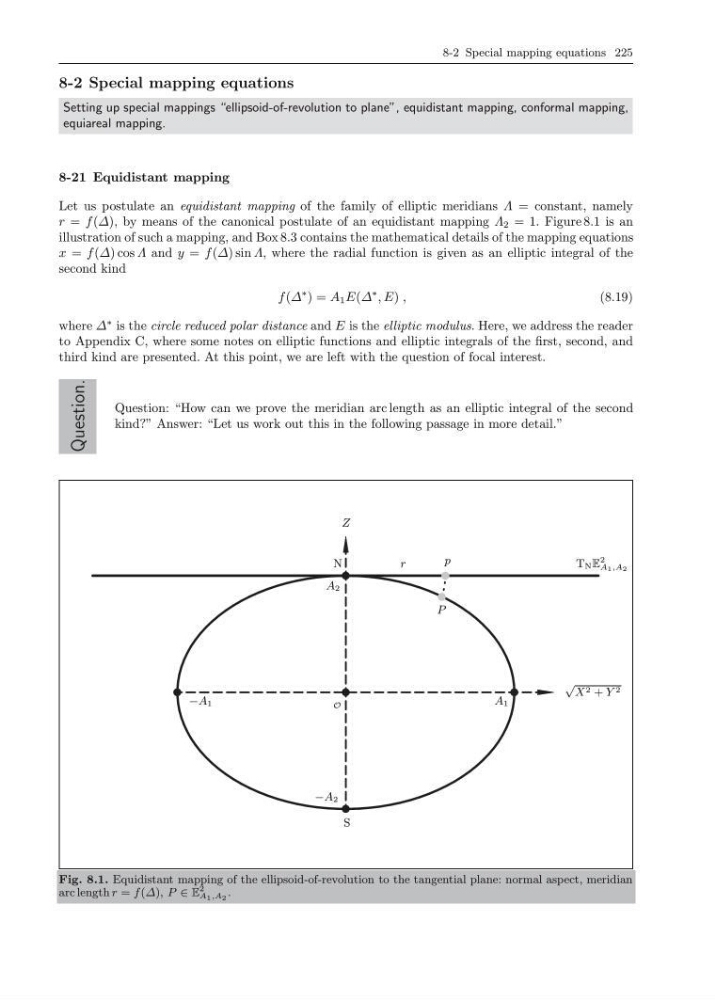
r = f (∆), by means of the canonical postulate of an equidistant mapping Λ 2 = 1. Figure 8.1 is an
illustration of such a mapping, and Box 8.3 contains the mathematical details of the mapping equations
x = f (∆) cos Λ and y = f (∆) sin Λ, where the radial function is given as an elliptic integral of the
second kind
f (∆
∗ ) = A 1 E(∆
∗ , E) ,
(8.19)
where ∆
∗ is the circle reduced polar distance and E is the elliptic modulus. Here, we address the reader
to Appendix C, where some notes on elliptic functions and elliptic integrals of the first, second, and
third kind are presented. At this point, we are left with the question of focal interest.
Question.
Question: “How can we prove the meridian arc length as an elliptic integral of the second
kind?” Answer: “Let us work out this in the following passage in more detail.”
N
Z
T N E
2
A 1 ,A 2
r
A 2
−A 2
A 1
−A 1
p
P
O
√
X 2 + Y 2
S
Fig. 8.1. Equidistant mapping of the ellipsoid-of-revolution to the tangential plane: normal aspect, meridian
arc length r = f (∆), P ∈ E
2
A 1 ,A 2 .
8-2 Special mapping equations
Setting up special mappings “ellipsoid-of-revolution to plane”, equidistant mapping, conformal mapping,
equiareal mapping.
8-21 Equidistant mapping
Let us postulate an equidistant mapping of the family of elliptic meridians Λ = constant, namely
r = f (∆), by means of the canonical postulate of an equidistant mapping Λ 2 = 1. Figure 8.1 is an
illustration of such a mapping, and Box 8.3 contains the mathematical details of the mapping equations
x = f (∆) cos Λ and y = f (∆) sin Λ, where the radial function is given as an elliptic integral of the
second kind
f (∆
∗ ) = A 1 E(∆
∗ , E) ,
(8.19)
where ∆
∗ is the circle reduced polar distance and E is the elliptic modulus. Here, we address the reader
to Appendix C, where some notes on elliptic functions and elliptic integrals of the first, second, and
third kind are presented. At this point, we are left with the question of focal interest.
Question.
Question: “How can we prove the meridian arc length as an elliptic integral of the second
kind?” Answer: “Let us work out this in the following passage in more detail.”
N
Z
T N E
2
A 1 ,A 2
r
A 2
−A 2
A 1
−A 1
p
P
O
√
X 2 + Y 2
S
Fig. 8.1. Equidistant mapping of the ellipsoid-of-revolution to the tangential plane: normal aspect, meridian
arc length r = f (∆), P ∈ E
2
A 1 ,A 2 .