

8 “Ellipsoid-of-revolution to tangential plane”
Mapping the ellipsoid-of-revolution to a tangential plane. Azimuthal projections in the normal aspect
(polar aspect): equidistant, conformal, equiareal, and perspective mapping.
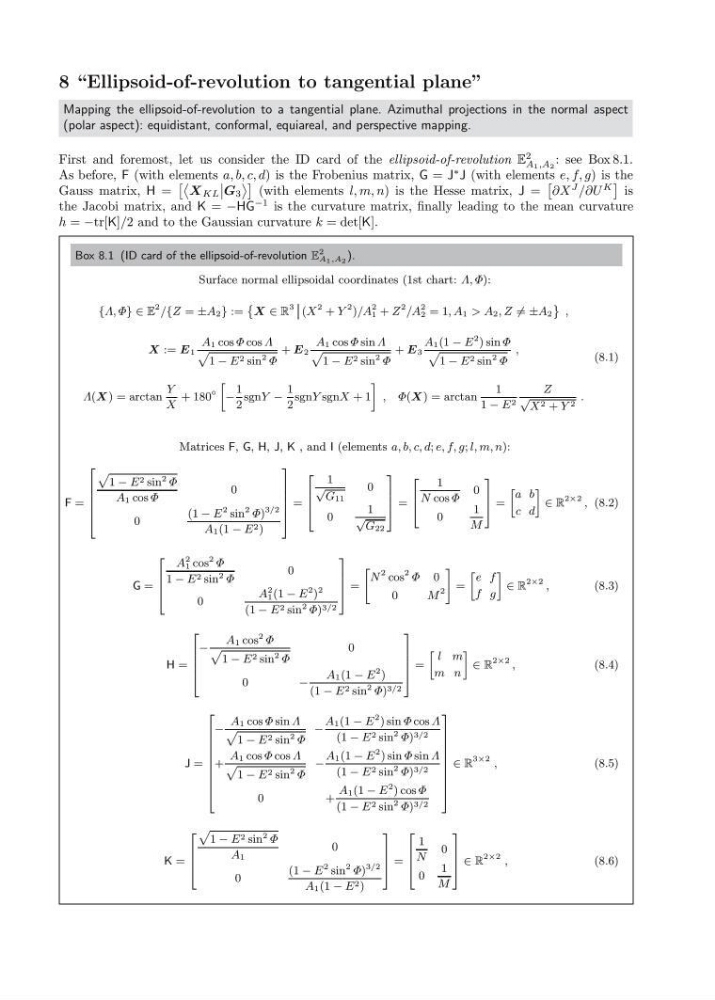
First and foremost, let us consider the ID card of the ellipsoid-of-revolution E
2
A 1 ,A 2
: see Box 8.1.
As before, F (with elements a, b, c, d) is the Frobenius matrix, G = J
∗ J (with elements e, f, g) is the
Gauss matrix, H =
X KL
G 3
(with elements l, m, n) is the Hesse matrix, J =
∂X
J /∂U
K
is
the Jacobi matrix, and K = −HG
−1 is the curvature matrix, finally leading to the mean curvature
h = −tr[K]/2 and to the Gaussian curvature k = det[K].
Box 8.1 (ID card of the ellipsoid-of-revolution E
2
A 1 ,A 2 ).
Surface normal ellipsoidal coordinates (1st chart: Λ, Φ):
{Λ, Φ} ∈ E
2 /{Z = ±A 2 } :=
˘
X ∈ R
3 (X
2 + Y
2 )/A
2
1 + Z
2 /A
2
2 = 1, A 1 > A 2 , Z = ±A 2
¯
,
X := E 1
A 1 cos Φ cos Λ
p
1 − E 2 sin
2 Φ
+ E 2
A 1 cos Φ sin Λ
p
1 − E 2 sin
2 Φ
+ E 3
A 1 (1 − E
2 ) sin Φ
p
1 − E 2 sin
2 Φ
,
Λ(X ) = arctan
Y
X
+ 180
◦
»
−
1
2
sgnY −
1
2
sgnY sgnX + 1
–
, Φ(X ) = arctan
1
1 − E 2
Z
√
X 2 + Y 2
.
(8.1)
Matrices F, G, H, J, K , and I (elements a, b, c, d; e, f, g; l, m, n):
F =
2
6
6
6
6
4
p
1 − E 2 sin
2 Φ
A 1 cos Φ
0
0
(1 − E
2 sin
2 Φ)
3/2
A 1 (1 − E 2 )
3
7
7
7
7
5
=
2
6
6
4
1
√
G 11
0
0
1
√
G 22
3
7
7
5 =
2
6
4
1
N cos Φ
0
0
1
M
3
7
5 =
» a b
c d
–
∈ R
2×2 , (8.2)
G =
2
6
6
4
A
2
1 cos
2 Φ
1 − E 2 sin
2 Φ
0
0
A
2
1 (1 − E
2 )
2
(1 − E 2 sin
2 Φ) 3/2
3
7
7
5 =
"
N
2 cos
2 Φ 0
0
M
2
#
=
» e f
f g
–
∈ R
2×2 ,
(8.3)
H =
2
6
6
6
4
−
A 1 cos
2 Φ
p
1 − E 2 sin
2 Φ
0
0
−
A 1 (1 − E
2 )
(1 − E 2 sin
2 Φ) 3/2
3
7
7
7
5
=
» l m
m n
–
∈ R
2×2 ,
(8.4)
J =
2
6
6
6
6
6
6
6
6
4
−
A 1 cos Φ sin Λ
p
1 − E 2 sin
2 Φ
−
A 1 (1 − E
2 ) sin Φ cos Λ
(1 − E 2 sin
2 Φ) 3/2
+
A 1 cos Φ cos Λ
p
1 − E 2 sin
2 Φ
−
A 1 (1 − E
2 ) sin Φ sin Λ
(1 − E 2 sin
2 Φ) 3/2
0
+
A 1 (1 − E
2 ) cos Φ
(1 − E 2 sin
2 Φ) 3/2
3
7
7
7
7
7
7
7
7
5
∈ R
3×2 ,
(8.5)
K =
2
6
6
4
p
1 − E 2 sin
2 Φ
A 1
0
0
(1 − E
2 sin
2 Φ)
3/2
A 1 (1 − E 2 )
3
7
7
5 =
2
6
6
4
1
N
0
0
1
M
3
7
7
5 ∈ R
2×2 ,
(8.6)
Mapping the ellipsoid-of-revolution to a tangential plane. Azimuthal projections in the normal aspect
(polar aspect): equidistant, conformal, equiareal, and perspective mapping.
First and foremost, let us consider the ID card of the ellipsoid-of-revolution E
2
A 1 ,A 2
: see Box 8.1.
As before, F (with elements a, b, c, d) is the Frobenius matrix, G = J
∗ J (with elements e, f, g) is the
Gauss matrix, H =
X KL
G 3
(with elements l, m, n) is the Hesse matrix, J =
∂X
J /∂U
K
is
the Jacobi matrix, and K = −HG
−1 is the curvature matrix, finally leading to the mean curvature
h = −tr[K]/2 and to the Gaussian curvature k = det[K].
Box 8.1 (ID card of the ellipsoid-of-revolution E
2
A 1 ,A 2 ).
Surface normal ellipsoidal coordinates (1st chart: Λ, Φ):
{Λ, Φ} ∈ E
2 /{Z = ±A 2 } :=
˘
X ∈ R
3 (X
2 + Y
2 )/A
2
1 + Z
2 /A
2
2 = 1, A 1 > A 2 , Z = ±A 2
¯
,
X := E 1
A 1 cos Φ cos Λ
p
1 − E 2 sin
2 Φ
+ E 2
A 1 cos Φ sin Λ
p
1 − E 2 sin
2 Φ
+ E 3
A 1 (1 − E
2 ) sin Φ
p
1 − E 2 sin
2 Φ
,
Λ(X ) = arctan
Y
X
+ 180
◦
»
−
1
2
sgnY −
1
2
sgnY sgnX + 1
–
, Φ(X ) = arctan
1
1 − E 2
Z
√
X 2 + Y 2
.
(8.1)
Matrices F, G, H, J, K , and I (elements a, b, c, d; e, f, g; l, m, n):
F =
2
6
6
6
6
4
p
1 − E 2 sin
2 Φ
A 1 cos Φ
0
0
(1 − E
2 sin
2 Φ)
3/2
A 1 (1 − E 2 )
3
7
7
7
7
5
=
2
6
6
4
1
√
G 11
0
0
1
√
G 22
3
7
7
5 =
2
6
4
1
N cos Φ
0
0
1
M
3
7
5 =
» a b
c d
–
∈ R
2×2 , (8.2)
G =
2
6
6
4
A
2
1 cos
2 Φ
1 − E 2 sin
2 Φ
0
0
A
2
1 (1 − E
2 )
2
(1 − E 2 sin
2 Φ) 3/2
3
7
7
5 =
"
N
2 cos
2 Φ 0
0
M
2
#
=
» e f
f g
–
∈ R
2×2 ,
(8.3)
H =
2
6
6
6
4
−
A 1 cos
2 Φ
p
1 − E 2 sin
2 Φ
0
0
−
A 1 (1 − E
2 )
(1 − E 2 sin
2 Φ) 3/2
3
7
7
7
5
=
» l m
m n
–
∈ R
2×2 ,
(8.4)
J =
2
6
6
6
6
6
6
6
6
4
−
A 1 cos Φ sin Λ
p
1 − E 2 sin
2 Φ
−
A 1 (1 − E
2 ) sin Φ cos Λ
(1 − E 2 sin
2 Φ) 3/2
+
A 1 cos Φ cos Λ
p
1 − E 2 sin
2 Φ
−
A 1 (1 − E
2 ) sin Φ sin Λ
(1 − E 2 sin
2 Φ) 3/2
0
+
A 1 (1 − E
2 ) cos Φ
(1 − E 2 sin
2 Φ) 3/2
3
7
7
7
7
7
7
7
7
5
∈ R
3×2 ,
(8.5)
K =
2
6
6
4
p
1 − E 2 sin
2 Φ
A 1
0
0
(1 − E
2 sin
2 Φ)
3/2
A 1 (1 − E 2 )
3
7
7
5 =
2
6
6
4
1
N
0
0
1
M
3
7
7
5 ∈ R
2×2 ,
(8.6)