

6- 2 Special mapping equations 213
6-23 Equal area mapping (transverse Lambert projection)
For displaying eastern and western hemispheres in atlas maps, the equatorial aspect of the well-known
Lambert projection is widely used. In order to derive the mapping equations, we immediately start
from equations (5.35) of Lemma 5.3 again substituting spherical longitude Λ and spherical latitude Φ
by their counterparts meta-longitude A and meta-latitude B. We end up with the parameterization
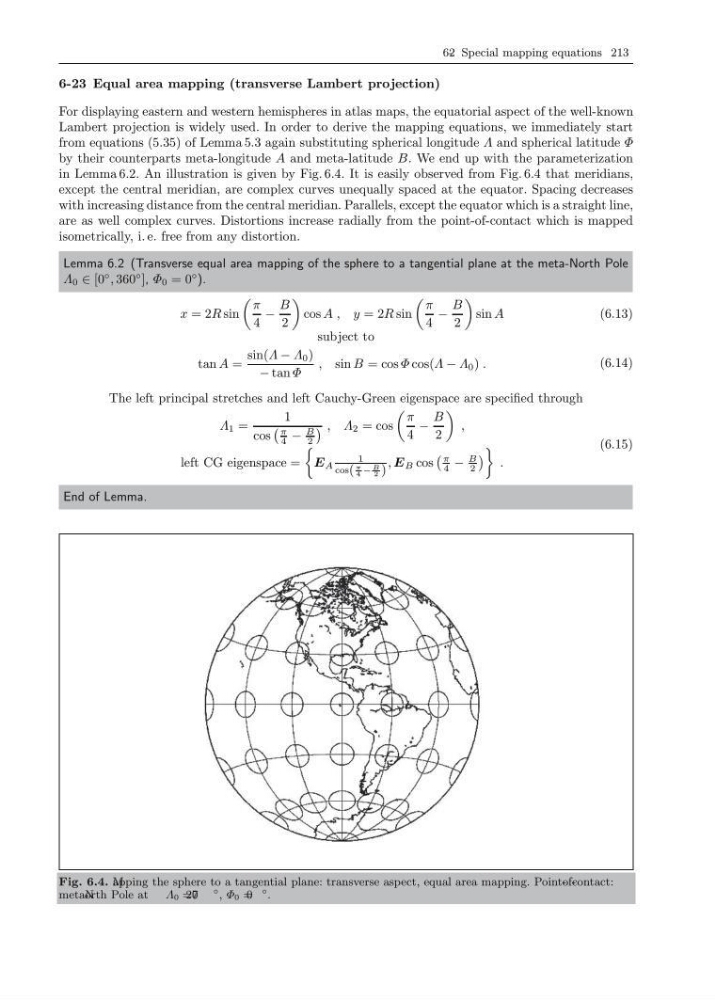
in Lemma 6.2. An illustration is given by Fig. 6.4. It is easily observed from Fig. 6.4 that meridians,
except the central meridian, are complex curves unequally spaced at the equator. Spacing decreases
with increasing distance from the central meridian. Parallels, except the equator which is a straight line,
are as well complex curves. Distortions increase radially from the point-of-contact which is mapped
isometrically, i. e. free from any distortion.
Lemma 6.2 (Transverse equal area mapping of the sphere to a tangential plane at the meta-North Pole
Λ 0 ∈ [0
◦ , 360
◦ ], Φ 0 = 0
◦ ).
x = 2R sin
π
4
−
B
2
cos A , y = 2R sin
π
4
−
B
2
sin A
(6.13)
subject to
tan A =
sin(Λ − Λ 0 )
− tan Φ
, sin B = cos Φ cos(Λ − Λ 0 ) .
(6.14)
The left principal stretches and left Cauchy-Green eigenspace are specified through
Λ 1 =
1
cos
π
4 −
B
2
, Λ 2 = cos
π
4
−
B
2
,
left CG eigenspace =
E A
1
cos(
π
4 −
B
2 )
, E B cos
π
4 −
B
2
.
(6.15)
End of Lemma.
Fig. 6.4. M
apping the sphere to a tangential plane: transverse aspect, equal area mapping. Point- of- contact:
meta- N
orth Pole at Λ 0 = 27 0
◦ , Φ 0 = 0
◦ .
6-23 Equal area mapping (transverse Lambert projection)
For displaying eastern and western hemispheres in atlas maps, the equatorial aspect of the well-known
Lambert projection is widely used. In order to derive the mapping equations, we immediately start
from equations (5.35) of Lemma 5.3 again substituting spherical longitude Λ and spherical latitude Φ
by their counterparts meta-longitude A and meta-latitude B. We end up with the parameterization
in Lemma 6.2. An illustration is given by Fig. 6.4. It is easily observed from Fig. 6.4 that meridians,
except the central meridian, are complex curves unequally spaced at the equator. Spacing decreases
with increasing distance from the central meridian. Parallels, except the equator which is a straight line,
are as well complex curves. Distortions increase radially from the point-of-contact which is mapped
isometrically, i. e. free from any distortion.
Lemma 6.2 (Transverse equal area mapping of the sphere to a tangential plane at the meta-North Pole
Λ 0 ∈ [0
◦ , 360
◦ ], Φ 0 = 0
◦ ).
x = 2R sin
π
4
−
B
2
cos A , y = 2R sin
π
4
−
B
2
sin A
(6.13)
subject to
tan A =
sin(Λ − Λ 0 )
− tan Φ
, sin B = cos Φ cos(Λ − Λ 0 ) .
(6.14)
The left principal stretches and left Cauchy-Green eigenspace are specified through
Λ 1 =
1
cos
π
4 −
B
2
, Λ 2 = cos
π
4
−
B
2
,
left CG eigenspace =
E A
1
cos(
π
4 −
B
2 )
, E B cos
π
4 −
B
2
.
(6.15)
End of Lemma.
Fig. 6.4. M
apping the sphere to a tangential plane: transverse aspect, equal area mapping. Point- of- contact:
meta- N
orth Pole at Λ 0 = 27 0
◦ , Φ 0 = 0
◦ .