

4
1 From Riemann manifolds to Riemann manifolds
R
2
R
3
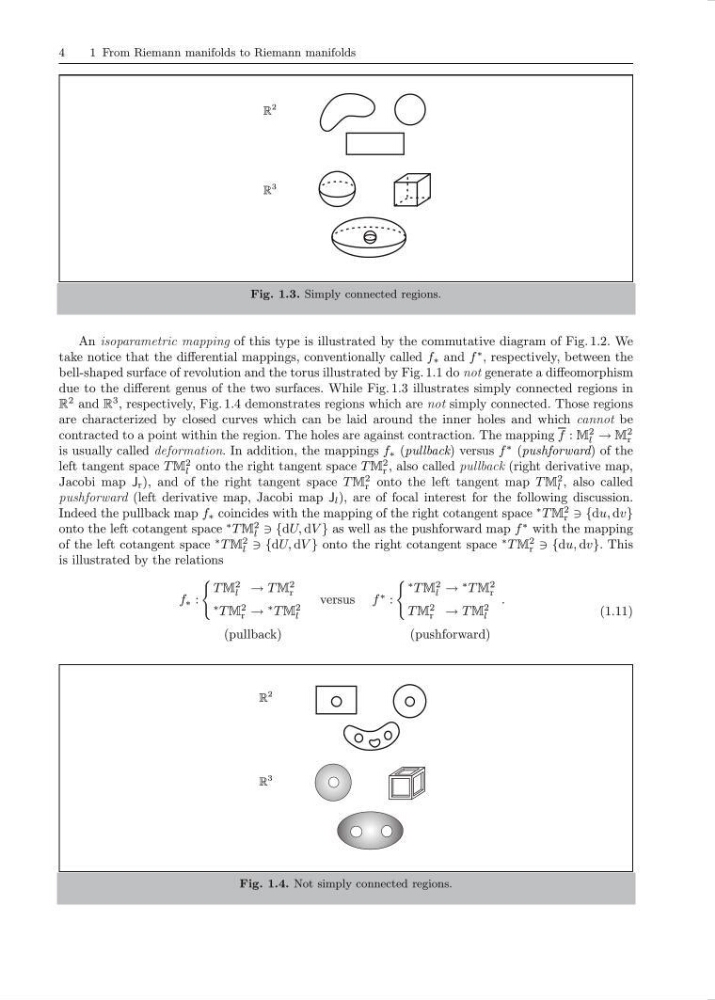
Fig. 1.3. Simply connected regions.
An isoparametric mapping of this type is illustrated by the commutative diagram of Fig. 1.2. We
take notice that the differential mappings, conventionally called f ∗ and f
∗ , respectively, between the
bell-shaped surface of revolution and the torus illustrated by Fig. 1.1 do not generate a diffeomorphism
due to the different genus of the two surfaces. While Fig. 1.3 illustrates simply connected regions in
R
2 and R
3 , respectively, Fig. 1.4 demonstrates regions which are not simply connected. Those regions
are characterized by closed curves which can be laid around the inner holes and which cannot be
contracted to a point within the region. The holes are against contraction. The mapping f : M
2
l → M
2
r
is usually called deformation. In addition, the mappings f ∗ (pullback) versus f
∗ (pushforward) of the
left tangent space T M
2
l onto the right tangent space T M
2
r , also called pullback (right derivative map,
Jacobi map J r ), and of the right tangent space T M
2
r onto the left tangent map T M
2
l , also called
pushforward (left derivative map, Jacobi map J l ), are of focal interest for the following discussion.
Indeed the pullback map f ∗ coincides with the mapping of the right cotangent space
∗ T M
2
r {du, dv}
onto the left cotangent space
∗ T M
2
l {dU, dV } as well as the pushforward map f
∗ with the mapping
of the left cotangent space
∗ T M
2
l {dU, dV } onto the right cotangent space
∗ T M
2
r {du, dv}. This
is illustrated by the relations
f ∗ :
T M
2
l → T M
2
r
∗ T M
2
r →
∗ T M
2
l
versus f
∗ :
∗ T M
2
l →
∗ T M
2
r
T M
2
r → T M
2
l
.
(pullback)
(pushforward)
(1.11)
R
2
R
3
Fig. 1.4. Not simply connected regions.
1 From Riemann manifolds to Riemann manifolds
R
2
R
3
Fig. 1.3. Simply connected regions.
An isoparametric mapping of this type is illustrated by the commutative diagram of Fig. 1.2. We
take notice that the differential mappings, conventionally called f ∗ and f
∗ , respectively, between the
bell-shaped surface of revolution and the torus illustrated by Fig. 1.1 do not generate a diffeomorphism
due to the different genus of the two surfaces. While Fig. 1.3 illustrates simply connected regions in
R
2 and R
3 , respectively, Fig. 1.4 demonstrates regions which are not simply connected. Those regions
are characterized by closed curves which can be laid around the inner holes and which cannot be
contracted to a point within the region. The holes are against contraction. The mapping f : M
2
l → M
2
r
is usually called deformation. In addition, the mappings f ∗ (pullback) versus f
∗ (pushforward) of the
left tangent space T M
2
l onto the right tangent space T M
2
r , also called pullback (right derivative map,
Jacobi map J r ), and of the right tangent space T M
2
r onto the left tangent map T M
2
l , also called
pushforward (left derivative map, Jacobi map J l ), are of focal interest for the following discussion.
Indeed the pullback map f ∗ coincides with the mapping of the right cotangent space
∗ T M
2
r {du, dv}
onto the left cotangent space
∗ T M
2
l {dU, dV } as well as the pushforward map f
∗ with the mapping
of the left cotangent space
∗ T M
2
l {dU, dV } onto the right cotangent space
∗ T M
2
r {du, dv}. This
is illustrated by the relations
f ∗ :
T M
2
l → T M
2
r
∗ T M
2
r →
∗ T M
2
l
versus f
∗ :
∗ T M
2
l →
∗ T M
2
r
T M
2
r → T M
2
l
.
(pullback)
(pushforward)
(1.11)
R
2
R
3
Fig. 1.4. Not simply connected regions.