

5-2 Special mapping equations 183
Question.
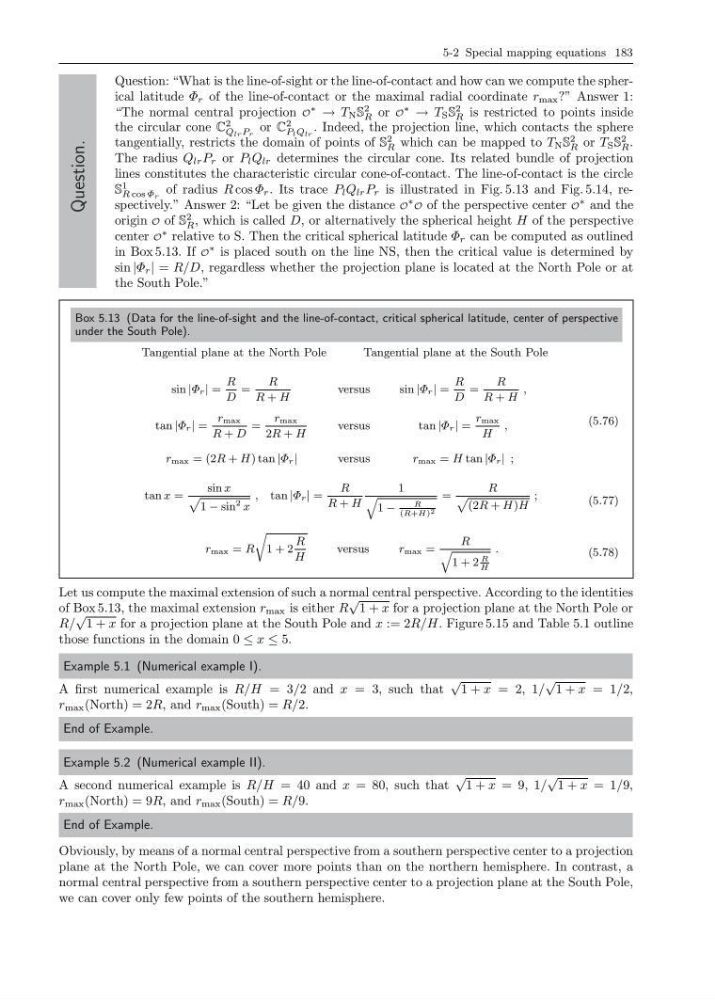
Question: “What is the line-of-sight or the line-of-contact and how can we compute the spherical latitude Φ r of the line-of-contact or the maximal radial coordinate r max ?” Answer 1:
“The normal central projection O
∗
→ T N S
2
R or O
∗
→ T S S
2
R is restricted to points inside
the circular cone C
2
Q lr P r
or C
2
P l Q lr
. Indeed, the projection line, which contacts the sphere
tangentially, restricts the domain of points of S
2
R which can be mapped to T N S
2
R or T S S
2
R .
The radius Q lr P r or P l Q lr determines the circular cone. Its related bundle of projection
lines constitutes the characteristic circular cone-of-contact. The line-of-contact is the circle
S
1
R cos Φ r
of radius R cos Φ r . Its trace P l Q lr P r is illustrated in Fig. 5.13 and Fig. 5.14, respectively.” Answer 2: “Let be given the distance O
∗ O of the perspective center O
∗ and the
origin O of S
2
R , which is called D, or alternatively the spherical height H of the perspective
center O
∗ relative to S. Then the critical spherical latitude Φ r can be computed as outlined
in Box 5.13. If O
∗ is placed south on the line NS, then the critical value is determined by
sin |Φ r | = R/D, regardless whether the projection plane is located at the North Pole or at
the South Pole.”
Box 5.13 (Data for the line-of-sight and the line-of-contact, critical spherical latitude, center of perspective
under the South Pole).
Tangential plane at the North Pole
Tangential plane at the South Pole
sin |Φ r | =
R
D
=
R
R + H
versus
sin |Φ r | =
R
D
=
R
R + H
,
tan |Φ r | =
r max
R + D
=
r max
2R + H
versus
tan |Φ r | =
r max
H
,
r max = (2R + H) tan |Φ r |
versus
r max = H tan |Φ r | ;
(5.76)
tan x =
sin x
p
1 − sin
2 x
, tan |Φ r | =
R
R + H
1
q
1 −
R
(R+H) 2
=
R
p
(2R + H)H
;
(5.77)
r max = R
r
1 + 2
R
H
versus
r max =
R
q
1 + 2
R
H
.
(5.78)
Let us compute the maximal extension of such a normal central perspective. According to the identities
of Box 5.13, the maximal extension r max is either R
√
1 + x for a projection plane at the North Pole or
R/
√
1 + x for a projection plane at the South Pole and x := 2R/H. Figure 5.15 and Table 5.1 outline
those functions in the domain 0 ≤ x ≤ 5.
Example 5.1 (Numerical example I).
A first numerical example is R/H = 3/2 and x = 3, such that
√
1 + x = 2, 1/
√
1 + x = 1/2,
r max (North) = 2R, and r max (South) = R/2.
End of Example.
Example 5.2 (Numerical example II).
A second numerical example is R/H = 40 and x = 80, such that
√
1 + x = 9, 1/
√
1 + x = 1/9,
r max (North) = 9R, and r max (South) = R/9.
End of Example.
Obviously, by means of a normal central perspective from a southern perspective center to a projection
plane at the North Pole, we can cover more points than on the northern hemisphere. In contrast, a
normal central perspective from a southern perspective center to a projection plane at the South Pole,
we can cover only few points of the southern hemisphere.
Question.
Question: “What is the line-of-sight or the line-of-contact and how can we compute the spherical latitude Φ r of the line-of-contact or the maximal radial coordinate r max ?” Answer 1:
“The normal central projection O
∗
→ T N S
2
R or O
∗
→ T S S
2
R is restricted to points inside
the circular cone C
2
Q lr P r
or C
2
P l Q lr
. Indeed, the projection line, which contacts the sphere
tangentially, restricts the domain of points of S
2
R which can be mapped to T N S
2
R or T S S
2
R .
The radius Q lr P r or P l Q lr determines the circular cone. Its related bundle of projection
lines constitutes the characteristic circular cone-of-contact. The line-of-contact is the circle
S
1
R cos Φ r
of radius R cos Φ r . Its trace P l Q lr P r is illustrated in Fig. 5.13 and Fig. 5.14, respectively.” Answer 2: “Let be given the distance O
∗ O of the perspective center O
∗ and the
origin O of S
2
R , which is called D, or alternatively the spherical height H of the perspective
center O
∗ relative to S. Then the critical spherical latitude Φ r can be computed as outlined
in Box 5.13. If O
∗ is placed south on the line NS, then the critical value is determined by
sin |Φ r | = R/D, regardless whether the projection plane is located at the North Pole or at
the South Pole.”
Box 5.13 (Data for the line-of-sight and the line-of-contact, critical spherical latitude, center of perspective
under the South Pole).
Tangential plane at the North Pole
Tangential plane at the South Pole
sin |Φ r | =
R
D
=
R
R + H
versus
sin |Φ r | =
R
D
=
R
R + H
,
tan |Φ r | =
r max
R + D
=
r max
2R + H
versus
tan |Φ r | =
r max
H
,
r max = (2R + H) tan |Φ r |
versus
r max = H tan |Φ r | ;
(5.76)
tan x =
sin x
p
1 − sin
2 x
, tan |Φ r | =
R
R + H
1
q
1 −
R
(R+H) 2
=
R
p
(2R + H)H
;
(5.77)
r max = R
r
1 + 2
R
H
versus
r max =
R
q
1 + 2
R
H
.
(5.78)
Let us compute the maximal extension of such a normal central perspective. According to the identities
of Box 5.13, the maximal extension r max is either R
√
1 + x for a projection plane at the North Pole or
R/
√
1 + x for a projection plane at the South Pole and x := 2R/H. Figure 5.15 and Table 5.1 outline
those functions in the domain 0 ≤ x ≤ 5.
Example 5.1 (Numerical example I).
A first numerical example is R/H = 3/2 and x = 3, such that
√
1 + x = 2, 1/
√
1 + x = 1/2,
r max (North) = 2R, and r max (South) = R/2.
End of Example.
Example 5.2 (Numerical example II).
A second numerical example is R/H = 40 and x = 80, such that
√
1 + x = 9, 1/
√
1 + x = 1/9,
r max (North) = 9R, and r max (South) = R/9.
End of Example.
Obviously, by means of a normal central perspective from a southern perspective center to a projection
plane at the North Pole, we can cover more points than on the northern hemisphere. In contrast, a
normal central perspective from a southern perspective center to a projection plane at the South Pole,
we can cover only few points of the southern hemisphere.